

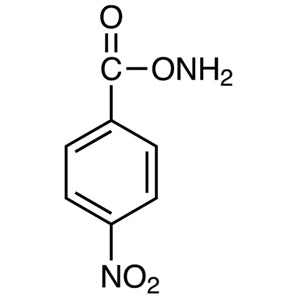
O-(4-Nitrobenzoyl)hydroxylamine is a chemical compound widely used as a building block in the synthesis of complex molecules. It plays a crucial role in organic chemistry laboratories, where it serves as a versatile reagent for various chemical reactions. This compound is particularly valued for its ability to participate in substitution, condensation, and ester formation reactions. Its presence in laboratory settings enables chemists to construct molecules with specific structural features, making it an essential tool in synthetic chemistry.
The compound's reactivity and stability under controlled conditions make it a preferred choice for researchers. Its functional group allows it to engage in reactions that require active functional groups, enhancing its utility in organic synthesis. The compound's ability to react selectively and efficiently contributes to its popularity among chemists. Its chemical properties ensure that it remains a reliable and effective reagent in a wide range of experimental applications.
In Indonesian laboratories, O-(4-Nitrobenzoyl)hydroxylamine is commonly used in the development of new chemical compounds and in the synthesis of complex organic structures. Its availability in the local market supports ongoing research and innovation in the field of chemistry. Researchers rely on this compound to conduct experiments that require precise chemical transformations, making it a valuable resource for both academic and industrial applications.
Related TCI products
- TCI B4780 85006-25-3 N,O-Bis(tert-butoxycarbonyl)hydroxylamine
- TCI B4589 39684-28-1 O-(tert-Butyl)hydroxylamine Hydrochloride
- TCI B1700 57497-39-9 N-(tert-Butyl)hydroxylamine Hydrochloride
- TCI N0942 59642-21-6 N-(4-Nitrobenzoyl)-beta-alanine
- TCI H1581 5470-11-1 Hydroxylamine Hydrochloride
- TCI H0196 10039-54-0 Hydroxylamine Sulfate
- Organic synthesis of complex molecules requiring substitution reactions due to its reactive functional group.
- Development of new chemical compounds through condensation reactions facilitated by its structural versatility.
- Ester formation processes in laboratory settings where controlled chemical transformations are needed.
- Research in synthetic chemistry for creating compounds with specific structural features.
- Applications in the creation of novel materials and pharmaceutical intermediates through functional group participation.
| Brand | TCI |
|---|---|
| CAS number | 35657-36-4 |
| Molecular formula | — |
| Purity | — |
| Category | Chemistry > Building Blocks > Non-Heterocyclic Building Blocks |
| Pack sizes | Available in standard laboratory quantities |
| Physical form | Solid or liquid depending on the specific product |
| Storage | Store in a cool, dry place away from direct sunlight |
O-(4-Nitrobenzoyl)hydroxylamine should be stored in a cool, dry environment to maintain its chemical stability. It is recommended to keep the compound in a tightly sealed container to prevent exposure to moisture and air. Due to its reactivity, it should be handled with care, using appropriate personal protective equipment such as gloves and safety goggles. The compound should be stored away from incompatible materials to avoid any potential chemical interactions. Proper labeling of storage containers is essential for safe handling and to ensure that it is easily identifiable in a laboratory setting. Regular inspection of storage conditions is advised to maintain the integrity of the compound.
—
Produk Terkait
-
N,O-Bis(tert-butoxycarbonyl)hydroxylamine TCI B4780
Regular price From Rp 1.378.650,00Regular price -
O-(tert-Butyl)hydroxylamineHydrochloride TCI B4589
Regular price From Rp 2.597.700,00Regular price -
N-(tert-Butyl)hydroxylamineHydrochloride TCI B1700
Regular price From Rp 1.326.150,00Regular price -
N-(4-Nitrobenzoyl)-beta-alanine TCI N0942
Regular price From Rp 664.650,00Regular price -
HydroxylamineHydrochloride TCI H1581
Regular price From Rp 477.750,00Regular price -
HydroxylamineSulfate TCI H0196
Regular price From Rp 477.750,00Regular price -
(4-Chlorobenzoyl)acetonitrile TCI C2582
Regular price Rp 6.333.600,00Regular price -
(3-Chlorobenzoyl)acetonitrile TCI C2581
Regular price From Rp 769.650,00Regular price


