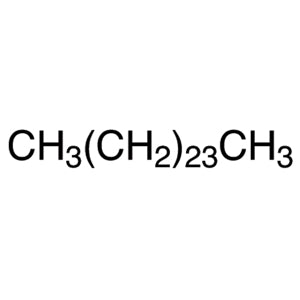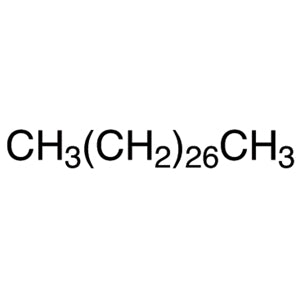
Octacosane is a linear alkane composed of 28 carbon atoms, making it a fundamental compound in chemical research. As a non-heterocyclic building block, it serves as a key component in the synthesis of more complex organic molecules. Its simple and stable hydrocarbon structure makes it ideal for use in laboratory settings where chemical stability and predictability are essential. Octacosane is widely used as a raw material or additive in various chemical experiments, supporting both academic and industrial applications. Its inert nature ensures that it does not interfere with other reactions, making it a reliable choice for researchers.
Octacosane is characterized by its non-polar nature and exceptional chemical stability. These properties make it highly resistant to reactions with other substances, ensuring consistent performance in laboratory conditions. Its high boiling point allows it to be used in high-temperature processes such as distillation and evaporation. Additionally, its stability under normal laboratory conditions reduces the risk of degradation or unwanted side reactions. These attributes make Octacosane a preferred choice for applications requiring long-term reliability and minimal reactivity.
In Indonesian laboratories, Octacosane is commonly used in both pure chemical research and industrial applications. It is a favored material due to its reliability and versatility across different experimental setups. Researchers and technicians in educational institutions and local companies rely on Octacosane for its consistent performance and ease of handling. Its widespread use underscores its importance in supporting a variety of chemical processes and analytical techniques.
- Used in organic synthesis as a stable building block for creating complex molecules due to its inert and predictable chemical behavior.
- Applied in spectroscopy analysis as a reference standard to calibrate instruments and ensure accurate results.
- Employed in quality control testing as a control substance to validate analytical methods and ensure consistency.
- Utilized in high-temperature distillation processes because of its high boiling point and chemical stability.
- Incorporated into research projects requiring non-reactive components for maintaining the integrity of experimental conditions.
| Brand | TCI |
|---|---|
| CAS number | 630-02-4 |
| Molecular formula | — |
| Purity | — |
| Category | Chemistry > Building Blocks > Non-Heterocyclic Building Blocks |
| Pack sizes | Available in various quantities as per standard laboratory supply |
| Physical form | Solid at room temperature |
| Storage | Store in a cool, dry place away from direct sunlight and heat sources |
Octacosane should be stored in a cool, dry environment to maintain its chemical stability. It is recommended to keep it in a sealed container to prevent exposure to moisture and air, which could potentially affect its properties. Due to its non-polar nature, it is best stored in airtight glass or plastic containers that are resistant to chemical reactions. In laboratory settings, it is important to handle Octacosane with care to avoid contamination and ensure safe usage. Regular monitoring of storage conditions is advised to maintain its integrity and effectiveness in experimental applications.
—
Produk Terkait
-
Pentacosane[StandardMaterialforGC] TCI S0297
Regular price Rp 2.359.350,00Regular price -
Pentacosane TCI P0139
Regular price From Rp 1.803.900,00Regular price -
Heptacosane TCI H0017
Regular price From Rp 3.419.850,00Regular price -
OctacosanoicAcid TCI M1342
Regular price Rp 1.273.650,00Regular price -
Undecylcyclohexane TCI U0037
Regular price Rp 6.599.250,00Regular price -
Undecane TCI U0002
Regular price From Rp 505.050,00Regular price -
1,3,5-Trimethyladamantane TCI T3872
Regular price From Rp 2.199.750,00Regular price -
Tetratriacontane TCI T2938
Regular price From Rp 3.260.250,00Regular price
![629-99-2 Pentacosane [Standard Material for GC] - AMI Scientific](http://amiscientific.com/cdn/shop/files/TCI2510S0297.jpg?v=1767138649&width=533)