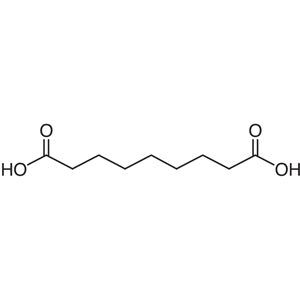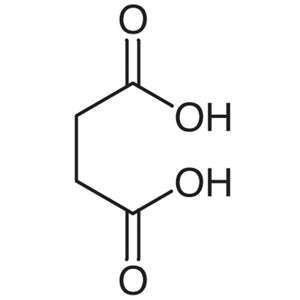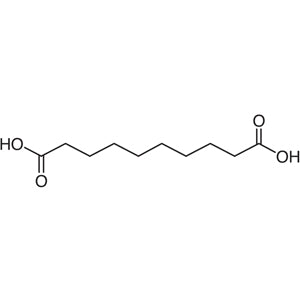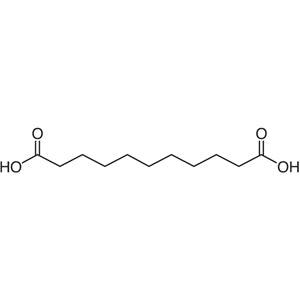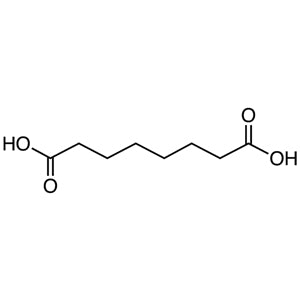
Suberic Acid from TCI (product code O0023), also known as octanedioic acid, is an aliphatic dicarboxylic acid with an eight-carbon chain and a carboxyl group at each end. In the laboratory it serves as a bifunctional building block that can react at both ends of the molecule. Because of this, suberic acid is widely used to build long-chain polymers, to prepare crosslinking agents, and as a reference compound in the analysis of metabolites and organic acids.
The main reason researchers choose suberic acid is the length of its methylene chain, which keeps a fixed distance between its two reactive groups. This spacing matters when designing protein crosslinkers, for example active ester derivatives of suberic acid that link amine groups. In polymer chemistry, its bifunctional structure allows polyesters and polyamides to form through condensation reactions. Because it is a solid, it can also be weighed accurately, which helps in work that needs careful stoichiometry and reproducible results between batches of experiments.
In Indonesia, suberic acid is used in polymer and materials chemistry laboratories at universities, where it is a monomer for condensation polymerisation studies. Biochemistry laboratories use it when preparing crosslinking reagents for protein studies. Analytical laboratories that work with metabolite and organic acid profiling use it as a reference compound. Because it comes from TCI, a brand many research institutions already know, it fits easily into established academic and industrial research workflows.
TCI brochures (PDF)
- Lipids 2025-12-17 · p. 8
- Polyester synthesis: its two terminal carboxyl groups let suberic acid react with diols in condensation reactions, forming long-chain polyester structures for materials research.
- Polyamide synthesis: suberic acid acts as the diacid component that condenses with diamines, which makes it a useful bifunctional monomer for studying polyamide formation and properties.
- Protein crosslinker preparation: active ester derivatives of suberic acid link amine groups, and the eight-carbon chain gives a fixed, predictable spacer length between the linked sites.
- Reference compound for metabolite analysis: as a defined dicarboxylic acid, suberic acid serves as a reference standard when identifying and comparing organic acids in metabolite analysis.
- General organic synthesis building block: its bifunctional structure lets chemists add groups at both chain ends, which helps build symmetrical molecules and intermediates for further synthetic work.
| Brand | TCI (product code O0023) |
|---|---|
| CAS number | 505-48-6 |
| Molecular formula | — |
| Purity | — |
| Category | Chemistry > Building Blocks > Non-Heterocyclic Building Blocks |
| Pack sizes | available in the pack sizes listed in the TCI catalogue; please confirm when ordering |
| Physical form | solid |
| Storage | keep tightly closed in a cool, dry place; follow the label and Safety Data Sheet |
Keep Suberic Acid in its original, tightly sealed container in a cool, dry, well-ventilated area, away from heat, moisture, and incompatible materials such as strong oxidising agents and strong bases. Close the container promptly after each use so the solid does not absorb moisture or pick up contamination. Wear standard personal protective equipment, including a lab coat, safety glasses, and chemical-resistant gloves. Weigh and transfer the powder carefully to avoid creating dust, and use a fume hood or local exhaust when handling larger quantities. Always check the product label and TCI Safety Data Sheet for full hazard information, first-aid measures, and disposal guidance, and follow your institution's chemical safety procedures.
—
Produk Terkait
-
AzelaicAcid TCI A0561
Regular price From Rp 505.050,00Regular price -
AdipicAcid TCI A0161
Regular price From Rp 452.550,00Regular price -
AzelaicAcid TCI A1318
Regular price From Rp 795.900,00Regular price -
TetradecanedioicAcid TCI T0704
Regular price From Rp 2.121.000,00Regular price -
SuccinicAcid TCI S0100
Regular price From Rp 477.750,00Regular price -
SebacicAcid TCI S0022
Regular price From Rp 505.050,00Regular price -
PimelicAcid TCI P0435
Regular price From Rp 1.193.850,00Regular price -
1,9-NonanedicarboxylicAcid TCI N0333
Regular price From Rp 2.704.800,00Regular price