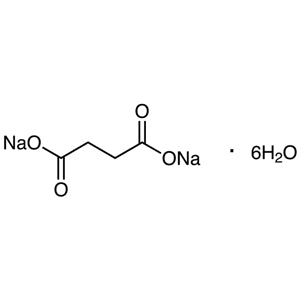
Succinic Acid from TCI is a four-carbon aliphatic dicarboxylic acid. It is also an important intermediate in the citric acid cycle of cellular metabolism. In the chemistry laboratory, succinic acid is a versatile non-heterocyclic building block. Chemists use it as a starting material for esters, anhydrides, amides, and polyesters. It is also widely used in biochemistry, for example as a substrate for the enzyme succinate dehydrogenase and as a component of buffer solutions. This range makes it a useful reagent for both synthetic and life-science work.
Researchers choose succinic acid for its simple, symmetrical structure. Its two carboxyl groups are easy to modify, which makes it an ideal linker in polymer synthesis and in the preparation of bifunctional compounds. At room temperature it is a stable white crystalline solid that is non-volatile and soluble in water. It is easy to weigh accurately and can be stored for long periods. Succinic acid is also known as a bio-based chemical that can be produced by fermentation. This has made it increasingly attractive in green chemistry and biodegradable polymer research.
In Indonesia, succinic acid is relevant to organic chemistry, biochemistry, food technology, and chemical engineering laboratories at universities and research institutions. Students and researchers use it in undergraduate synthesis practicals, thesis projects on esterification and polymerisation, and enzyme activity studies in biochemistry courses. The growing national interest in renewable resources and sustainable materials also makes this compound a practical choice for projects on bio-based chemicals and environmentally friendly polymers.
- Ester synthesis: the two reactive carboxyl groups of succinic acid allow straightforward esterification, producing mono- or diesters for organic synthesis studies and teaching experiments.
- Anhydride and amide preparation: its simple symmetrical structure makes it a dependable starting material for succinic anhydride and a range of amide derivatives in research laboratories.
- Polyester and polymer research: as a bifunctional linker, succinic acid is well suited to building polyester chains, including biodegradable polymers studied in green chemistry programmes.
- Enzyme studies: succinic acid acts as a substrate for succinate dehydrogenase, so it is useful for biochemistry practicals and research on cellular metabolism and the citric acid cycle.
- Buffer preparation: its water solubility and stability as a crystalline solid make succinic acid a convenient component for buffer solutions in biochemical and analytical work.
| Brand | TCI (product code S0100) |
|---|---|
| CAS number | 110-15-6 |
| Molecular formula | — |
| Purity | — |
| Category | Chemistry > Building Blocks > Non-Heterocyclic Building Blocks |
| Pack sizes | available in several pack sizes; please ask our team for the options currently offered |
| Physical form | white crystalline solid at room temperature, soluble in water |
| Storage | keep tightly closed in a cool, dry place |
Store succinic acid in its original, tightly sealed container in a cool, dry, well-ventilated area, away from moisture, direct sunlight, and incompatible materials such as strong bases and strong oxidising agents. Glass or chemically resistant plastic containers with secure caps are suitable once the product has been opened. Wear standard laboratory protective equipment, including safety glasses, gloves, and a lab coat, when handling it. Avoid creating or inhaling dust, and weigh the powder in a well-ventilated area or fume hood. Label containers clearly, and read the Safety Data Sheet before use for complete hazard and first-aid information.
—
Product Categories
Produk Terkait
-
PalmiticAcid TCI P1145
Regular price Rp 2.704.800,00Regular priceRp 1.891.050,00Sale price Rp 2.704.800,00 -
PalmiticAcid TCI P0002
Regular price From Rp 505.050,00Regular priceRp 352.800,00Sale price From Rp 505.050,00 -
DL-LacticAcid TCI L0226
Regular price From Rp 452.550,00Regular priceRp 316.050,00Sale price From Rp 452.550,00 -
AzelaicAcid TCI A0561
Regular price From Rp 557.550,00Regular priceRp 405.300,00Sale price From Rp 557.550,00 -
AdipicAcid TCI A0161
Regular price From Rp 452.550,00Regular priceRp 316.050,00Sale price From Rp 452.550,00 -
AzelaicAcid TCI A1318
Regular price From Rp 848.400,00Regular priceRp 609.000,00Sale price From Rp 848.400,00 -
TetradecanedioicAcid TCI T0704
Regular price From Rp 2.173.500,00Regular priceRp 1.535.100,00Sale price From Rp 2.173.500,00 -
DisodiumSuccinateHexahydrate TCI S0105
Regular price From Rp 530.250,00Regular priceRp 386.400,00Sale price From Rp 530.250,00