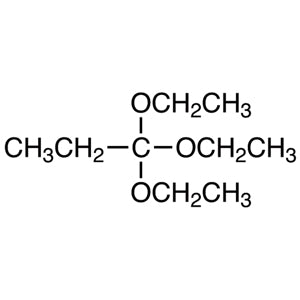
Triethyl Orthopropionate from TCI, product code O0067, is the ortho ester of propionic acid. Its central carbon atom carries three ethoxy groups and one ethyl group. It belongs to the orthoester family of reagents, which matter a great deal in organic synthesis, and it is best known for its role in the Johnson-Claisen rearrangement. Chemists use Triethyl Orthopropionate to form new carbon-carbon bonds with stereochemical control. They also use it to build a three-carbon fragment into heterocyclic rings. This makes it a useful non-heterocyclic building block in both research and teaching laboratories.
Chemists choose this reagent over triethyl orthoacetate because of one structural difference: an extra methyl group on the alpha carbon. When Triethyl Orthopropionate reacts with allylic alcohols, that methyl group ends up in the product, a γ,δ-unsaturated ester with a methyl substituent at the alpha position. The reaction passes through a cyclic transition state, so the stereochemistry of the product can often be predicted. In heterocyclic synthesis, the reagent closes the ring and puts an ethyl group at the newly formed position, as in benzimidazoles or oxazolines. The by-product is ethanol, which evaporates easily, so work-up and purification stay simple.
In Indonesia, Triethyl Orthopropionate is relevant to research groups in natural product synthesis, medicinal chemistry, and synthetic methodology at universities and research institutions. Natural product groups can use the Johnson-Claisen rearrangement to set stereocentres in complex targets. Medicinal chemistry teams can use it to make substituted heterocyclic scaffolds for compound libraries. Methodology groups may use it as a model orthoester when they develop new rearrangement or cyclisation conditions. Postgraduate students working on multistep synthesis projects will also find it a practical and dependable reagent.
- Johnson-Claisen rearrangement: the reagent reacts with allylic alcohols to give γ,δ-unsaturated esters with an alpha methyl substituent, and the cyclic transition state gives predictable stereochemical control.
- Stereocontrolled carbon-carbon bond formation: the rearrangement builds a new C-C bond and a defined stereocentre in one step, which is useful when constructing complex natural product frameworks.
- Benzimidazole synthesis: condensing it with suitable diamine precursors closes the benzimidazole ring and places an ethyl group at the newly formed ring position, releasing ethanol as the by-product.
- Oxazoline formation: reacting it with appropriate amino alcohols closes the oxazoline ring and installs an ethyl substituent, so no separate alkylation step is needed afterwards.
- Synthetic methodology research: its close structural relationship to triethyl orthoacetate makes it a good comparison substrate for studying how an alpha substituent affects the outcome of orthoester-based reactions.
| Brand | TCI (product code O0067) |
|---|---|
| CAS number | 115-80-0 |
| Molecular formula | — |
| Purity | — |
| Category | Chemistry > Building Blocks > Non-Heterocyclic Building Blocks |
| Pack sizes | see the available TCI pack sizes listed on the product page |
| Physical form | liquid orthoester reagent |
| Storage | keep tightly closed, protected from moisture, and away from heat and ignition sources |
Keep Triethyl Orthopropionate in its original, tightly sealed container in a cool, dry, well-ventilated place, away from heat, sparks, and open flames. Orthoesters react with moisture and acids, so limit exposure to air and humidity. Flushing the container headspace with an inert gas after use helps preserve quality. Store it apart from strong acids and oxidising agents. Handle it in a fume hood and wear suitable gloves, safety glasses, and a laboratory coat. Always read the supplier's Safety Data Sheet before use, and dispose of residues and ethanol-containing waste according to institutional chemical waste procedures.
—
Produk Terkait
-
TrimethylOrthopropionate TCI T2288
Regular price Rp 848.400,00Regular price -
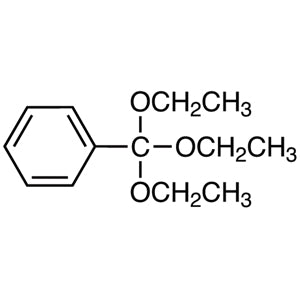
TriethylOrthobenzoate TCI T3070
Regular price From Rp 955.500,00Regular price -
TriethylOrthovalerate TCI T0977
Regular price From Rp 3.710.700,00Regular price -
TriethylOrthobutyrate TCI O0173
Regular price From Rp 1.035.300,00Regular price -
TriethylOrthoacetate TCI O0105
Regular price From Rp 477.750,00Regular price -
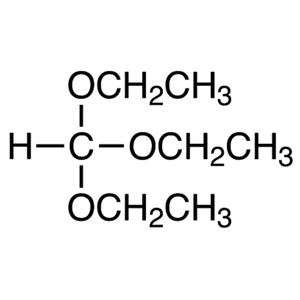
TriethylOrthoformate TCI O0066
Regular price From Rp 530.250,00Regular price -
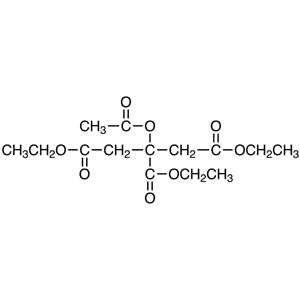
TriethylO-Acetylcitrate TCI A0086
Regular price From Rp 584.850,00Regular price -
Triethyl1,1,2-Ethanetricarboxylate TCI T2431
Regular price From Rp 743.400,00Regular price