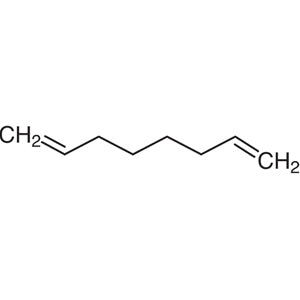
1,7-Octadiene from TCI is an eight-carbon aliphatic hydrocarbon with a double bond at each end of its chain. Both vinyl groups sit at the terminal positions, which makes this compound a very versatile non-heterocyclic building block for organic synthesis and polymer chemistry. In the laboratory, 1,7-octadiene is commonly used as a substrate for olefin reactions, as a comonomer, as a crosslinking agent, or as a model compound in catalysis studies. It helps researchers build longer carbon frameworks or form polymer networks with controlled structures.
Researchers choose this compound because transition metal catalysts can reach its two terminal double bonds fairly easily, and the two groups have balanced reactivity. They can react at the same time or one after the other, so researchers can decide whether to functionalize only one end or use both ends as a bridge. The methylene chain between the two double bonds makes the final product more flexible. Because it contains no heteroatoms, 1,7-octadiene also works well as a clean reference substrate in mechanistic studies of hydrosilylation, metathesis, and hydroformylation reactions, where there are no competing functional groups.
In Indonesian laboratories, 1,7-octadiene from TCI is typically used by university research groups, polymer and materials science laboratories, and industrial research and development teams working on catalysis or specialty monomers. Organic chemists use it to build carbon chains and test new catalytic methods. Polymer researchers use it to add controlled crosslinking or branching to their materials. Because it is a simple, well-defined structure, it is also useful in teaching and method-development work, where clear and reproducible results matter.
- Olefin metathesis studies: the two terminal vinyl groups make 1,7-octadiene a practical substrate for studying ring-closing and acyclic diene metathesis with transition metal catalysts.
- Polymer crosslinking: with double bonds at both ends, the molecule can bridge two polymer chains, so researchers can build networks with controlled crosslink density and structure.
- Copolymerization as a comonomer: it can be added to olefin polymerizations to introduce branching or leave pendant vinyl groups that can be modified after polymerization.
- Hydrosilylation and hydroformylation research: because it has no heteroatoms, it gives a clean model substrate for comparing catalyst selectivity and reaction mechanisms without interference from other functional groups.
- Stepwise functionalization in organic synthesis: its two reactive ends can be modified one at a time or together, so it can serve as a flexible eight-carbon spacer for building more complex molecules.
| Brand | TCI (product code O0104) |
|---|---|
| CAS number | 3710-30-3 |
| Molecular formula | — |
| Purity | — |
| Category | Chemistry > Building Blocks > Non-Heterocyclic Building Blocks |
| Pack sizes | see the current product listing for available pack sizes |
| Physical form | liquid (aliphatic hydrocarbon diene) |
| Storage | keep tightly closed in a cool, well-ventilated area away from heat and ignition sources |
Store 1,7-octadiene in its original, tightly sealed container in a cool, dry, well-ventilated area. Keep it away from heat, sparks, open flames, and oxidizing agents, because low-molecular-weight hydrocarbons are generally flammable. If the material will be stored for a long time after opening, use containers that limit exposure to air and light, and consider blanketing with an inert gas. Handle it inside a fume hood, and wear suitable gloves, safety glasses, and a laboratory coat. Ground equipment when transferring larger volumes, and keep spill absorbents nearby. Always check the TCI Safety Data Sheet for full hazard, handling, and disposal information before use.
—
Produk Terkait
-
1,7-OctadieneDiepoxide TCI D1586
Regular price From Rp 1.696.800,00Regular price -
9-Vinylanthracene TCI V0130
Regular price From Rp 2.545.200,00Regular price -
5-Vinylbicyclo[221]hept-2-ene(stabilizedwithBHT) TCI V0062
Regular price From Rp 769.650,00Regular price -
1,3,5-Undecatriene(mixtureofisomers) TCI U0062
Regular price From Rp 3.155.250,00Regular price -
1-Undecene TCI U0052
Regular price From Rp 2.068.500,00Regular price -
1-Undecene TCI U0025
Regular price Rp 1.060.500,00Regular price -
1,10-Undecadiene TCI U0024
Regular price From Rp 2.491.650,00Regular price -
1,4,4a,5,8,8a-Hexahydro-1,4:5,8-dimethanonaphthalene(mixtureofisomers)(stabilizedwithBHT) TCI T4428
Regular price From Rp 4.056.150,00Regular price


![3048-64-4 5-Vinylbicyclo[2.2.1]hept-2-ene (stabilized with BHT) - AMI Scientific](http://amiscientific.com/cdn/shop/files/TCI2510V0062.jpg?v=1767145572&width=533)