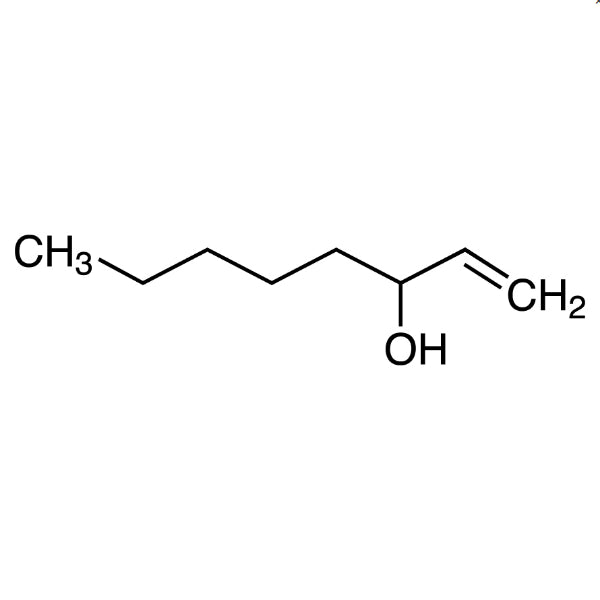
1-Octen-3-ol is an eight-carbon secondary allylic alcohol, often called "mushroom alcohol" because it gives fresh mushrooms and several other natural materials their characteristic aroma. In the laboratory, this TCI material works as a versatile non-heterocyclic building block. Its simple molecule carries both a hydroxyl group and a terminal double bond. Researchers can therefore use it in organic synthesis, aroma compound studies and insect biology research, and it is a practical, well-characterised starting material for both teaching and research laboratories.
The main reason chemists choose this material is that it has two reactive functional groups close together. The secondary hydroxyl group can be oxidised, esterified or converted into an ether. The terminal vinyl double bond suits addition reactions, epoxidation, metathesis and hydroboration. The allylic position also allows a range of selective rearrangements and substitutions. The compound also has a chiral centre, which makes it useful for stereochemistry studies and enantiomer separation work. Its distinctive odour makes it easy to identify in sensory analysis and chromatography.
In Indonesia, 1-Octen-3-ol is relevant to food technology laboratories studying the aroma components of oyster mushrooms and other locally cultivated edible mushrooms. University organic chemistry groups can use it as a model substrate for teaching and research on allylic alcohol reactivity. Entomology and public health laboratories may use it in insect behaviour studies, since the compound is widely studied as an insect attractant. Flavour and fragrance researchers may also use it as a reference compound in analytical method development.
- Organic synthesis: The secondary hydroxyl group and terminal vinyl group allow oxidation, esterification, etherification, epoxidation, metathesis and hydroboration, all starting from one simple and accessible molecule.
- Aroma and flavour research: As the compound responsible for the characteristic mushroom aroma, it is a useful reference material for identifying and studying aroma components in mushrooms and other natural products.
- Stereochemistry studies: Because the molecule has a chiral centre, it suits studies of stereoselective reactions, chiral analysis and enantiomer separation in academic and research laboratories.
- Chromatographic and sensory analysis: Its highly distinctive odour and defined structure make it easy to recognise, so it serves as a practical reference standard in gas chromatography and sensory evaluation work.
- Insect biology research: The compound is widely studied in insect behaviour and attraction research, which makes it relevant for entomology and vector biology laboratories investigating chemical signalling in insects.
| Brand | TCI (product code O0159) |
|---|---|
| CAS number | 3391-86-4 |
| Molecular formula | — |
| Purity | — |
| Category | Chemistry > Building Blocks > Non-Heterocyclic Building Blocks |
| Pack sizes | available in TCI's standard pack sizes; please ask AMI Scientific about current options |
| Physical form | liquid |
| Storage | keep tightly closed in a cool, dry, well-ventilated place; follow the storage conditions on the TCI label and SDS |
Store 1-Octen-3-ol in its original, tightly sealed container, in a cool, dry and well-ventilated area away from heat, sparks, open flames and direct sunlight. Keep it away from strong oxidising agents. Reseal the container promptly after use so the material does not evaporate or become contaminated, and so its strong odour does not spread through the laboratory. Handle it in a fume hood where possible, and wear suitable gloves, safety glasses and a lab coat. Avoid breathing vapours and avoid contact with skin and eyes. Always read the TCI Safety Data Sheet before use, and dispose of waste according to local regulations.
—
Produk Terkait
-
7-Octen-1-ol TCI O0280
Regular price From Rp 5.910.450,00Regular price -
cis-5-Octen-1-ol TCI O0250
Regular price From Rp 1.988.700,00Regular price -
cis-3-Octen-1-ol TCI O0248
Regular price Rp 3.312.750,00Regular price -
1-Octen-3-ylAcetate TCI O0559
Regular price From Rp 1.060.500,00Regular price -
1-Octen-3-one(stabilizedwithBHT) TCI O0382
Regular price From Rp 1.220.100,00Regular price -
2-Octen-4-one TCI O0360
Regular price Rp 6.863.850,00Regular price -
3-Octen-2-one TCI O0252
Regular price From Rp 795.900,00Regular price -
trans-2-Octen-1-ol TCI O0247
Regular price From Rp 2.862.300,00Regular price