

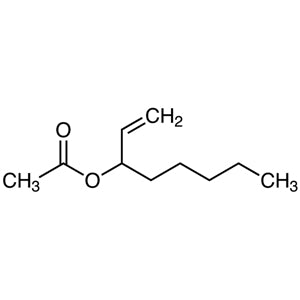
1-Octen-3-yl Acetate is a chemical compound widely used in laboratory settings, particularly in the synthesis of organic compounds. As a building block in chemical synthesis, it plays a crucial role in creating more complex molecular structures. This compound is valued for its versatility and compatibility with various chemical reactions, making it a fundamental tool in both research and industrial applications. Its presence in laboratory workflows supports the development of new materials, pharmaceuticals, and specialty chemicals.
The compound is preferred due to its stable yet reactive nature, allowing it to participate effectively in a range of chemical transformations. Its volatility facilitates efficient evaporation and separation processes, which are essential in purification and analytical techniques. Additionally, its non-toxic profile and relative safety under proper handling conditions make it suitable for use in high-standard laboratory environments. These properties contribute to its popularity among chemists and researchers.
In Indonesian laboratories, 1-Octen-3-yl Acetate is commonly used in both pure and applied chemical research. It is a key component in the synthesis of various organic compounds and is frequently utilized in academic and industrial research settings. Its availability and reliability make it a preferred choice for institutions and laboratories engaged in chemical development and experimentation.
- Organic synthesis applications benefit from 1-Octen-3-yl Acetate due to its ability to participate in various chemical reactions, enabling the formation of complex molecular structures.
- It is suitable for analytical chemistry experiments because of its volatility, which allows for efficient evaporation and separation during purification processes.
- In pharmaceutical research, this compound is used as a building block for the synthesis of active pharmaceutical ingredients, supporting drug development efforts.
- It is ideal for polymer chemistry applications, where its reactivity helps in the formation of polymeric materials with specific functional properties.
- Environmental chemistry studies may utilize this compound to investigate its behavior in different chemical environments and its potential impact on ecological systems.
| Brand | TCI |
|---|---|
| CAS number | 2442-10-6 |
| Molecular formula | — |
| Purity | — |
| Category | Chemistry > Building Blocks > Non-Heterocyclic Building Blocks |
| Pack sizes | Available in various quantities as per supplier specifications |
| Physical form | Liquid |
| Storage | Store in a cool, dry place away from direct sunlight |
This compound should be stored in a cool, dry environment, away from direct sunlight and sources of heat. It is recommended to use airtight containers to prevent exposure to moisture and air, which may affect its stability. Due to its volatility, it should be handled in a well-ventilated area to minimize inhalation risks. Proper personal protective equipment, such as gloves and safety goggles, should be worn during handling to ensure safety. The compound is non-toxic under normal conditions but should be treated with care to avoid any potential hazards associated with chemical exposure. Regular monitoring of storage conditions is advised to maintain its integrity and ensure safe usage in laboratory settings.
—
Produk Terkait
-
1-Octen-3-one(stabilizedwithBHT) TCI O0382
Regular price From Rp 1.220.100,00Regular price -
2-Octen-4-one TCI O0360
Regular price Rp 6.863.850,00Regular price -
3-Octen-2-one TCI O0252
Regular price From Rp 795.900,00Regular price -
ButylAcetate[forSpectrophotometry] TCI A0228
Regular price Rp 1.538.250,00Regular price -
VinylAcetateMonomer(stabilizedwithHQ) TCI A0045
Regular price Rp 477.750,00Regular price -
PropylAcetate TCI A0044
Regular price From Rp 477.750,00Regular price -
PhenylAcetate TCI A0043
Regular price Rp 452.550,00Regular price -
n-OctylAcetate TCI A0042
Regular price From Rp 505.050,00Regular price


![123-86-4 Butyl Acetate [for Spectrophotometry] - AMI Scientific](http://amiscientific.com/cdn/shop/files/TCI2510A0228.jpg?v=1767078302&width=533)


