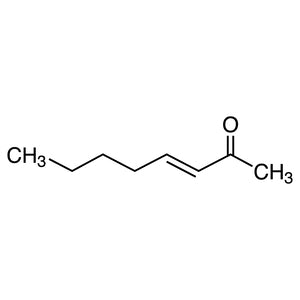
3-Octen-2-one is an organic compound widely used in chemical reactions for the synthesis of complex molecules. It serves as a key building block in organic chemistry, enabling the construction of larger molecular structures. This compound is particularly valuable in the development of aromatic and heterocyclic compounds due to its reactivity and structural versatility. In laboratory settings, it plays a crucial role in various synthetic pathways, contributing to the advancement of chemical research and innovation.
The unique molecular structure of 3-Octen-2-one, featuring a carbon chain with a carbonyl group and alkyl groups, gives it high reactivity. This makes it an ideal candidate for reactions such as Diels-Alder and substitution reactions, where precise chemical transformations are required. Its volatility and distinctive aroma also make it a valuable tool in fragrance and flavor chemistry. The compound is non-colored and has good solubility in organic solvents like ethyl acetate and chloroform, enhancing its applicability in diverse experimental conditions.
In Indonesian laboratories, 3-Octen-2-one is extensively used in organic chemistry research, particularly in academic institutions and research organizations. Its role in building molecular frameworks supports a wide range of scientific investigations, from pharmaceutical development to material science. As a fundamental reagent, it is integral to many research programs and experimental protocols in the chemical sciences.
- Organic synthesis applications benefit from 3-Octen-2-one's reactivity and structural versatility, enabling the creation of complex aromatic and heterocyclic compounds.
- It is ideal for Diels-Alder reactions due to its ability to participate in conjugated systems, facilitating the formation of cyclohexene derivatives.
- Substitution reactions in synthetic pathways are enhanced by its carbonyl group, allowing for selective functional group transformations.
- In fragrance and flavor chemistry, its volatile nature and distinctive aroma make it a key component in the development of perfumes and food additives.
- It is widely used in academic and research laboratories for teaching and experimental purposes, supporting both undergraduate and postgraduate studies.
| Brand | TCI |
|---|---|
| CAS number | 1669-44-9 |
| Molecular formula | — |
| Purity | — |
| Category | Chemistry > Building Blocks > Non-Heterocyclic Building Blocks |
| Pack sizes | Available in various sizes as per supplier specifications |
| Physical form | Liquid |
| Storage | Store in a cool, dark place away from heat and direct sunlight |
3-Octen-2-one should be stored in a cool, dark environment to maintain its chemical stability and prevent degradation. It is recommended to use airtight containers made of glass or inert plastic to minimize exposure to air and moisture. Due to its volatility and potential for inhalation, proper ventilation should be ensured in the laboratory. Personal protective equipment such as gloves and safety goggles should be worn when handling the compound. Avoid contact with skin and eyes, and ensure that spillage is contained and cleaned up promptly. This compound is non-colored and has a distinctive aroma, so it should be handled with care to prevent unnecessary exposure.
—
Produk Terkait
-
1-Octen-3-ylAcetate TCI O0559
Regular price From Rp 1.060.500,00Regular price -
1-Octen-3-one(stabilizedwithBHT) TCI O0382
Regular price From Rp 1.220.100,00Regular price -
2-Octen-4-one TCI O0360
Regular price Rp 6.863.850,00Regular price -
7-Octen-1-ol TCI O0280
Regular price From Rp 5.910.450,00Regular price -
cis-5-Octen-1-ol TCI O0250
Regular price From Rp 1.988.700,00Regular price -
cis-3-Octen-1-ol TCI O0248
Regular price Rp 3.312.750,00Regular price -
1-Octen-3-ol TCI O0159
Regular price From Rp 980.700,00Regular price -
trans-2-Octen-1-ol TCI O0247
Regular price From Rp 2.862.300,00Regular price