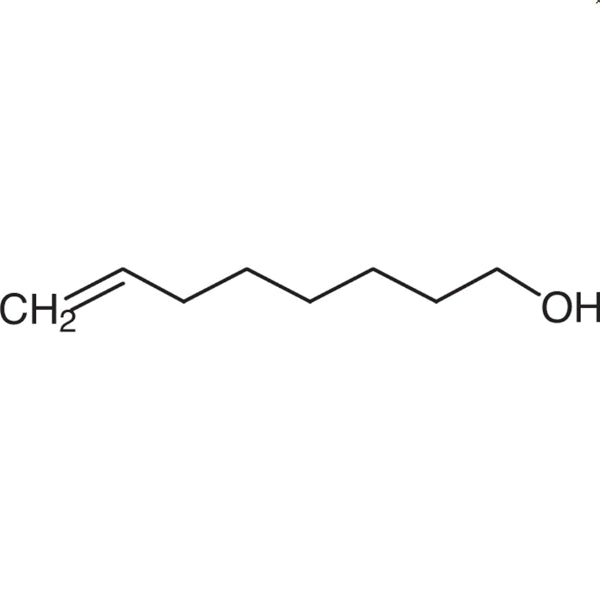
7-Octen-1-ol is an organic compound classified as a branched-chain alcohol, commonly used in chemical laboratories as a building block for the synthesis of complex molecules. This versatile compound serves as a precursor in various chemical reactions, enabling the formation of aromatic and heterocyclic structures. Its molecular structure provides flexibility, making it suitable for a wide range of synthetic pathways. In research and development settings, 7-Octen-1-ol is a valuable tool for chemists aiming to create novel compounds with specific functional groups.
The compound is known for its volatility and characteristic aroma, which aids in its identification and handling in laboratory environments. Its hydroxyl group contributes to its reactivity, allowing it to participate in reactions such as esterification, hydroxylation, and substitution. These properties make it a preferred choice for organic chemists seeking to manipulate molecular structures with precision. Additionally, its non-colored nature simplifies visual identification during experimental procedures.
In Indonesian laboratories, 7-Octen-1-ol is frequently utilized by researchers and scientists in the fields of pharmacy and materials science. It plays a key role in the development of new compounds, supporting both academic and industrial research. Its availability and chemical versatility make it a staple in educational and applied chemistry settings, contributing to the advancement of scientific knowledge and innovation.
- Organic synthesis is a primary application where 7-Octen-1-ol is used to build complex molecular structures due to its reactivity and structural flexibility.
- Pharmaceutical research benefits from this compound as it can be modified to create new drug molecules with desired biological activities.
- Material science applications utilize 7-Octen-1-ol for the development of advanced polymers and functional materials through chemical modification.
- Educational institutions incorporate this compound into laboratory courses to teach students about organic chemistry and synthetic techniques.
- Analytical chemistry uses 7-Octen-1-ol as a standard reference material for testing and calibrating analytical instruments in laboratory settings.
| Brand | TCI |
|---|---|
| CAS number | 13175-44-5 |
| Molecular formula | — |
| Purity | — |
| Category | Chemistry > Building Blocks > Non-Heterocyclic Building Blocks |
| Pack sizes | — |
| Physical form | Liquid |
| Storage | Store in a cool, dry place away from light and incompatible materials |
7-Octen-1-ol should be stored in a cool, dry environment, away from direct sunlight and heat sources to maintain its stability. It is recommended to keep the compound in a tightly sealed container made of glass or high-density polyethylene to prevent evaporation and contamination. Due to its volatility, proper ventilation is essential in laboratory settings to minimize exposure. Care should be taken to avoid contact with skin and eyes, and personal protective equipment such as gloves and safety goggles should be worn when handling the substance. The compound should not be stored near incompatible materials such as strong oxidizers or acids to prevent chemical reactions. Regular monitoring of storage conditions ensures the integrity and safety of the material during use.
—
Produk Terkait
-
TCI B5774 5,10-Bis(4,4,5,5-tetramethyl-1,3,2-dioxaborolan-2-yl)naphtho[1,2-c:5,6-c']bis([1,2,5]oxadiazole)
Regular price Rp 10.255.350,00Regular price -
Dihydroiodide TCI B6569
Regular price From Rp 1.936.200,00Regular price -
Trifluoromethanesulfonate TCI B7003
Regular price From Rp 1.936.200,00Regular price
![5,10-Bis(4,4,5,5-tetramethyl-1,3,2-dioxaborolan-2-yl)naphtho[1,2-c:5,6-c']bis([1,2,5]oxadiazole) - TCI B5774 - AMI Scientific](http://amiscientific.com/cdn/shop/files/TCI2510B5774.jpg?v=1769180228&width=533)