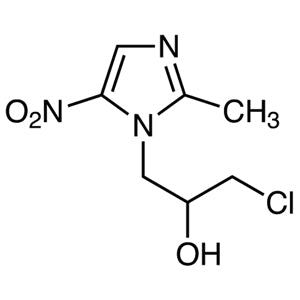
Ornidazole is a chemical compound widely used in pharmacology and microbiology as an antiparasitic agent. It plays a crucial role in laboratory settings by enabling the study of parasitic infections and the development of new therapeutic agents. This compound is particularly effective against various types of parasites, including those responsible for helminthic and protozoan infections. Its utility extends to both basic research and applied studies, making it an essential tool for scientists working in life sciences.
Ornidazole is favored for its high purity and consistent quality, which are critical for accurate and reproducible experimental results. Its chemical stability under controlled conditions ensures reliable performance in laboratory experiments. Additionally, its solubility in organic solvents such as ethyl acetate and acetone facilitates its use in a wide range of chemical reactions and analytical procedures. These properties make it a preferred choice for researchers seeking precision and reliability in their work.
In Indonesian laboratories, Ornidazole is commonly used by pharmacists and microbiologists for testing antiparasitic and antibacterial activities. It is also employed in drug development research, where its safety profile and non-toxic nature make it suitable for experimental use. Its role in supporting scientific inquiry is vital, especially in regions where parasitic diseases are prevalent and research efforts are focused on finding effective treatments.
- Antiparasitic Activity Testing: Ornidazole is used to evaluate the effectiveness of antiparasitic compounds against various parasites, supporting research into new treatments for parasitic infections.
- Antibacterial Activity Screening: It serves as a reference compound in assays that assess the antibacterial properties of new or existing drugs, aiding in the development of broad-spectrum antibiotics.
- Drug Development Research: Ornidazole is utilized in the formulation and testing of new pharmaceutical products, particularly those targeting parasitic diseases, due to its known efficacy and safety profile.
- Biochemical Analysis: Its solubility and chemical stability make it suitable for use in biochemical assays where precise and consistent results are required.
- Microbiological Studies: It is employed in studies that investigate the mechanisms of parasitic infections and the response of microorganisms to antiparasitic agents.
| Brand | TCI |
|---|---|
| CAS number | 16773-42-5 |
| Molecular formula | — |
| Purity | — |
| Category | Life Science > Biochemicals and Reagents > Antibiotics |
| Pack sizes | Available in various quantities as per standard laboratory supply options |
| Physical form | Solid powder |
| Storage | Store in a cool, dark place away from direct sunlight and high temperatures |
Ornidazole should be stored in a cool, dark place to maintain its chemical stability and prevent degradation. It is recommended to keep it in a tightly sealed container to minimize exposure to moisture and air. Due to its sensitivity to light and high temperatures, it should be protected from direct sunlight and stored at room temperature. In laboratory settings, it is important to handle Ornidazole with care, using appropriate personal protective equipment when necessary. Its non-toxic and non-reactive nature makes it relatively safe to handle, but standard laboratory safety protocols should still be followed to ensure proper usage and storage.
—
Produk Terkait
-
TCI B5774 5,10-Bis(4,4,5,5-tetramethyl-1,3,2-dioxaborolan-2-yl)naphtho[1,2-c:5,6-c']bis([1,2,5]oxadiazole)
Regular price Rp 10.255.350,00Regular price -
Dihydroiodide TCI B6569
Regular price From Rp 1.936.200,00Regular price -
Trifluoromethanesulfonate TCI B7003
Regular price From Rp 1.936.200,00Regular price
![5,10-Bis(4,4,5,5-tetramethyl-1,3,2-dioxaborolan-2-yl)naphtho[1,2-c:5,6-c']bis([1,2,5]oxadiazole) - TCI B5774 - AMI Scientific](http://amiscientific.com/cdn/shop/files/TCI2510B5774.jpg?v=1769180228&width=533)