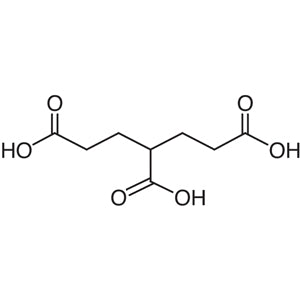
1,3,5-Pentanetricarboxylic Acid is an aliphatic carboxylic acid with three carboxyl groups along a pentane chain. Supplied by TCI under product code P0075, it belongs to the non-heterocyclic building block group. In the laboratory it serves as a multifunctional starting material for synthesizing polyesters, polyamides and branched molecules. It is also used as a ligand or organic linker in coordination chemistry and in the design of porous materials, where its several reactive sites help build larger structures.
Researchers choose this compound because its three reactive sites are chemically equivalent, so it can act as a branching node in a growing molecule or network. All three carboxyl groups can be esterified, converted into amides, or deprotonated to bind metal ions. This gives chemists flexibility in how they bring it into a synthesis. Its flexible aliphatic chain gives it different properties from rigid aromatic tricarboxylic acids, which makes it useful for designing more pliable polymer networks and coordination structures. As a solid, it is also easy to weigh and handle.
In Indonesia, this compound suits university laboratories working in polymer chemistry, materials chemistry and inorganic chemistry, especially groups developing resins, crosslinking agents or coordination polymers. Supramolecular chemistry researchers who study hydrogen bonding and molecular assembly may also find it a useful building unit. Its multifunctional structure fits both teaching-oriented synthesis projects and more advanced research programs that need a dependable branched carboxylic acid from an established brand like TCI.
Related TCI products
- TCI B5795 677010-20-7 [1,1'-Biphenyl]-3,4',5-tricarboxylic Acid
- TCI T2431 7459-46-3 Triethyl 1,1,2-Ethanetricarboxylate
- TCI T3033 52831-11-5 Trimethyl 1,3,5-Cyclohexanetricarboxylate (cis- and trans- mixture)
- TCI T3029 185855-30-5 Trimethyl 1,2,4-Cyclohexanetricarboxylate (cis- and trans- mixture)
- TCI T2429 6138-26-7 Trimethyl 1,2,3-Propanetricarboxylate
- TCI T1481 6279-86-3 Triethyl Methanetricarboxylate
- Polyester synthesis: the three equivalent carboxyl groups can be esterified with diols, so the acid works as a branching point that builds networked or branched polyester structures.
- Polyamide and branched molecule preparation: the carboxyl groups can be converted into amides, so the compound can introduce controlled branching into polyamides and other multifunctional organic molecules.
- Coordination chemistry ligand: the carboxyl groups can be deprotonated to bind metal ions, so the acid works as a multidentate organic linker for building coordination compounds and coordination polymers.
- Porous material design: the flexible aliphatic chain gives frameworks a different shape from those built with rigid aromatic linkers, which lets researchers explore more pliable porous structures.
- Crosslinking agent and resin development: three reactive sites on one molecule make it a candidate for linking polymer chains together, which helps laboratories studying resin formulation and network properties.
| Brand | TCI (product code P0075) |
|---|---|
| CAS number | 6940-58-5 |
| Molecular formula | — |
| Purity | — |
| Category | Chemistry > Building Blocks > Non-Heterocyclic Building Blocks |
| Pack sizes | please check the product page for available pack sizes |
| Physical form | solid |
| Storage | keep in a tightly closed container in a cool, dry place, following the TCI label and safety data sheet |
Store 1,3,5-Pentanetricarboxylic Acid in its original, tightly sealed container in a cool, dry, well-ventilated area, away from moisture, direct sunlight and incompatible substances such as strong bases and oxidizing agents. Close the container promptly after each use so the solid does not absorb atmospheric moisture. When handling it, wear standard laboratory protective equipment: safety glasses, gloves and a lab coat. Weigh the powder carefully to avoid creating dust, and work in a fume hood or a well-ventilated area when possible. Avoid contact with skin and eyes, and do not inhale the dust. Before use, read the safety data sheet supplied by TCI for specific hazard information, first-aid measures and disposal requirements. Dispose of waste according to institutional and local regulations.
—
Produk Terkait
-
[1,1'-Biphenyl]-3,4',5-tricarboxylicAcid TCI B5795
Regular price Rp 6.281.100,00Regular price -
Triethyl1,1,2-Ethanetricarboxylate TCI T2431
Regular price From Rp 743.400,00Regular price -
Trimethyl1,3,5-Cyclohexanetricarboxylate(cis-andtrans-mixture) TCI T3033
Regular price From Rp 5.274.150,00Regular price -
Trimethyl1,2,4-Cyclohexanetricarboxylate(cis-andtrans-mixture) TCI T3029
Regular price From Rp 1.590.750,00Regular price -
Trimethyl1,2,3-Propanetricarboxylate TCI T2429
Regular price From Rp 1.378.650,00Regular price -
TriethylMethanetricarboxylate TCI T1481
Regular price From Rp 1.087.800,00Regular price -
1,2,3-PropanetricarboxylicAcid TCI P0490
Regular price From Rp 2.916.900,00Regular price -
(1alpha,3alpha,5alpha)-1,3,5-CyclohexanetricarboxylicAcid TCI C2063
Regular price From Rp 2.916.900,00Regular price
![[1,1'-Biphenyl]-3,4',5-tricarboxylic Acid (CAS 677010-20-7) - TCI B5795 - AMI Scientific](http://amiscientific.com/cdn/shop/files/TCI2510B5795.jpg?v=1767092758&width=533)