

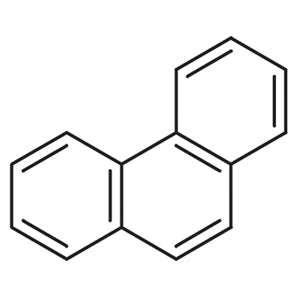
Phenanthrene is a polycyclic aromatic hydrocarbon made of three fused benzene rings in an angular arrangement. This TCI product is listed under photocatalysts within the field of catalysis and inorganic chemistry. In the laboratory, Phenanthrene is used as a photosensitizer, an organic photocatalyst, a starting material for synthesizing phenanthrene derivatives, and a reference compound for analyzing polycyclic aromatic hydrocarbons in environmental and petrochemical samples. It is useful in both research and routine analytical work.
Chemists choose this material because its aromatic system absorbs ultraviolet light and can form excited states that support both energy transfer and electron transfer. This makes it suitable for certain photochemical reactions. The 9 and 10 positions on its framework are relatively reactive, so they can be oxidized to 9,10-phenanthrenequinone or functionalized further. The phenanthrene skeleton also appears in many natural products, including steroids and alkaloids, which makes it important in synthetic studies that build or modify these complex molecular frameworks.
In Indonesia, environmental and testing laboratories widely use Phenanthrene to analyze PAH contamination in water, soil, sediment, and air samples. It is a familiar reference material when laboratories need to identify and measure polycyclic aromatic hydrocarbons in environmental monitoring. Organic chemistry laboratories use it for photochemistry research and for synthesizing aromatic derivatives, where its reactive positions and light-absorbing properties are useful. Its role spans both analytical testing and synthetic research across many laboratory settings in the country.
TCI brochures (PDF)
- Organic Photoreaction Reagents 2025-02-13 · p. 7
Related TCI products
- TCI P2877 85-01-8 Phenanthrene (purified by sublimation)
- TCI P0331 85-01-8 Phenanthrene Zone Refined (number of passes:30)
- TCI C0339 218-01-9 Benzo[a]phenanthrene (purified by sublimation)
- TCI B6541 195-19-7 Benzo[c]phenanthrene
- TCI M1411 121254-39-5 2-Methylcyclopenta[l]phenanthrene
- TCI P3265 605-87-8 Phenanthren-3-ol
- Photosensitization: Phenanthrene absorbs ultraviolet light and forms excited states that can pass energy to other molecules, which makes it suitable for photosensitized reactions.
- Organic photocatalysis: Its excited states can take part in electron transfer processes, so researchers use it as an organic photocatalyst in selected photochemical transformations.
- Synthesis of phenanthrene derivatives: The relatively reactive 9 and 10 positions allow oxidation to 9,10-phenanthrenequinone or further functionalization, so it works well as a starting material.
- PAH reference standard: Phenanthrene serves as a reference compound in the analysis of polycyclic aromatic hydrocarbons in environmental samples such as water, soil, sediment, and air.
- Natural product synthesis studies: The phenanthrene skeleton is found in steroids and alkaloids, which makes it a valuable model and building block in synthetic research on these compound classes.
| Brand | TCI (product code P0079) |
|---|---|
| CAS number | 85-01-8 |
| Molecular formula | — |
| Purity | — |
| Category | Chemistry > Catalysis and Inorganic Chemistry > Photocatalysts [Catalysis] |
| Pack sizes | please refer to the pack size options listed on the product page |
| Physical form | solid |
| Storage | keep in a tightly closed container in a cool, dry, well-ventilated area, away from light and oxidizing agents |
Store Phenanthrene in its original, tightly sealed container in a cool, dry, well-ventilated place, protected from direct light and heat sources. Keep it away from strong oxidizing agents and incompatible materials. Clearly labeled glass or chemically resistant containers are suitable if the material has to be transferred. Handle it in a fume hood or well-ventilated area, and wear suitable gloves, safety glasses, and a laboratory coat. Avoid creating or breathing dust, and prevent contact with skin and eyes. Because Phenanthrene is a polycyclic aromatic hydrocarbon, dispose of waste according to local regulations for hazardous chemicals, and read the supplier's safety data sheet before use.
—
Produk Terkait
-
Phenanthrene(purifiedbysublimation) TCI P2877
Regular price From Rp 1.353.450,00Regular price -
PhenanthreneZoneRefined(numberofpasses:30) TCI P0331
Regular price Rp 2.942.100,00Regular price -
Benzo[a]phenanthrene(purifiedbysublimation) TCI C0339
Regular price From Rp 1.936.200,00Regular price -
Benzo[c]phenanthrene TCI B6541
Regular price From Rp 1.829.100,00Regular price -
2-Methylcyclopenta[l]phenanthrene TCI M1411
Regular price From Rp 2.279.550,00Regular price -
Phenanthren-3-ol TCI P3265
Regular price Rp 3.949.050,00Regular price -
9,10-Phenanthrenequinone TCI P1136
Regular price From Rp 2.121.000,00Regular price -
9,10-Phenanthrenequinone TCI P0080
Regular price From Rp 1.510.950,00Regular price


![Benzo[a]phenanthrene (purified by sublimation) (CAS 218-01-9) - TCI C0339 - AMI Scientific](http://amiscientific.com/cdn/shop/files/TCI2510C0339.jpg?v=1769144565&width=533)
![Benzo[c]phenanthrene (CAS 195-19-7) - TCI B6541 - AMI Scientific](http://amiscientific.com/cdn/shop/files/TCI2510B6541.jpg?v=1767093862&width=533)
![121254-39-5 2-Methylcyclopenta[l]phenanthrene - AMI Scientific](http://amiscientific.com/cdn/shop/files/TCI2510M1411.jpg?v=1767124927&width=533)


