


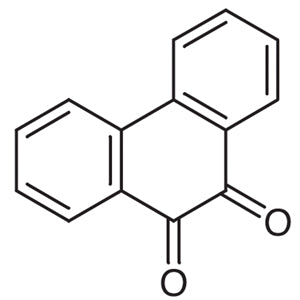
9,10-Phenanthrenequinone is an ortho-quinone built on the phenanthrene skeleton, with two adjacent carbonyl groups at positions 9 and 10. This TCI product sits in the Material Building Blocks category, specifically among ligands for functional metal complexes. Laboratories use it as a precursor for diimine and heterocyclic ligands, as an organic photocatalyst or oxidant, and as a starting material for synthesizing conjugated aromatic compounds. In practice, it serves as a versatile entry point for building larger, extended π-systems used in coordination and materials research.
Researchers choose this compound mainly because its 1,2-dicarbonyl unit is so versatile. When it condenses with 1,2-diamines, it forms phenazine or quinoxaline frameworks with extensive conjugation. These frameworks are the basis of widely used ligands such as dipyridophenazine derivatives, which are common in photoactive metal complexes. Its quinone redox behavior also allows reversible electron exchange. That makes the compound attractive for photoredox research, electrochemical sensors, and charge-storage materials. One rigid, well-defined molecule can therefore support synthetic, photochemical, and electrochemical work.
In Indonesia, 9,10-Phenanthrenequinone is relevant to inorganic and coordination chemistry laboratories that synthesize luminescent metal complexes. It also suits electrochemistry laboratories studying organic electrode materials for batteries, and organic chemistry groups developing conjugated heterocycles. University research groups, national research institutions, and industrial R&D teams working on functional materials can use it as a dependable building block. AMI Scientific supplies the TCI product to help these laboratories run reproducible experiments with a reagent from an established brand.
TCI brochures (PDF)
- Pyrene Derivatives Bearing Diketone Moieties for Battery Materials and Building Blocks 2023-11-22 · p. 2
- Polymerization Initiators 2025-09-17 · p. 4
- Ligands 2025-12-01 · p. 19
- Biomaterials Research Reagents 2025-02-19 · p. 25
Related TCI products
- Diimine ligand synthesis: the adjacent carbonyl groups condense readily with 1,2-diamines to give phenazine and quinoxaline frameworks used to build chelating diimine ligands.
- Dipyridophenazine-type ligand preparation: the compound is a key precursor for extended dipyridophenazine derivatives, which are widely used in photoactive and luminescent metal complexes.
- Photoredox and photocatalysis research: its quinone structure and conjugated aromatic skeleton let it act as an organic photocatalyst or oxidant in light-driven reaction studies.
- Organic electrode materials for batteries: reversible quinone redox chemistry makes it a useful model compound for researchers studying organic charge-storage and electrode materials.
- Electrochemical sensors and conjugated heterocycles: its well-defined redox behavior and reactive dicarbonyl unit support sensor development and the synthesis of new conjugated aromatic heterocyclic compounds.
| Brand | TCI (product code P0080) |
|---|---|
| CAS number | 84-11-7 |
| Molecular formula | — |
| Purity | — |
| Category | Materials Science > Material Building Blocks > Ligands for Functional Metal Complexes |
| Pack sizes | as listed for this TCI product code on the product page |
| Physical form | solid organic compound (see the TCI product documentation for details) |
| Storage | keep tightly closed in a cool, dry place away from light |
Store 9,10-Phenanthrenequinone in its original tightly sealed container in a cool, dry, well-ventilated area, away from direct light, heat sources, and strong reducing agents. Amber glass or other light-protective, chemically compatible containers are suitable if the material is transferred. Handle it in a fume hood or a well-ventilated area to avoid inhaling dust. Wear standard personal protective equipment, including a lab coat, safety glasses, and chemical-resistant gloves. Avoid contact with skin and eyes, and wash hands thoroughly after handling. Always read the TCI Safety Data Sheet before use, and dispose of waste according to local regulations and your institution's procedures.
—
Product Categories
- Material Building BlocksLigands for Functional Metal ComplexesRedox Active Ligands
- Polymer/Macromolecule ReagentsPolymerization ReagentsPolymerization Initiators
- Biomaterials/Biocompatible Materials Research ReagentsPolymerization Reagents (Initiators, Catalysts, Ligands) [Biomaterials/Biocompatible Materials Research Reagents]Photopolymerization Initiators
Produk Terkait
-
9,10-Phenanthrenequinone TCI P1136
Regular price From Rp 2.173.500,00Regular priceRp 1.535.100,00Sale price From Rp 2.173.500,00 -
3'-Hydroxyacetophenone TCI A0104
Regular price From Rp 1.113.000,00Regular priceRp 793.800,00Sale price From Rp 1.113.000,00 -
Anthraquinone TCI A0502
Regular price From Rp 477.750,00Regular priceRp 333.900,00Sale price From Rp 477.750,00 -
SodiumAnthraquinone-2-sulfonateMonohydrate TCI A0508
Regular price From Rp 822.150,00Regular priceRp 590.100,00Sale price From Rp 822.150,00 -
Acetophenone TCI A0061
Regular price From Rp 769.650,00Regular priceRp 537.600,00Sale price From Rp 769.650,00 -
TriphenylsulfoniumBis(trifluoromethanesulfonyl)imide TCI T4393
Regular price From Rp 1.298.850,00Regular priceRp 924.000,00Sale price From Rp 1.298.850,00 -
(9-Oxo-9H-thioxanthen-2-yl)[4-[(9-oxo-9H-thioxanthen-2-yl)thio]phenyl](phenyl)sulfoniumTetrakis(perfluorophenyl)borate TCI T4223
Regular price From Rp 1.643.250,00Regular priceRp 1.164.450,00Sale price From Rp 1.643.250,00 -
(9-Oxo-9H-thioxanthen-2-yl)[4-[(9-oxo-9H-thioxanthen-2-yl)thio]phenyl](phenyl)sulfoniumTrifluorotris(perfluoroethyl)phosphate(V) TCI T4222
Regular price From Rp 2.252.250,00Regular priceRp 1.590.750,00Sale price From Rp 2.252.250,00


![TCI T4223 1195763-48-4 (9-Oxo-9H-thioxanthen-2-yl)[4-[(9-oxo-9H-thioxanthen-2-yl)thio]phenyl](phenyl)sulfonium Tetrakis(perfluorophenyl)borate](http://amiscientific.com/cdn/shop/files/TCI2510T4223_cf7e9d09-4622-438c-8f99-db5b99de2771.jpg?v=1792664587&width=533)
![1195763-48-4 (9-Oxo-9H-thioxanthen-2-yl)[4-[(9-oxo-9H-thioxanthen-2-yl)thio]phenyl](phenyl)sulfonium Tetrakis(perfluorophenyl)borate - AMI Scientific](http://amiscientific.com/cdn/shop/files/TCI2510T4223.jpg?v=1767144890&width=533)
![TCI T4222 1195763-42-8 (9-Oxo-9H-thioxanthen-2-yl)[4-[(9-oxo-9H-thioxanthen-2-yl)thio]phenyl](phenyl)sulfonium Trifluorotris(perfluoroethyl)phosphate(V)](http://amiscientific.com/cdn/shop/files/TCI2510T4222_7a31efd1-7ca2-41c4-a301-b134fb356b52.jpg?v=1792664585&width=533)
![1195763-42-8 (9-Oxo-9H-thioxanthen-2-yl)[4-[(9-oxo-9H-thioxanthen-2-yl)thio]phenyl](phenyl)sulfonium Trifluorotris(perfluoroethyl)phosphate(V) - AMI Scientific](http://amiscientific.com/cdn/shop/files/TCI2510T4222.jpg?v=1767144886&width=533)