

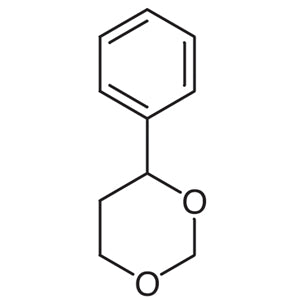
4-Phenyl-1,3-dioxane from TCI is a cyclic acetal with a six-membered 1,3-dioxane ring and a phenyl substituent at the 4-position. The ring contains oxygen atoms, but TCI lists this compound as a non-heterocyclic building block in its catalogue. In organic chemistry it is a well-known example of a cyclic acetal of a 1,3-diol, such as the typical product of the Prins reaction between styrene and formaldehyde. In the laboratory, researchers use it as a synthetic intermediate, as a model compound for acetal chemistry, and as a reference material in studies of cyclisation reactions.
Researchers choose 4-Phenyl-1,3-dioxane because the cyclic acetal group is generally stable under basic and neutral conditions but can be opened under acidic conditions. This behaviour is very useful in multi-step synthesis strategies. Opening the dioxane ring can give 1-phenyl-1,3-propanediol derivatives or other oxygen-containing intermediates. The six-membered ring also suits conformational studies, because the position of the phenyl substituent affects the stability of the chair conformers. The phenyl group also makes the compound easy to detect by UV when monitoring reactions, which simplifies routine analytical work.
In Indonesia, this material is relevant to organic chemistry laboratories at universities and research institutions. Typical users include academic research groups working on synthetic methodology, postgraduate students studying acetal formation and cleavage, and teaching laboratories that show how protecting-group strategies work in practice. It also serves laboratories that need a defined model compound for comparison in cyclisation and ring-opening experiments, where a well-characterised commercial reference from an established brand such as TCI helps keep results consistent from batch to batch.
Related TCI products
- TCI B2682 2425-41-4 5,5-Bis(hydroxymethyl)-2-phenyl-1,3-dioxane
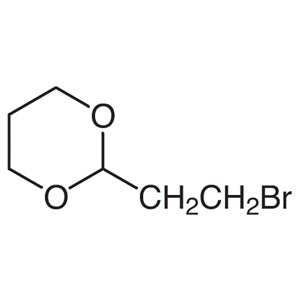
- TCI B1182 33884-43-4 2-(2-Bromoethyl)-1,3-dioxane
- TCI D2066 4845-50-5 1,4-Dioxane-2,3-diol
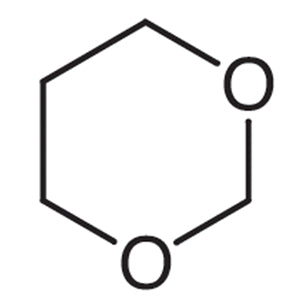
- TCI D0859 505-22-6 1,3-Dioxane
- TCI T3839 16837-14-2 2,2,5-Trimethyl-1,3-dioxane-5-carboxylic Acid
- TCI B3694 1585236-34-5 (2S,3S,5R,6R)-5,6-Bis(azidomethyl)-2,3-dimethoxy-2,3-dimethyl-1,4-dioxane
- Synthetic intermediate: the cyclic acetal can be carried through basic or neutral reaction steps and then opened under acidic conditions, which suits multi-step synthesis routes.
- Model compound for acetal chemistry: its well-defined 1,3-dioxane ring makes it a practical substrate for studying how cyclic acetals form, stay stable, and are cleaved under different conditions.
- Reference material in cyclisation studies: as a typical Prins reaction product of styrene and formaldehyde, it is a useful comparison standard when analysing cyclisation reaction outcomes.
- Preparation of 1-phenyl-1,3-propanediol derivatives: ring opening of the dioxane gives access to these diol derivatives and other oxygen-containing intermediates for further synthetic work.
- Conformational analysis: the six-membered ring with a phenyl substituent at position 4 suits studies of chair-conformer stability and how substituent position affects it.
| Brand | TCI (product code P0166) |
|---|---|
| CAS number | 772-00-9 |
| Molecular formula | — |
| Purity | — |
| Category | Chemistry > Building Blocks > Non-Heterocyclic Building Blocks |
| Pack sizes | as listed in the TCI catalogue; please confirm available sizes when ordering |
| Physical form | refer to the TCI Certificate of Analysis and product documentation |
| Storage | keep tightly closed according to the manufacturer's label and Safety Data Sheet |
Store 4-Phenyl-1,3-dioxane in its original, tightly closed container in a cool, dry, well-ventilated place, away from direct sunlight and heat sources. Because the cyclic acetal can be cleaved under acidic conditions, keep it away from acids and strong oxidising agents. Use clean glass or compatible chemical-resistant containers when transferring or weighing. Handle the material in a fume hood, wearing a laboratory coat, safety glasses, and suitable gloves. Avoid inhaling vapour or dust and avoid contact with skin and eyes. Always read the manufacturer's Safety Data Sheet before use, and dispose of waste according to local regulations and institutional laboratory safety procedures.
—
Produk Terkait
-
5,5-Bis(hydroxymethyl)-2-phenyl-1,3-dioxane TCI B2682
Regular price Rp 6.943.650,00Regular price -
2-(2-Bromoethyl)-1,3-dioxane TCI B1182
Regular price From Rp 1.246.350,00Regular price -
1,4-Dioxane-2,3-diol TCI D2066
Regular price Rp 1.803.900,00Regular price -
1,3-Dioxane TCI D0859
Regular price From Rp 2.597.700,00Regular price -
2,2,5-Trimethyl-1,3-dioxane-5-carboxylicAcid TCI T3839
Regular price From Rp 2.809.800,00Regular price -
(2S,3S,5R,6R)-5,6-Bis(azidomethyl)-2,3-dimethoxy-2,3-dimethyl-1,4-dioxane TCI B3694
Regular price Rp 1.856.400,00Regular price -
tert-Butyl(4R,6S)-6-(Hydroxymethyl)-2,2-dimethyl-1,3-dioxane-4-acetate TCI B4214
Regular price Rp 2.650.200,00Regular price -
5-Bromo-5-nitro-1,3-dioxane[forBiochemicalResearch] TCI B3769
Regular price Rp 1.696.800,00Regular price




![30007-47-7 5-Bromo-5-nitro-1,3-dioxane [for Biochemical Research] - AMI Scientific](http://amiscientific.com/cdn/shop/files/TCI2510B3769.jpg?v=1767090329&width=533)