

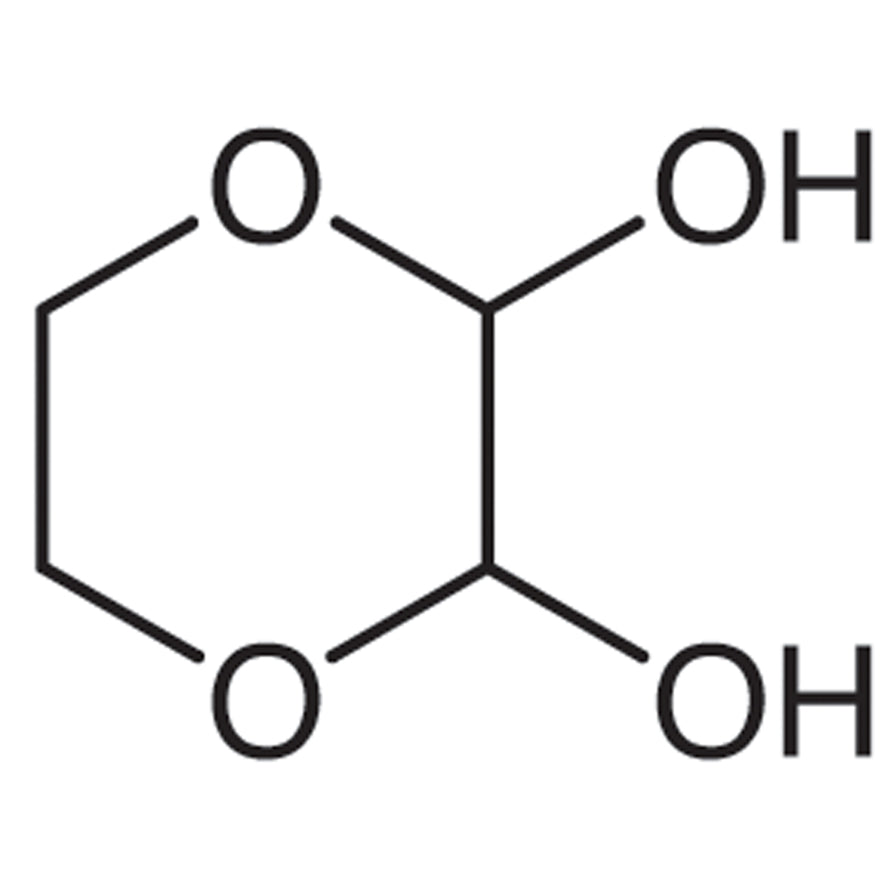
TCI D2066 1,4-Dioxane-2,3-diol is an oxygenated cyclic compound known in practical laboratory work as the solid, easy-to-handle form of glyoxal. Its dioxane ring bearing two hydroxyl groups at the 2- and 3-positions is the product of the dimerisation and hydration of glyoxal, and in solution the compound can release the reactive dicarbonyl unit once again. In the laboratory, its role is to replace aqueous glyoxal solutions, which are difficult to measure out accurately, polymerise readily, and carry a large amount of water into sensitive reaction mixtures.
The characteristic that makes this compound the preferred choice lies in the ease with which it is handled. As a solid, it can be weighed precisely, so reaction stoichiometry is far more controllable than when using glyoxal solutions whose concentration must first be standardised. The compound is also more stable in storage and does not pour excess water into the reaction system. When heated or dissolved under suitable conditions, the two geminal hydroxyl groups on the ring open the way for release of the dicarbonyl group, so the compound behaves as a source of two electrophilic carbon atoms that is highly useful in synthetic work.
In Indonesian laboratories, this compound is typically used in synthetic and organic chemistry work where a controlled glyoxal equivalent is required — university research groups, institutional research laboratories, and industrial R&D units engaged in building-block chemistry. It is chosen wherever an accurately weighable solid reagent is preferable to standardising an aqueous solution, and where introducing additional water into a moisture-sensitive reaction mixture would be undesirable.
Related TCI products
- TCI B2682 2425-41-4 5,5-Bis(hydroxymethyl)-2-phenyl-1,3-dioxane
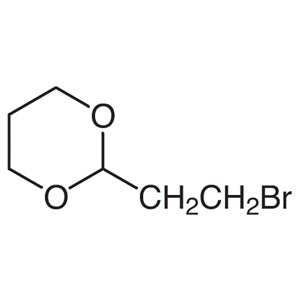
- TCI B1182 33884-43-4 2-(2-Bromoethyl)-1,3-dioxane
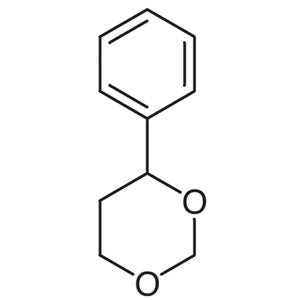
- TCI P0166 772-00-9 4-Phenyl-1,3-dioxane
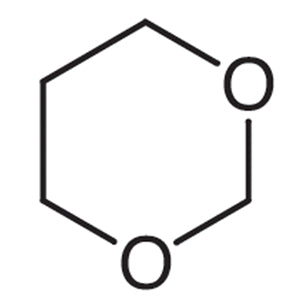
- TCI D0859 505-22-6 1,3-Dioxane
- TCI T3839 16837-14-2 2,2,5-Trimethyl-1,3-dioxane-5-carboxylic Acid
- TCI B3694 1585236-34-5 (2S,3S,5R,6R)-5,6-Bis(azidomethyl)-2,3-dimethoxy-2,3-dimethyl-1,4-dioxane
- Glyoxal-equivalent reagent in organic synthesis — supplies the reactive dicarbonyl unit in a solid, accurately weighable form, avoiding the need to standardise an aqueous glyoxal solution before use.
- Two-carbon electrophilic building block — the geminal hydroxyl groups on the ring open the way for release of the dicarbonyl group, providing two electrophilic carbon atoms for constructing larger molecular frameworks.
- Reactions in moisture-sensitive systems — because the compound does not carry excess water into the mixture, it suits reaction media where the additional water from aqueous glyoxal would interfere.
- Stoichiometrically controlled small-scale synthesis — the solid form can be weighed precisely, making it appropriate for reactions in which the reagent-to-substrate ratio must be tightly defined and reproducible.
- Non-heterocyclic building-block chemistry in research laboratories — its position in the building-blocks category makes it a routine starting material for method development and exploratory synthetic work.
| Brand | TCI (Tokyo Chemical Industry) |
|---|---|
| CAS number | 4845-50-5 |
| Molecular formula | — |
| Purity | — |
| Category | Chemistry > Building Blocks > Non-Heterocyclic Building Blocks |
| Pack sizes | available in TCI standard research-scale packaging; please confirm the available pack size when ordering |
| Physical form | solid (the solid, easy-to-handle form of glyoxal) |
| Storage | keep in the closed original container in a cool, dry place, protected from moisture |
- Catalogue code: D2066
Store the compound in its original closed container in a cool, dry place, away from moisture and from direct sunlight or heat sources. Tightly sealed glass or the manufacturer's supplied container is suitable; keeping the container closed helps preserve the advantage of the solid form, which is greater storage stability than that of aqueous glyoxal solutions. Weigh the solid out in a fume hood or a well-ventilated area, using standard laboratory personal protective equipment — safety glasses, gloves, and a laboratory coat — and avoid inhaling dust or generating airborne powder. Since the compound can release the reactive dicarbonyl unit in solution, prepare solutions only immediately before use, and keep containers clearly labelled. Always consult the manufacturer's Safety Data Sheet before handling and dispose of residues in accordance with the applicable laboratory chemical waste procedures.
—
Produk Terkait
-
5,5-Bis(hydroxymethyl)-2-phenyl-1,3-dioxane TCI B2682
Regular price Rp 6.943.650,00Regular price -
2-(2-Bromoethyl)-1,3-dioxane TCI B1182
Regular price From Rp 1.246.350,00Regular price -
4-Phenyl-1,3-dioxane TCI P0166
Regular price Rp 743.400,00Regular price -
1,3-Dioxane TCI D0859
Regular price From Rp 2.597.700,00Regular price -
2,2,5-Trimethyl-1,3-dioxane-5-carboxylicAcid TCI T3839
Regular price From Rp 2.809.800,00Regular price -
(2S,3S,5R,6R)-5,6-Bis(azidomethyl)-2,3-dimethoxy-2,3-dimethyl-1,4-dioxane TCI B3694
Regular price Rp 1.856.400,00Regular price -
tert-Butyl(4R,6S)-6-(Hydroxymethyl)-2,2-dimethyl-1,3-dioxane-4-acetate TCI B4214
Regular price Rp 2.650.200,00Regular price -
5-Bromo-5-nitro-1,3-dioxane[forBiochemicalResearch] TCI B3769
Regular price Rp 1.696.800,00Regular price



![30007-47-7 5-Bromo-5-nitro-1,3-dioxane [for Biochemical Research] - AMI Scientific](http://amiscientific.com/cdn/shop/files/TCI2510B3769.jpg?v=1767090329&width=533)