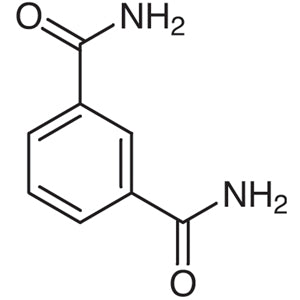
Phthalamide (TCI P0283), with CAS number 88-96-0, is a chemical compound widely used in laboratory settings as a foundational building block in organic synthesis. It is a key reagent in the development of various chemical structures, particularly in the formation of heterocyclic compounds. Its unique molecular structure, featuring an amide group attached to a phthalic acid ring, makes it versatile for a range of chemical transformations. This compound is commonly employed in synthetic pathways where controlled reactivity and stability are essential.
Phthalamide is prized for its chemical stability and predictable reactivity, which allow it to participate in numerous reactions without undergoing significant degradation. It dissolves well in organic solvents such as ethyl acetate and acetone, making it convenient for use in solution-based experiments. Its ability to react selectively with strong bases or substitution agents further enhances its utility in synthetic chemistry. These properties make it a reliable and preferred choice for researchers and students alike.
In Indonesian laboratories, phthalamide is frequently used in both academic and industrial research settings. It is a staple in organic chemistry courses and practical experiments, where it serves as a critical component in the synthesis of various compounds. Its availability and reliability have made it a popular choice among Indonesian scientists and educators, supporting both teaching and research activities.
Related TCI products
- TCI A2169 31127-80-7 5-Acetamido-N,N'-bis(2,3-dihydroxypropyl)-2,4,6-triiodoisophthalamide
- TCI A1951 203515-86-0 5-Amino-N,N'-bis(2,3-dihydroxypropyl)isophthalamide Hydrochloride
- TCI T0013 3010-82-0 Terephthalamide
- TCI I0152 1740-57-4 Isophthalamide
- TCI P0282 88-97-1 Phthalamic Acid
- TCI N0067 132-66-1 N-(1-Naphthyl)phthalamic Acid
- Organic synthesis applications benefit from phthalamide's ability to participate in controlled reactions, making it ideal for creating complex molecular structures.
- Heterocyclic compound formation relies on phthalamide's stable molecular framework, which supports the development of diverse chemical entities.
- Substitution reactions often utilize phthalamide due to its reactivity with strong bases, enabling the synthesis of functionalized derivatives.
- Teaching laboratories use phthalamide to demonstrate fundamental chemical reactions and synthetic pathways in organic chemistry courses.
- Industrial research settings apply phthalamide for the development of new chemical products, leveraging its predictable chemical behavior.
| Brand | TCI |
|---|---|
| CAS number | 88-96-0 |
| Molecular formula | — |
| Purity | — |
| Category | Chemistry > Building Blocks > Non-Heterocyclic Building Blocks |
| Pack sizes | Available in various quantities as per supplier specifications |
| Physical form | Solid |
| Storage | Store in a cool, dry place away from moisture and direct sunlight |
Phthalamide should be stored in a cool, dry environment to maintain its chemical stability and prevent degradation. It is recommended to keep it in airtight containers to minimize exposure to moisture and air. As a solid, it is typically stored in glass or plastic containers that are resistant to chemical reactions. Laboratory personnel should handle phthalamide with care, using appropriate personal protective equipment such as gloves and safety goggles. It is important to ensure that storage areas are well-ventilated and free from incompatible substances. Proper handling and storage practices help preserve the integrity of the compound and ensure safe usage in laboratory settings.
—
Produk Terkait
-
5-Acetamido-N,N'-bis(2,3-dihydroxypropyl)-2,4,6-triiodoisophthalamide TCI A2169
Regular price Rp 7.473.900,00Regular price -
5-Amino-N,N'-bis(2,3-dihydroxypropyl)isophthalamideHydrochloride TCI A1951
Regular price Rp 2.279.550,00Regular price -
Terephthalamide TCI T0013
Regular price From Rp 2.809.800,00Regular price -
Isophthalamide TCI I0152
Regular price Rp 1.988.700,00Regular price -
PhthalamicAcid TCI P0282
Regular price Rp 2.016.000,00Regular price -
N-(1-Naphthyl)phthalamicAcid TCI N0067
Regular price Rp 6.386.100,00Regular price -
TerephthalamicAcid TCI T1768
Regular price From Rp 3.976.350,00Regular price -
Tetrafluoroisophthalamide TCI T1851
Regular price From Rp 1.035.300,00Regular price