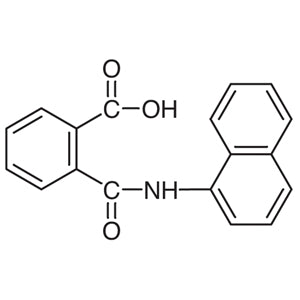
TCI N0067 N-(1-Naphthyl)phthalamic Acid is an organic compound derived from phthalamic acid, carrying a naphthyl group on its amide nitrogen. The material is widely recognised among plant physiology researchers for its ability to interact with the auxin transport system, which is why it is frequently adopted as a tool for studying the movement of growth hormones through plant tissues. In the laboratory it serves a dual role: as a research reagent in its own right, and as a synthetic starting material in the preparation of more complex aromatic amide derivatives. The TCI presentation is supplied in pack sizes that are practical for experimental-scale work.
The characteristics that lead researchers to select this material stem from its structure, which combines a hydrophobic naphthalene ring system with a free carboxylic acid group and an amide linkage. This combination gives the compound a distinctive solubility profile: relatively low in neutral water, but increasing under basic conditions because the carboxylic acid group becomes deprotonated. Polar organic solvents such as dimethyl sulfoxide and acetone are therefore the usual choices for preparing stock solutions. The crystalline solid form is a further practical advantage, since it allows accurate weighing and offers better long-term storage stability than a liquid preparation.
In Indonesian laboratories, this compound is typically encountered in university plant physiology and agricultural science programmes, in agronomy and horticulture research groups, and in synthetic organic chemistry laboratories working on aromatic amide chemistry. Research institutes investigating plant growth and development also draw on it for mechanistic studies of hormone transport. Its supply in experiment-scale packs suits the working pattern of academic and institutional laboratories, where quantities are consumed steadily across multiple trials rather than in bulk.
TCI brochures (PDF)
- Agrochemical Ingredients for Research and Experimental Use 2026-01-08 · p. 3
- Plant Research Reagents 2026-02-24 · p. 10
Related TCI products
- Auxin transport studies in plant tissues: the compound's established interaction with the auxin transport system makes it a direct experimental tool for tracing how growth hormones move through plant structures.
- Plant physiology teaching and research experiments: its well-documented behaviour as a research reagent allows reproducible demonstrations and investigations of growth hormone regulation in university laboratory settings.
- Synthesis of complex aromatic amide derivatives: the free carboxylic acid group and existing amide linkage provide reactive handles for building more elaborate aromatic amide structures from a defined starting material.
- Preparation of stock solutions for bioassay work: solubility in polar organic solvents such as dimethyl sulfoxide and acetone permits convenient preparation of concentrated solutions for subsequent dilution into assay systems.
- pH-dependent solubility investigations: the carboxylic acid group deprotonates under basic conditions, making the material useful where solubility behaviour across different pH environments needs to be examined or exploited.
| Brand | TCI (Tokyo Chemical Industry) |
|---|---|
| CAS number | 132-66-1 |
| Molecular formula | — |
| Purity | — |
| Category | Chemistry > Building Blocks > Non-Heterocyclic Building Blocks |
| Pack sizes | supplied in pack sizes practical for experimental-scale laboratory work |
| Physical form | crystalline solid, suitable for accurate weighing and stable long-term storage |
| Storage | — |
- Chemical name: N-(1-Naphthyl)phthalamic Acid
Store the material in a tightly closed original container, kept dry and protected from moisture and direct sunlight. Its crystalline solid form makes it more stable in long-term storage than a liquid preparation, provided the container is properly sealed after each use. Handle the compound in a well-ventilated area or fume hood, using standard laboratory personal protective equipment including gloves, safety glasses and a laboratory coat, and avoid generating or inhaling dust during weighing. Prepared stock solutions in dimethyl sulfoxide or acetone should be stored in clearly labelled, solvent-compatible containers with secure closures. Always consult the manufacturer's safety data sheet before use and follow local institutional waste disposal procedures.
—
Product Categories
- Cell BiologyNutrition ResearchAgrochemical Research Reagents (for Experimental Use)
- Molecular BiologyPlant BiotechnologyAgrochemical Research Reagents (for Experimental Use)
- Pharmaceutical Development and Drug Discovery ResearchBuilding Blocks for Pharmaceutical Ingredients (for Research and Experimental Use)
Produk Terkait
-
PhthalamicAcid TCI P0282
Regular price Rp 2.068.500,00Regular priceRp 1.461.600,00Sale price Rp 2.068.500,00 -
TerephthalamicAcid TCI T1768
Regular price From Rp 4.028.850,00Regular priceRp 2.832.900,00Sale price From Rp 4.028.850,00 -
5-Acetamido-N,N'-bis(2,3-dihydroxypropyl)-2,4,6-triiodoisophthalamide TCI A2169
Regular price Rp 7.526.400,00Regular priceRp 5.278.350,00Sale price Rp 7.526.400,00 -
AzelaicAcid TCI A0561
Regular price From Rp 557.550,00Regular priceRp 405.300,00Sale price From Rp 557.550,00 -
AzelaicAcid TCI A1318
Regular price From Rp 848.400,00Regular priceRp 609.000,00Sale price From Rp 848.400,00 -
Ethyl4-(4-Chloro-2-methylphenoxy)butyrate TCI E1149
Regular price From Rp 2.411.850,00Regular priceRp 1.702.050,00Sale price From Rp 2.411.850,00 -
N-(3,4-Dichlorophenyl)propionamide TCI D6180
Regular price From Rp 1.801.800,00Regular priceRp 1.275.750,00Sale price From Rp 1.801.800,00 -
Methyl(2,4-Dichlorophenoxy)acetate TCI D6084
Regular price From Rp 2.359.350,00Regular priceRp 1.665.300,00Sale price From Rp 2.359.350,00