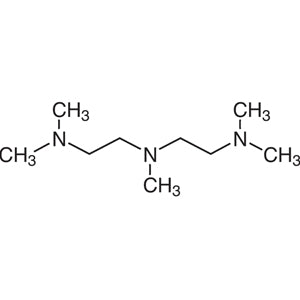
N,N,N',N'',N''-Pentamethyldiethylenetriamine (PMDETA), with CAS number 3030-47-5, is a versatile chemical compound widely used in laboratory settings. As a substituted amine, it plays a crucial role in polymerization reactions, particularly in the synthesis of thermoplastic and elastomeric polymers. Its complex molecular structure, featuring five methyl groups attached to nitrogen atoms, makes it a valuable reagent for crosslinking and functional group modification. PMDETA is commonly found in materials science research, where it contributes to the development of advanced polymer systems and organic compounds.
The chemical properties of PMDETA make it a preferred choice for various applications. It exhibits good solubility in organic solvents, facilitating easy handling and integration into reaction mixtures. Its reactivity towards acids, bases, and oxidizing agents allows it to participate in a wide range of chemical transformations. Despite its reactivity, PMDETA maintains a degree of stability under controlled conditions, which is essential for maintaining the integrity of synthesized compounds. This balance of reactivity and stability makes it ideal for use in complex synthetic processes.
In Indonesian laboratories, PMDETA is frequently utilized in polymerization research, especially in the development of new materials and composite structures. Its role in crosslinking and chain extension is critical for creating polymers with specific mechanical and thermal properties. Researchers in materials science and chemical engineering often rely on PMDETA to achieve desired molecular architectures and functional properties in their experiments.
- Polymerization reactions benefit from PMDETA due to its ability to act as a multifunctional crosslinking agent, enhancing the structural integrity of thermoplastic and elastomeric materials.
- In the synthesis of complex organic compounds, PMDETA serves as a versatile reagent for introducing multiple nitrogen functionalities into molecular frameworks.
- PMDETA is commonly used in the modification of polymer chains to improve properties such as thermal stability and mechanical strength in advanced material development.
- Its solubility in organic solvents makes it suitable for use in solution-based polymerization techniques, enabling precise control over reaction conditions.
- The reactivity of PMDETA allows it to participate in catalytic systems, supporting the development of more efficient and selective chemical transformations.
| Brand | TCI |
|---|---|
| CAS number | 3030-47-5 |
| Molecular formula | — |
| Purity | — |
| Category | Materials Science > Polymer/Macromolecule Reagents > Polymerization Reagents |
| Pack sizes | Available in various sizes as per supplier specifications |
| Physical form | Liquid |
| Storage | Store in a cool, dry place away from direct sunlight and incompatible materials |
PMDETA should be stored in a cool, dry environment to prevent degradation and maintain its chemical integrity. It is recommended to use sealed, airtight containers made of materials compatible with its chemical nature, such as glass or high-density polyethylene. Due to its reactivity, it should be kept away from strong acids, bases, and oxidizing agents to avoid unwanted side reactions. Proper ventilation is essential when handling PMDETA to minimize exposure. In laboratory settings, personal protective equipment such as gloves, goggles, and lab coats should be worn at all times. Regular monitoring of storage conditions ensures the material remains stable and safe for use in chemical processes.
—
Produk Terkait
-
TCI B5774 5,10-Bis(4,4,5,5-tetramethyl-1,3,2-dioxaborolan-2-yl)naphtho[1,2-c:5,6-c']bis([1,2,5]oxadiazole)
Regular price Rp 10.255.350,00Regular price -
Dihydroiodide TCI B6569
Regular price From Rp 1.936.200,00Regular price -
Trifluoromethanesulfonate TCI B7003
Regular price From Rp 1.936.200,00Regular price
![5,10-Bis(4,4,5,5-tetramethyl-1,3,2-dioxaborolan-2-yl)naphtho[1,2-c:5,6-c']bis([1,2,5]oxadiazole) - TCI B5774 - AMI Scientific](http://amiscientific.com/cdn/shop/files/TCI2510B5774.jpg?v=1769180228&width=533)