

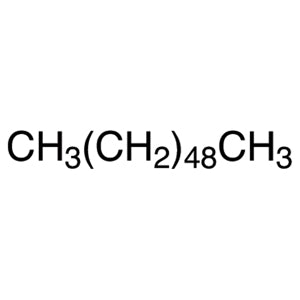
Pentacontane is a long-chain aliphatic hydrocarbon commonly used in laboratory settings for its structural versatility and chemical stability. As a non-heterocyclic building block, it plays a vital role in the synthesis of complex organic molecules. Its linear carbon chain makes it an essential component in the development of new chemical compounds and materials. This compound is widely utilized in both academic and industrial research due to its ability to serve as a foundational element in molecular design. Its inert nature ensures that it does not interfere with other reactions, making it a reliable choice for a variety of chemical processes.
Pentacontane is preferred for its chemical stability and low reactivity, which contribute to its reliability in laboratory environments. It does not readily decompose or react under normal conditions, ensuring consistent performance in experiments. Its solid physical form allows for easy measurement and accurate dosing, which is crucial for precise chemical synthesis. Additionally, its non-reactive nature reduces the risk of unwanted side reactions, making it a safe and dependable material for use in controlled laboratory settings. These characteristics make it an ideal choice for applications requiring high chemical stability and minimal interference.
In Indonesian laboratories, Pentacontane is frequently used in organic chemistry research and industrial chemical development. It is particularly valuable in projects that require the construction of long carbon chains, such as in the synthesis of polymers or specialized organic compounds. Its availability and reliability make it a standard material in both academic and research institutions across Indonesia. Its use supports a wide range of chemical investigations, contributing to the advancement of scientific knowledge and industrial innovation.
- Organic synthesis projects benefit from Pentacontane's stable structure, allowing it to serve as a reliable building block for complex molecule creation.
- Industrial chemical development relies on Pentacontane for its inert properties, ensuring it does not interfere with other reaction components.
- Polymer research utilizes Pentacontane as a foundational element in creating long-chain molecular structures essential for material science.
- Analytical chemistry experiments use Pentacontane as a reference standard due to its consistent chemical behavior and purity.
- Teaching laboratories incorporate Pentacontane to demonstrate the principles of hydrocarbon structure and chemical stability in organic chemistry courses.
| Brand | TCI |
|---|---|
| CAS number | 6596-40-3 |
| Molecular formula | — |
| Purity | — |
| Category | Chemistry > Building Blocks > Non-Heterocyclic Building Blocks |
| Pack sizes | Available in various quantities as per supplier specifications |
| Physical form | Solid |
| Storage | Store in a cool, dry place away from direct sunlight and moisture |
Pentacontane should be stored in a cool, dry environment to maintain its chemical stability. It is recommended to keep it in airtight containers to prevent exposure to moisture and air, which could affect its integrity over time. Due to its non-reactive nature, it does not require special handling beyond standard laboratory safety protocols. However, it should be stored away from incompatible materials to ensure long-term stability. Proper labeling and secure storage are essential to prevent accidental use or contamination. In laboratory settings, it is important to follow standard safety practices when handling and storing chemical substances to ensure a safe working environment.
—
Produk Terkait
-
Undecylcyclohexane TCI U0037
Regular price Rp 6.599.250,00Regular price -
Undecane TCI U0002
Regular price From Rp 505.050,00Regular price -
1,3,5-Trimethyladamantane TCI T3872
Regular price From Rp 2.199.750,00Regular price -
Tetratriacontane TCI T2938
Regular price From Rp 3.260.250,00Regular price -
exo-Tetrahydrodicyclopentadiene TCI T1994
Regular price From Rp 1.246.350,00Regular price -
1,1,2,2-Tetramethylcyclopropane TCI T1721
Regular price Rp 3.180.450,00Regular price -
1,1,3,5-Tetramethylcyclohexane TCI T1717
Regular price Rp 6.148.800,00Regular price -
2,2,4,4-Tetramethylpentane TCI T1704
Regular price From Rp 1.220.100,00Regular price


