

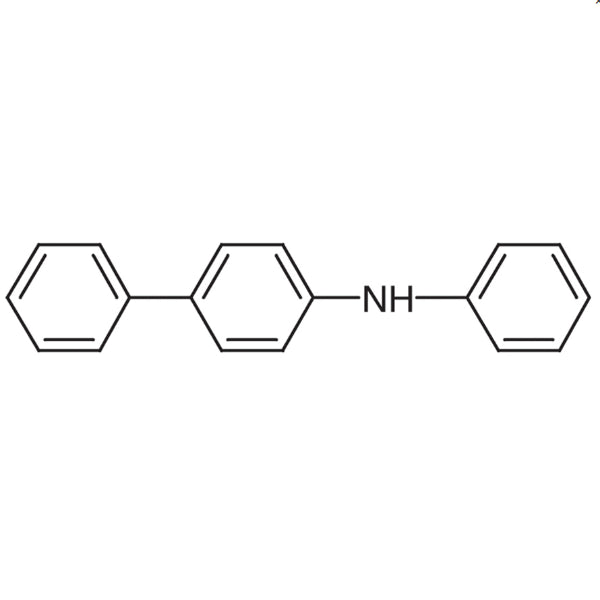
N-Phenyl-4-biphenylamine from TCI (product code P1498) is a secondary diarylamine. Its nitrogen atom carries a phenyl group and a biphenyl group joined at the para position (4-biphenylyl). It belongs to the small molecule semiconductor building blocks and is widely used to prepare triarylamines. Triarylamines form the backbone of hole-transport materials in OLEDs, perovskite solar cells, and organic photoconductors. In the laboratory, the N-H bond is the reactive site for attaching further aromatic units through C-N coupling reactions, so the compound is a useful starting point for building larger conjugated structures.
The para linkage in the biphenyl unit gives a longer, more linear conjugated system than the meta isomer. This extended conjugation helps delocalise charge and tends to support good hole mobility in the final material. For this reason, the para-biphenylamine motif appears in many well-known hole-transport material structures. The electron-rich nitrogen makes the compound a strong donor. The biphenyl unit adds thermal stability and extends the aromatic system involved in charge transport. Together, these features make the compound a preferred building block for researchers designing organic semiconductors with predictable electronic behaviour.
For Indonesian laboratories researching organic optoelectronic devices, this compound offers a shortcut to building hole-transport materials without first assembling the diarylamine core. University research groups in chemistry, physics, and materials engineering can use it to synthesise new triarylamine derivatives, compare structural variants, or reproduce materials reported in the literature. It also suits research institutions developing thin-film devices such as perovskite solar cells and OLED prototypes, where a reliable supply of consistent starting materials matters for reproducible results.
TCI brochures (PDF)
- Building Blocks for Organic Semiconductor 2026-03-24 · p. 30
- Synthesis of triarylamines: the reactive N-H bond allows a third aromatic unit to be attached by C-N coupling, giving the triarylamine frameworks that form the core of most hole-transport materials.
- Hole-transport materials for OLEDs: the para-biphenylamine motif provides extended conjugation and charge delocalisation, which supports the hole mobility needed in organic light-emitting device layers.
- Perovskite solar cell research: derivatives built from this donor-rich amine can be explored as hole-transport layers, where good charge extraction and thermal stability are both important for device performance.
- Organic photoconductor development: the electron-rich nitrogen and extended aromatic system make the compound suitable for building charge-transporting materials used in organic photoconductive layers and related devices.
- Structure-property studies of isomers: the linear para-linked biphenyl unit can be compared directly with meta-linked analogues, helping researchers understand how conjugation geometry affects charge transport in small-molecule semiconductors.
| Brand | TCI (product code P1498) |
|---|---|
| CAS number | 32228-99-2 |
| Molecular formula | — |
| Purity | — |
| Category | Materials Science > Material Building Blocks > Small Molecule Semiconductor Building Blocks |
| Pack sizes | as listed in the current TCI catalogue; please contact AMI Scientific for available options |
| Physical form | see the TCI certificate of analysis and safety data sheet |
| Storage | store as directed on the product label and SDS, in a tightly closed original container |
Store N-Phenyl-4-biphenylamine in its original, tightly closed container in a cool, dry, well-ventilated place, away from direct sunlight, heat sources, and strong oxidising agents. Keep the container clearly labelled. Reseal it promptly after each use to limit exposure to moisture and air. Follow the storage conditions stated on the TCI label and safety data sheet. Handle the compound in a fume hood or a well-ventilated area, and wear suitable personal protective equipment, including a lab coat, safety glasses, and chemical-resistant gloves. Avoid creating dust and avoid contact with skin, eyes, and clothing. Weigh and transfer the material with clean, dry tools to prevent contamination of research-grade samples. Dispose of residues and contaminated materials according to local regulations and your institution's chemical waste procedures.
—
Produk Terkait
-
N-Phenyl-3-biphenylamine TCI P1497
Regular price Rp 4.506.600,00Regular price -
4-Bromodiphenylamine TCI B3949
Regular price From Rp 1.378.650,00Regular price -
3-Methyldiphenylamine TCI M1258
Regular price Rp 1.618.050,00Regular price -
2-Bromodiphenylamine TCI B5744
Regular price From Rp 2.625.000,00Regular price -
N,N-Bis(4'-diphenylamino-4-biphenylyl)amine TCI B5676
Regular price From Rp 1.590.750,00Regular price -
4-Aminotriphenylamine TCI A2624
Regular price Rp 3.100.650,00Regular price -
4,4',4''-Tris[9,9-dimethylfluoren-2-yl(phenyl)amino]triphenylamine TCI T3438
Regular price From Rp 2.571.450,00Regular price -
4,4',4''-Tris(diphenylamino)triphenylamine TCI T3062
Regular price From Rp 2.068.500,00Regular price


![303111-06-0 4,4',4''-Tris[9,9-dimethylfluoren-2-yl(phenyl)amino]triphenylamine - AMI Scientific](http://amiscientific.com/cdn/shop/files/TCI2510T3438.jpg?v=1769143732&width=533)
