

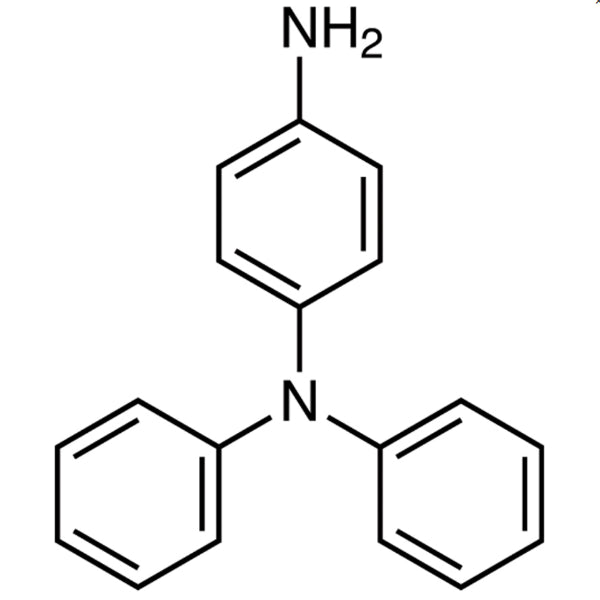
4-Aminotriphenylamine (4-ATPA) is a key organic compound widely used in material research and semiconductor technology. This compound plays a crucial role in the development of organic conductive materials, particularly in the creation of optoelectronic devices and solar cells. In the laboratory, 4-ATPA serves as a fundamental building block for synthesizing complex molecules with unique electronic properties. Its versatility and chemical stability make it an essential component in the exploration of advanced material science applications.
The chemical structure of 4-ATPA, with its three phenyl groups and an amino group, contributes to its strong electron-donating properties. These characteristics allow it to form stable bonds with various molecules, making it ideal for use in semiconductor applications. Additionally, its high chemical stability ensures that it remains effective under a range of experimental conditions. These properties make 4-ATPA a preferred choice for researchers working on organic electronics and energy conversion technologies.
In Indonesian laboratories, 4-ATPA is commonly used in material science and semiconductor technology research. It is a vital component in the development of new materials with applications in electronics and energy. Its availability supports ongoing research efforts, enabling scientists to explore the unique properties of this compound in various experimental contexts. The compound’s role in advancing scientific innovation is well recognized in the local research community.
TCI brochures (PDF)
- Building Blocks for Organic Semiconductor 2026-03-24 · p. 31
Related TCI products
- TCI D2172 4181-05-9 4-(N,N-Diphenylamino)benzaldehyde
- TCI B5676 167218-39-5 N,N-Bis(4'-diphenylamino-4-biphenylyl)amine
- TCI B2843 53566-95-3 Bis(4-formylphenyl)phenylamine
- TCI P1498 32228-99-2 N-Phenyl-4-biphenylamine
- TCI P1497 198275-79-5 N-Phenyl-3-biphenylamine
- TCI T2251 124729-98-2 4,4',4''-Tris[phenyl(m-tolyl)amino]triphenylamine
- Organic Conductive Material Synthesis: 4-ATPA is ideal for creating conductive polymers and organic semiconductors due to its electron-donating properties and chemical stability.
- Optoelectronic Device Development: Its use in optoelectronics allows for the fabrication of devices such as organic light-emitting diodes (OLEDs) and photovoltaic cells.
- Semiconductor Research: The compound is frequently used in the study of organic semiconductors, aiding in the development of next-generation electronic components.
- Energy Conversion Studies: 4-ATPA’s role in solar cell research makes it a valuable material for exploring new methods of energy harvesting.
- Molecular Building Block Applications: Its ability to form stable bonds with other molecules makes it a key component in the synthesis of complex organic structures.
| Brand | TCI |
|---|---|
| CAS number | 2350-01-8 |
| Molecular formula | — |
| Purity | — |
| Category | Materials Science > Material Building Blocks > Small Molecule Semiconductor Building Blocks |
| Pack sizes | Available in various quantities as per standard laboratory supply |
| Physical form | Solid |
| Storage | Store in a cool, dry place away from direct sunlight and moisture |
4-ATPA should be stored in a cool, dry environment to maintain its chemical stability and prevent degradation. It is recommended to keep the compound in a sealed container to avoid exposure to moisture and air. Due to its organic nature, it should be handled in a well-ventilated area to ensure safety. Avoid contact with incompatible substances such as strong oxidizing agents. Always use appropriate personal protective equipment, including gloves and safety goggles, when handling this material. Proper storage and handling procedures help preserve the integrity of the compound and ensure safe laboratory practices.
—
Produk Terkait
-
4-(N,N-Diphenylamino)benzaldehyde TCI D2172
Regular price From Rp 1.776.600,00Regular priceRp 1.257.900,00Sale price From Rp 1.776.600,00 -
N,N-Bis(4'-diphenylamino-4-biphenylyl)amine TCI B5676
Regular price From Rp 1.643.250,00Regular priceRp 1.164.450,00Sale price From Rp 1.643.250,00 -
Bis(4-formylphenyl)phenylamine TCI B2843
Regular price Rp 5.114.550,00Regular priceRp 3.592.050,00Sale price Rp 5.114.550,00 -
N-Phenyl-4-biphenylamine TCI P1498
Regular price Rp 2.227.050,00Regular priceRp 1.572.900,00Sale price Rp 2.227.050,00 -
N-Phenyl-3-biphenylamine TCI P1497
Regular price Rp 4.559.100,00Regular priceRp 3.203.550,00Sale price Rp 4.559.100,00 -
4,4',4''-Tris[phenyl(m-tolyl)amino]triphenylamine TCI T2251
Regular price Rp 1.563.450,00Regular priceRp 1.108.800,00Sale price Rp 1.563.450,00 -
TriphenylaceticAcid TCI T1585
Regular price From Rp 3.683.400,00Regular priceRp 2.591.400,00Sale price From Rp 3.683.400,00 -
4-BiphenylaceticAcid TCI B1278
Regular price From Rp 1.696.800,00Regular priceRp 1.202.250,00Sale price From Rp 1.696.800,00


