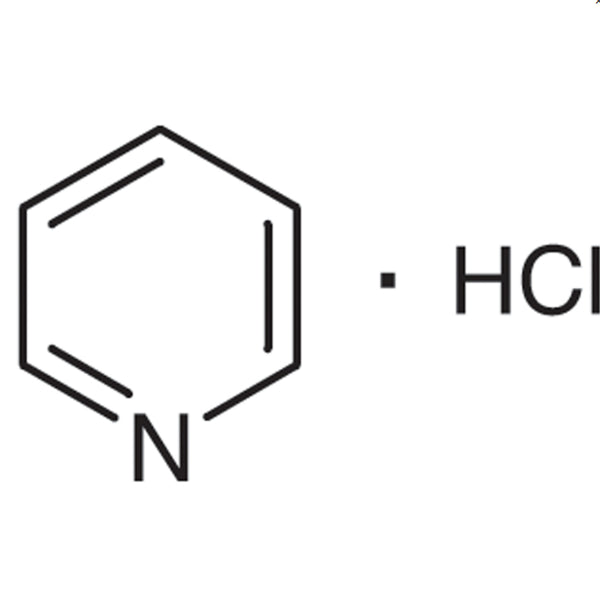
Pyridine Hydrochloride is a chemical compound widely used in various laboratory applications, particularly in the synthesis of heterocyclic compounds. It serves as a fundamental building block in organic chemistry, playing a crucial role in reactions that involve substitution, bond formation, and molecular modification. Its reactivity makes it a valuable reagent in both academic and industrial research settings, where it contributes to the development of complex chemical structures. Due to its versatility, it is frequently employed in analytical and synthetic processes to achieve desired chemical transformations.
The compound is known for its chemical stability under certain conditions, although it exhibits high reactivity towards water and other chemical substances. This reactivity, while beneficial in many reactions, also necessitates careful handling to prevent unwanted side reactions. Pyridine Hydrochloride is corrosive in nature and can cause irritation to the skin and eyes, which underscores the need for protective measures during its use. These properties make it a powerful yet potentially hazardous material that requires precise control in laboratory environments.
In Indonesian laboratories, Pyridine Hydrochloride is commonly used in chemical research, including pharmaceutical synthesis, industrial chemical production, and analytical experiments. Its presence in these contexts highlights its importance in advancing scientific knowledge and developing new chemical products. Researchers in Indonesia rely on this compound to conduct experiments that require high reactivity and structural complexity, making it an essential tool in the chemical sciences.
- Pharmaceutical synthesis where it acts as a key reagent in the creation of complex drug molecules due to its reactivity and ability to form stable intermediates.
- Industrial chemical production for the development of specialty chemicals and polymers, leveraging its role in heterocyclic ring formation.
- Analytical experiments where it is used as a reagent to modify molecular structures and facilitate detection through chemical reactions.
- Organic synthesis processes that require substitution reactions and bond formation, benefiting from its ability to participate in multiple reaction pathways.
- Research in heterocyclic chemistry where it serves as a fundamental building block for the synthesis of various nitrogen-containing compounds.
| Brand | TCI |
|---|---|
| CAS number | 628-13-7 |
| Molecular formula | — |
| Purity | — |
| Category | Chemistry > Building Blocks > Heterocyclic Building Blocks |
| Pack sizes | Available in various quantities as per standard laboratory supply |
| Physical form | Solid powder |
| Storage | Should be stored in a sealed container in a cool, dry place away from moisture and incompatible substances. |
Pyridine Hydrochloride should be stored in a sealed container in a cool, dry location, away from moisture and incompatible substances. It is essential to keep the material in a well-ventilated area to prevent the accumulation of harmful vapors. Protective gloves, goggles, and a lab coat should be worn when handling this compound to minimize exposure. Due to its corrosive nature, it should never be stored near food or drink. In laboratory settings, it is recommended to use fume hoods when working with this material to ensure safety and prevent accidental contact. Proper disposal procedures must be followed to comply with environmental and safety regulations.
—
Produk Terkait
-
TCI B5774 5,10-Bis(4,4,5,5-tetramethyl-1,3,2-dioxaborolan-2-yl)naphtho[1,2-c:5,6-c']bis([1,2,5]oxadiazole)
Regular price Rp 10.255.350,00Regular price -
Dihydroiodide TCI B6569
Regular price From Rp 1.936.200,00Regular price -
Trifluoromethanesulfonate TCI B7003
Regular price From Rp 1.936.200,00Regular price
![5,10-Bis(4,4,5,5-tetramethyl-1,3,2-dioxaborolan-2-yl)naphtho[1,2-c:5,6-c']bis([1,2,5]oxadiazole) - TCI B5774 - AMI Scientific](http://amiscientific.com/cdn/shop/files/TCI2510B5774.jpg?v=1769180228&width=533)