

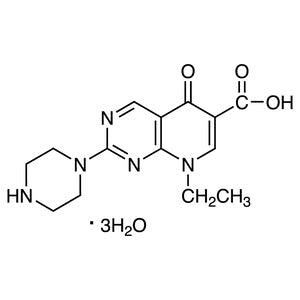
Pipemidic Acid Trihydrate is a chemical compound widely used in laboratory experiments, particularly in the fields of biochemistry and pharmacology. It is a trihydrate form of pipemidic acid, which is known for its strong antibacterial activity, especially against gram-negative bacteria. This compound plays a crucial role in various scientific investigations, including antimicrobial activity testing, drug development, and the study of antibiotic mechanisms. Its chemical structure features three water molecules in its crystalline form, contributing to its solubility and stability under certain conditions.
One of the key reasons Pipemidic Acid Trihydrate is preferred in laboratories is its stability and solubility in water. These properties make it easy to handle and incorporate into different chemical reactions. Additionally, its thermal stability ensures that it remains effective during long-term storage and use. The compound’s consistent performance and availability make it a reliable choice for researchers seeking a dependable reagent for their experiments.
In Indonesian laboratories, Pipemidic Acid Trihydrate is commonly used in health and environmental research. It is frequently employed in antibiotic efficacy testing and studies related to microbial resistance. Its application extends to pharmaceutical research, where it helps in the development of new antimicrobial agents. The compound’s versatility and reliability make it an essential component in many scientific investigations conducted in Indonesia.
TCI brochures (PDF)
- Pharmaceutical Ingredients for Research and Experimental Use 2026-03-09 · p. 6
- Antimicrobial Activity Testing: Pipemidic Acid Trihydrate is ideal for assessing the effectiveness of antibiotics against various bacterial strains, especially gram-negative bacteria.
- Drug Development Research: Its antibacterial properties make it a valuable tool in the formulation and testing of new antimicrobial compounds.
- Antibiotic Mechanism Studies: The compound is used to investigate how antibiotics interact with bacterial cells and inhibit their growth.
- Environmental Microbiology: It is employed in studies that examine the presence and behavior of microorganisms in different environmental samples.
- Pharmaceutical Quality Control: It serves as a standard reference material for ensuring the consistency and purity of antibiotic formulations.
| Brand | TCI |
|---|---|
| CAS number | 72571-82-5 |
| Molecular formula | — |
| Purity | — |
| Category | Life Science > Biochemicals and Reagents > Antibiotics |
| Pack sizes | Available in various quantities as per standard laboratory supply |
| Physical form | Solid, crystalline powder |
| Storage | Store in a cool, dry place away from moisture and direct sunlight |
Pipemidic Acid Trihydrate should be stored in a cool, dry environment to maintain its stability and effectiveness. It is recommended to keep the compound in airtight containers to prevent moisture absorption, which could affect its solubility and purity. Due to its chemical nature, it should be handled with care, using appropriate personal protective equipment such as gloves and safety goggles. Avoid exposure to high temperatures or direct sunlight, as these conditions may compromise its integrity. In laboratory settings, it is important to follow standard safety protocols when working with this compound to ensure safe and efficient use. Proper storage and handling practices help maintain the compound’s quality and extend its usability in research applications.
—
Product Categories
- Biochemicals and ReagentsAntibioticsAntibiotics (Chemical Structure Class)
- Biochemicals and ReagentsPharmaceutical Research Reagents (for Experimental Use)Antimicrobial Ingredients (for Research and Experimental Use)
- MicrobiologyAntibioticsAntibiotics (Chemical Structure Class)
- Pharmaceutical Development and Drug Discovery ResearchPharmaceutical Research Reagents (for Experimental Use)Antimicrobial Ingredients (for Research and Experimental Use)
- Pharmaceutical Development and Drug Discovery ResearchAntibioticsAntibiotics (Chemical Structure Class)
Produk Terkait
-
4-AminosalicylicAcid TCI A0420
Regular price From Rp 769.650,00Regular price -
Sodium4-AminosalicylateDihydrate TCI A0423
Regular price From Rp 875.700,00Regular price -
Wortmannin TCI W0007
Regular price Rp 11.580.450,00Regular price -
ValganciclovirHydrochloride TCI V0158
Regular price From Rp 1.565.550,00Regular price -
ValnemulinHydrochloride TCI V0144
Regular price From Rp 4.929.750,00Regular price -
Sulfamerazine TCI U0176
Regular price From Rp 2.359.350,00Regular price -
SulfadiazineSodium TCI U0171
Regular price Rp 1.167.600,00Regular price -
Sulfaphenazole TCI U0170
Regular price Rp 3.392.550,00Regular price


