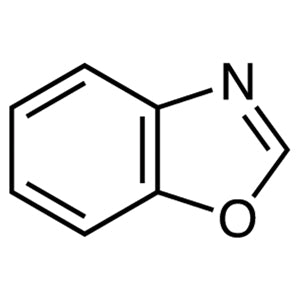
5-Phenylbenzoxazole-2-thiol from TCI is a heterocyclic compound built on a benzoxazole core. It carries a phenyl group at position 5 and a thiol group at position 2. Compounds of this type exist in a tautomeric equilibrium between the thiol form and the thione form, benzoxazole-2(3H)-thione. In the laboratory it serves as a building block for more complex benzoxazole derivatives, coordination ligands, and candidate bioactive compounds in medicinal chemistry research.
Chemists choose this compound because its sulfur atom is highly nucleophilic. It can be alkylated or acylated easily to give thioethers or thioesters. The sulfur atom can also be oxidised or replaced, which leads to other 2-substituted derivatives. The benzoxazole core is planar and aromatic, and this scaffold is widely studied in research on bioactive compounds and fluorescent materials. The extra phenyl group extends the aromatic system and affects solubility and molecular interactions. This makes the compound useful for varying structure in structure–activity relationship studies.
In Indonesia, this material suits organic chemistry, medicinal chemistry, coordination chemistry, and pharmacy laboratories that develop new heterocycles. University research groups, graduate students working on synthesis projects, and institutional laboratories exploring new benzoxazole scaffolds can use it as a reliable starting point. Its functional sulfur handle and extended aromatic core give researchers several directions for derivatisation within one well-defined starting material from an established reagent brand.
- Synthesis of benzoxazole derivatives: the reactive thiol group at position 2 lets chemists build more complex substituted benzoxazoles from a single, well-defined heterocyclic starting material.
- Preparation of thioethers and thioesters: the highly nucleophilic sulfur atom alkylates or acylates readily, so researchers can introduce many side chains under routine organic synthesis conditions.
- Coordination chemistry and ligand design: the sulfur and nitrogen-containing heterocycle makes it a useful precursor for coordination ligands studied in metal complex research and related inorganic work.
- Medicinal chemistry and structure–activity studies: the benzoxazole scaffold is widely studied in bioactive compound research, and the 5-phenyl group lets researchers vary aromatic size, solubility, and molecular interactions.
- Fluorescent material research: the planar, aromatic benzoxazole core, extended by the phenyl substituent, makes this compound a relevant scaffold for exploring new fluorescent or optically active organic materials.
| Brand | TCI (product code P2011) |
|---|---|
| CAS number | 17371-99-2 |
| Molecular formula | — |
| Purity | — |
| Category | Chemistry > Building Blocks > Heterocyclic Building Blocks |
| Pack sizes | sold in TCI's standard pack sizes; see the product listing for the sizes currently offered |
| Physical form | see the TCI product documentation and Certificate of Analysis |
| Storage | follow the conditions on the TCI label and Safety Data Sheet |
Keep this compound in its original, tightly closed TCI container. Store it in a cool, dry, well-ventilated area away from direct sunlight, moisture, heat sources, and incompatible materials such as strong oxidising agents. Always check the TCI label and Safety Data Sheet for the exact recommended storage temperature. Handle it in a fume hood or another well-ventilated area. Wear standard personal protective equipment, including a lab coat, chemical-resistant gloves, and safety glasses, and avoid breathing in dust or getting it on your skin. Clearly label all containers holding portions you have weighed out. Dispose of residues and contaminated materials according to your institution's chemical waste procedures and local regulations.
—
Produk Terkait
-
1,3,4-Thiadiazole-2-thiol TCI T2884
Regular price Rp 3.180.450,00Regular price -
2-Phenylbenzoxazole TCI P2264
Regular price From Rp 1.485.750,00Regular price -
2-Methyl-5-phenylbenzoxazole TCI M1244
Regular price Rp 1.298.850,00Regular price -
5-Methyl-1,3,4-thiadiazole-2-thiol TCI M0976
Regular price Rp 743.400,00Regular price -
2,5,6-Trimethylbenzoxazole TCI T1845
Regular price Rp 1.644.300,00Regular price -
Benzoxazole TCI B0095
Regular price Rp 1.829.100,00Regular price -
2-(2-Pyridyl)benzoxazole TCI P2098
Regular price Rp 1.431.150,00Regular price -
6-Methyl-1,3-benzoxazole-2(3H)-thione TCI M3063
Regular price From Rp 1.856.400,00Regular price