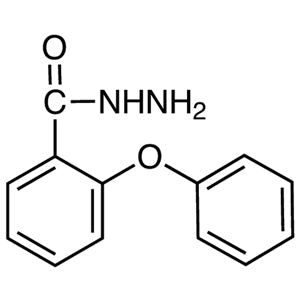
TCI P2357 2-Phenoxybenzohydrazide (CAS 43038-37-5) is an aromatic hydrazide. It consists of a benzoyl ring with a phenoxy substituent at the ortho position, attached to a hydrazide group (–CONHNH₂). It is classed as a non-heterocyclic building block. Its hydrazide group gives chemists a starting point for building many nitrogen-containing heterocycles and hydrazone compounds. In the laboratory it is mainly used in organic synthesis and exploratory medicinal chemistry. Researchers use it to prepare libraries of derivative compounds, which are then screened for biological and physicochemical properties.
Chemists choose this compound because its hydrazide group is nucleophilic. It reacts readily with aldehydes and ketones under mild conditions to form hydrazones (acylhydrazones). The hydrazide can also be cyclised into 1,3,4-oxadiazoles, 1,3,4-thiadiazoles or 1,2,4-triazoles by reaction with suitable reagents. The ortho-phenoxy substituent makes the molecule more lipophilic and affects its conformation. This diaryl ether motif is common in bioactive compounds, so derivatives of 2-phenoxybenzohydrazide are useful for structure–activity relationship studies.
In Indonesia, this compound suits organic chemistry and pharmaceutical chemistry laboratories as well as pharmacy faculties. It is a practical starting material for undergraduate and postgraduate research projects, thesis work and exploratory synthesis programmes that focus on hydrazone and nitrogen heterocycle chemistry. Research groups that design and screen small compound libraries can use it as a reliable scaffold for systematic derivatisation. It also works in teaching laboratories that demonstrate condensation and cyclisation reactions, where the mild reaction conditions make it suitable for hands-on synthesis exercises.
- Hydrazone synthesis: the nucleophilic hydrazide group condenses readily with aldehydes and ketones under mild conditions, so acylhydrazone derivatives can be prepared quickly and cleanly.
- Construction of 1,3,4-oxadiazoles: the hydrazide can be cyclised with suitable reagents to form the oxadiazole ring, which makes it a convenient precursor for this important heterocyclic class.
- Preparation of 1,3,4-thiadiazoles and 1,2,4-triazoles: the same hydrazide handle lets researchers reach several nitrogen-containing heterocycles from a single starting material.
- Exploratory medicinal chemistry: the diaryl ether motif occurs in many bioactive compounds, so derivatives are useful candidates for screening biological and physicochemical properties.
- Structure–activity relationship studies: the ortho-phenoxy group adds lipophilicity and affects conformation, so researchers can study how these structural features change the activity of a compound series.
| Brand | TCI (product code P2357) |
|---|---|
| CAS number | 43038-37-5 |
| Molecular formula | — |
| Purity | — |
| Category | Chemistry > Building Blocks > Non-Heterocyclic Building Blocks |
| Pack sizes | available in standard TCI pack sizes; please ask AMI Scientific for the current options |
| Physical form | refer to the TCI Certificate of Analysis and Safety Data Sheet |
| Storage | follow the storage conditions on the TCI label and Safety Data Sheet |
Store 2-Phenoxybenzohydrazide in its original, tightly closed manufacturer's container in a cool, dry, well-ventilated place, away from direct sunlight, heat sources and moisture. Keep it away from strong oxidising agents and from reactive carbonyl compounds unless they are being used intentionally. Always follow the specific storage temperature on the TCI label and Safety Data Sheet. When handling, wear standard personal protective equipment, including a lab coat, safety glasses and chemical-resistant gloves. Weigh and transfer the material in a fume hood or well-ventilated area, and avoid creating or breathing dust. Wash your hands thoroughly after handling. Dispose of any residues and contaminated materials according to institutional and local chemical waste regulations.
—
Produk Terkait
-
3-Methoxybenzohydrazide TCI A1446
Regular price From Rp 769.650,00Regular price -
2-Phenoxybenzaldehyde TCI P2475
Regular price From Rp 1.326.150,00Regular price -
4-Phenoxybenzaldehyde TCI P1333
Regular price From Rp 1.829.100,00Regular price -
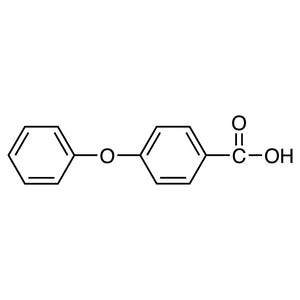
4-PhenoxybenzoicAcid TCI P1256
Regular price From Rp 823.200,00Regular price -
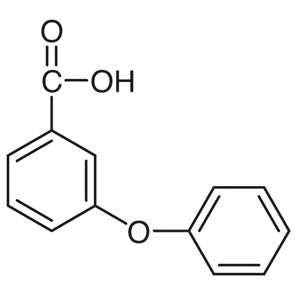
3-PhenoxybenzoicAcid TCI P1253
Regular price From Rp 1.353.450,00Regular price -
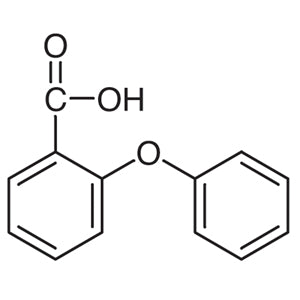
2-PhenoxybenzoicAcid TCI P1252
Regular price From Rp 1.644.300,00Regular price -
3-Phenoxybenzaldehyde TCI P0960
Regular price From Rp 1.908.900,00Regular price -
2-Methoxybenzohydrazide TCI M3840
Regular price From Rp 903.000,00Regular price