


9-Phenyl-3-(4,4,5,5-tetramethyl-1,3,2-dioxaborolan-2-yl)carbazole from TCI is the boronic acid pinacol ester of 9-phenylcarbazole, with the boron group at the 3-position. It is an organoboron reagent, a class of materials that plays a central role in Suzuki–Miyaura cross-coupling reactions. In the laboratory, this reagent lets researchers attach the 9-phenylcarbazole unit, one of the most widely used fragments in OLED materials, to a wide range of aryl halide frameworks in a single reaction step. This makes it a practical building block for constructing more complex conjugated molecules.
The pinacol ester form is preferred because it is generally more stable, easier to purify by chromatography, and easier to weigh accurately than the free boronic acid. Free boronic acids tend to form boroxine anhydrides, which can complicate stoichiometry and handling. The phenyl group on the nitrogen is already in place, so researchers do not need a separate N-arylation step, which shortens synthetic routes. The 9-phenylcarbazole unit is known as a good electron donor with high thermal stability, which is why it appears so often in hole-transport materials and in host materials for phosphorescent devices.
In Indonesia, this reagent is relevant to organic synthesis and materials chemistry laboratories that develop organic semiconductors, luminescent materials, or fluorescence-based sensors. University research groups working on optoelectronic materials can use it to prepare carbazole-containing target molecules for device studies and photophysical characterization. Industrial and institutional R&D laboratories exploring new functional materials will also find it useful as a ready-to-use coupling partner that cuts preparation time and keeps reaction workflows simple and reproducible.
TCI brochures (PDF)
- Carbazoles 2025-06-27 · p. 5
- Boron Compounds 2025-10-07 · p. 19
- Building Blocks for Organic Semiconductor 2026-03-24 · p. 22
Related TCI products
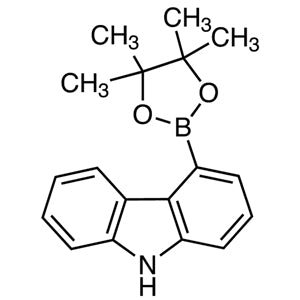
- TCI T3747 1255309-13-7 4-(4,4,5,5-Tetramethyl-1,3,2-dioxaborolan-2-yl)-9H-carbazole
- TCI T3612 1345614-94-9 3-(4,4,5,5-Tetramethyl-1,3,2-dioxaborolan-2-yl)-9-(p-tolyl)-9H-carbazole
- TCI T3452 785051-54-9 9-[4-(4,4,5,5-Tetramethyl-1,3,2-dioxaborolan-2-yl)phenyl]-9H-carbazole
- TCI T3441 1242412-60-7 2-(4,4,5,5-Tetramethyl-1,3,2-dioxaborolan-2-yl)-9H-carbazole
- TCI T3386 870119-58-7 9-[3-(4,4,5,5-Tetramethyl-1,3,2-dioxaborolan-2-yl)phenyl]carbazole
- TCI B5091 1391729-66-0 9-([1,1'-Biphenyl]-4-yl)-3-(4,4,5,5-tetramethyl-1,3,2-dioxaborolan-2-yl)-9H-carbazole
- Suzuki–Miyaura cross-coupling: the pinacol boronate group lets the 9-phenylcarbazole unit be coupled to many aryl halide frameworks in a single reaction step.
- Synthesis of hole-transport materials: the 9-phenylcarbazole unit is a good electron donor with high thermal stability, which suits it to hole-transporting molecular designs.
- Preparation of host materials for phosphorescent devices: its carbazole core is widely used in host materials, so the reagent helps build candidate host molecules efficiently.
- Development of luminescent materials and fluorescence-based sensors: researchers can add the carbazole donor unit to conjugated systems to study and tune their emission behavior.
- Streamlined multistep organic synthesis: because the N-phenyl group is already installed, a separate N-arylation step is not needed, which saves time and reduces purification work.
| Brand | TCI (product code P2376) |
|---|---|
| CAS number | 1126522-69-7 |
| Molecular formula | — |
| Purity | — |
| Category | Chemistry > Organometallic Reagents > Organoboron |
| Pack sizes | 1 g and 5 g |
| Physical form | refer to the product label and Certificate of Analysis |
| Storage | follow the conditions on the TCI label and Safety Data Sheet |
Keep the reagent in its original, tightly closed container in a cool, dry, well-ventilated place, away from moisture, direct light, and incompatible materials such as strong oxidizing agents. Always follow the storage conditions on the TCI label and the Safety Data Sheet. Reseal the container right after each use to protect the boronate ester from humidity. Handle it in a fume hood or another well-ventilated area, and wear suitable gloves, safety glasses, and a lab coat. Avoid inhaling dust and avoid contact with skin and eyes. Dispose of waste in line with local regulations and your institution's chemical waste procedures.
—
Produk Terkait
-
4-(4,4,5,5-Tetramethyl-1,3,2-dioxaborolan-2-yl)-9H-carbazole TCI T3747
Regular price Rp 5.194.350,00Regular price -
3-(4,4,5,5-Tetramethyl-1,3,2-dioxaborolan-2-yl)-9-(p-tolyl)-9H-carbazole TCI T3612
Regular price From Rp 1.060.500,00Regular price -
9-[4-(4,4,5,5-Tetramethyl-1,3,2-dioxaborolan-2-yl)phenyl]-9H-carbazole TCI T3452
Regular price From Rp 1.749.300,00Regular price -
2-(4,4,5,5-Tetramethyl-1,3,2-dioxaborolan-2-yl)-9H-carbazole TCI T3441
Regular price From Rp 2.545.200,00Regular price -
9-[3-(4,4,5,5-Tetramethyl-1,3,2-dioxaborolan-2-yl)phenyl]carbazole TCI T3386
Regular price From Rp 1.961.400,00Regular price -
9-([1,1'-Biphenyl]-4-yl)-3-(4,4,5,5-tetramethyl-1,3,2-dioxaborolan-2-yl)-9H-carbazole TCI B5091
Regular price From Rp 2.359.350,00Regular price -
9-([1,1'-Biphenyl]-3-yl)-3-(4,4,5,5-tetramethyl-1,3,2-dioxaborolan-2-yl)-9H-carbazole TCI B5054
Regular price From Rp 769.650,00Regular price -
9-Phenyl-3-[2-(4,4,5,5-tetramethyl-1,3,2-dioxaborolan-2-yl)phenyl]-9H-carbazole TCI P2772
Regular price From Rp 1.140.300,00Regular price

![785051-54-9 9-[4-(4,4,5,5-Tetramethyl-1,3,2-dioxaborolan-2-yl)phenyl]-9H-carbazole - AMI Scientific](http://amiscientific.com/cdn/shop/files/TCI2510T3452.jpg?v=1769143736&width=533)

![870119-58-7 9-[3-(4,4,5,5-Tetramethyl-1,3,2-dioxaborolan-2-yl)phenyl]carbazole - AMI Scientific](http://amiscientific.com/cdn/shop/files/TCI2510T3386.jpg?v=1769143726&width=533)
![1391729-66-0 9-([1,1'-Biphenyl]-4-yl)-3-(4,4,5,5-tetramethyl-1,3,2-dioxaborolan-2-yl)-9H-carbazole - AMI Scientific](http://amiscientific.com/cdn/shop/files/TCI2510B5091.jpg?v=1769180123&width=533)
![1533406-38-0 9-([1,1'-Biphenyl]-3-yl)-3-(4,4,5,5-tetramethyl-1,3,2-dioxaborolan-2-yl)-9H-carbazole - AMI Scientific](http://amiscientific.com/cdn/shop/files/TCI2510B5054.jpg?v=1769055853&width=533)
![1533406-38-0 9-([1,1'-Biphenyl]-3-yl)-3-(4,4,5,5-tetramethyl-1,3,2-dioxaborolan-2-yl)-9H-carbazole - AMI Scientific](http://amiscientific.com/cdn/shop/files/TCI2510B5054_956311a4-4a22-40ff-ad97-e0eb025c60b9.jpg?v=1769145376&width=533)
![1628817-49-1 9-Phenyl-3-[2-(4,4,5,5-tetramethyl-1,3,2-dioxaborolan-2-yl)phenyl]-9H-carbazole - AMI Scientific](http://amiscientific.com/cdn/shop/files/TCI2510P2772.jpg?v=1769057559&width=533)