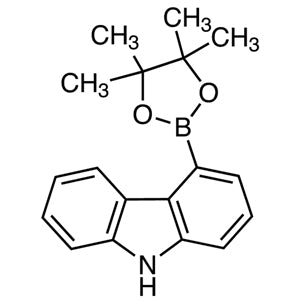
This chemical compound, 9-([1,1'-Biphenyl]-3-yl)-3-(4,4,5,5-tetramethyl-1,3,2-dioxaborolan-2-yl)-9H-carbazole, is a complex organoboron compound used extensively in organic chemistry laboratories. It plays a crucial role in various synthetic processes, particularly in the development of heterocyclic and aromatic compounds. Its unique structure, featuring a boron atom, makes it highly reactive and versatile for multiple chemical reactions. This compound is especially valuable in modern synthetic strategies where precision and efficiency are paramount.
The compound’s high reactivity is due to its organoboron functionality, which enables it to participate in a wide range of reactions, including coupling and substitution reactions. Its solubility in organic solvents such as ethyl acetate and dimethyl sulfoxide further enhances its utility in laboratory settings. These properties make it a preferred choice for chemists seeking reliable and efficient reagents for complex syntheses. Additionally, its stability under controlled conditions ensures consistent results, making it ideal for research applications requiring precision.
In Indonesian laboratories, this compound is highly relevant for organic chemistry research, particularly in pharmaceutical, material science, and environmental chemistry fields. With the growth of research institutions and industries in Indonesia, the demand for such compounds has increased. Its use in the synthesis of heterocyclic compounds is especially prominent, supporting advancements in scientific innovation and technological development.
TCI brochures (PDF)
- Carbazoles 2025-06-27 · p. 6
- Boron Compounds 2025-10-07 · p. 19
- Building Blocks for Organic Semiconductor 2026-03-24 · p. 18
Related TCI products
- TCI T3747 1255309-13-7 4-(4,4,5,5-Tetramethyl-1,3,2-dioxaborolan-2-yl)-9H-carbazole
- TCI T3612 1345614-94-9 3-(4,4,5,5-Tetramethyl-1,3,2-dioxaborolan-2-yl)-9-(p-tolyl)-9H-carbazole
- TCI T3452 785051-54-9 9-[4-(4,4,5,5-Tetramethyl-1,3,2-dioxaborolan-2-yl)phenyl]-9H-carbazole
- TCI T3441 1242412-60-7 2-(4,4,5,5-Tetramethyl-1,3,2-dioxaborolan-2-yl)-9H-carbazole
- TCI T3386 870119-58-7 9-[3-(4,4,5,5-Tetramethyl-1,3,2-dioxaborolan-2-yl)phenyl]carbazole
- TCI B5091 1391729-66-0 9-([1,1'-Biphenyl]-4-yl)-3-(4,4,5,5-tetramethyl-1,3,2-dioxaborolan-2-yl)-9H-carbazole
- Heterocyclic Compound Synthesis: This compound is ideal for creating complex ring structures due to its reactivity and solubility, making it essential for pharmaceutical research.
- Aromatic Compound Modification: Its organoboron functionality allows for efficient substitution and coupling reactions, supporting the development of aromatic derivatives.
- Suzuki-Miyaura Coupling Reactions: The compound’s structure makes it a key reagent in these reactions, which are widely used in organic synthesis for forming carbon-carbon bonds.
- Organic Material Development: It is used in the synthesis of advanced materials, contributing to innovations in polymer science and nanotechnology.
- Environmental Chemistry Research: Its role in synthetic processes aids in the development of compounds for environmental remediation and sustainable chemistry.
| Brand | TCI |
|---|---|
| CAS number | 1533406-38-0 |
| Molecular formula | — |
| Purity | — |
| Category | Chemistry > Organometallic Reagents > Organoboron [Organometallic Reagents] |
| Pack sizes | — |
| Physical form | — |
| Storage | — |
This compound should be stored in a cool, dry place away from direct sunlight and moisture. It is recommended to use airtight containers made of materials that are chemically inert, such as glass or polyethylene. Proper labeling and secure storage are essential to prevent accidental exposure. Due to its reactivity, it should be handled with appropriate personal protective equipment, including gloves and safety goggles. Regular monitoring of storage conditions ensures the compound remains stable and effective for laboratory use. Always follow standard laboratory safety protocols when working with organoboron compounds to minimize risks.
—
Produk Terkait
-
4-(4,4,5,5-Tetramethyl-1,3,2-dioxaborolan-2-yl)-9H-carbazole TCI T3747
Regular price Rp 5.246.850,00Regular priceRp 3.684.450,00Sale price Rp 5.246.850,00 -
3-(4,4,5,5-Tetramethyl-1,3,2-dioxaborolan-2-yl)-9-(p-tolyl)-9H-carbazole TCI T3612
Regular price From Rp 1.113.000,00Regular priceRp 793.800,00Sale price From Rp 1.113.000,00 -
9-[4-(4,4,5,5-Tetramethyl-1,3,2-dioxaborolan-2-yl)phenyl]-9H-carbazole TCI T3452
Regular price From Rp 1.801.800,00Regular priceRp 1.275.750,00Sale price From Rp 1.801.800,00 -
2-(4,4,5,5-Tetramethyl-1,3,2-dioxaborolan-2-yl)-9H-carbazole TCI T3441
Regular price From Rp 2.597.700,00Regular priceRp 1.832.250,00Sale price From Rp 2.597.700,00 -
9-[3-(4,4,5,5-Tetramethyl-1,3,2-dioxaborolan-2-yl)phenyl]carbazole TCI T3386
Regular price From Rp 2.013.900,00Regular priceRp 1.423.800,00Sale price From Rp 2.013.900,00 -
9-([1,1'-Biphenyl]-4-yl)-3-(4,4,5,5-tetramethyl-1,3,2-dioxaborolan-2-yl)-9H-carbazole TCI B5091
Regular price From Rp 2.411.850,00Regular priceRp 1.702.050,00Sale price From Rp 2.411.850,00 -
9-Phenyl-3-[2-(4,4,5,5-tetramethyl-1,3,2-dioxaborolan-2-yl)phenyl]-9H-carbazole TCI P2772
Regular price From Rp 1.192.800,00Regular priceRp 849.450,00Sale price From Rp 1.192.800,00 -
9-Phenyl-2,7-bis(4,4,5,5-tetramethyl-1,3,2-dioxaborolan-2-yl)-9H-carbazole TCI P2571
Regular price From Rp 1.776.600,00Regular priceRp 1.257.900,00Sale price From Rp 1.776.600,00