![1628817-49-1 9-Phenyl-3-[2-(4,4,5,5-tetramethyl-1,3,2-dioxaborolan-2-yl)phenyl]-9H-carbazole - AMI Scientific](http://amiscientific.com/cdn/shop/files/TCI2510P2772.jpg?v=1769057559&width=1946)
![1628817-49-1 9-Phenyl-3-[2-(4,4,5,5-tetramethyl-1,3,2-dioxaborolan-2-yl)phenyl]-9H-carbazole - AMI Scientific](http://amiscientific.com/cdn/shop/files/TCI2510P2772.jpg?v=1769057559&width=1445)
9-Phenyl-3-[2-(4,4,5,5-tetramethyl-1,3,2-dioxaborolan-2-yl)phenyl]-9H-carbazole is a complex organic compound widely used in laboratory settings for its unique chemical properties. This compound is a key reagent in various organic reactions, particularly in the synthesis of heterocyclic compounds and complex molecular structures. Its presence in the field of organoboron chemistry makes it a valuable tool for researchers aiming to develop new materials and pharmaceuticals. Due to its chemical structure, it plays a crucial role in catalytic processes and functional group transformations.
The compound's organoboron unit is a defining feature that enhances its reactivity and utility in coupling reactions such as the Suzuki-Miyaura reaction. This property allows it to participate in selective and efficient chemical transformations, making it a preferred choice for synthetic chemists. Its stability under certain reaction conditions ensures reliable performance, while its reactivity with halogenated compounds enables the formation of diverse molecular architectures. These characteristics make it a versatile reagent in both academic and industrial research environments.
In Indonesian laboratories, this compound is commonly used in organic chemistry research, especially in the synthesis of complex molecules and drug development. Its solubility in organic solvents and compatibility with various reaction conditions make it a practical choice for researchers. It is frequently employed in studies aimed at creating new compounds with potential applications in medicine and materials science. Its role in advancing chemical research is well established in both academic and industrial settings.
TCI brochures (PDF)
- Building Blocks for Organic Semiconductor 2026-03-24 · p. 22
Related TCI products
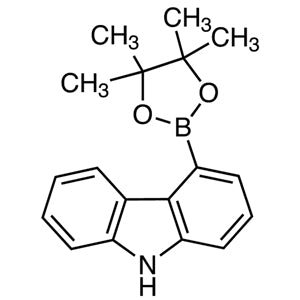
- TCI T3747 1255309-13-7 4-(4,4,5,5-Tetramethyl-1,3,2-dioxaborolan-2-yl)-9H-carbazole
- TCI T3612 1345614-94-9 3-(4,4,5,5-Tetramethyl-1,3,2-dioxaborolan-2-yl)-9-(p-tolyl)-9H-carbazole
- TCI T3452 785051-54-9 9-[4-(4,4,5,5-Tetramethyl-1,3,2-dioxaborolan-2-yl)phenyl]-9H-carbazole
- TCI T3441 1242412-60-7 2-(4,4,5,5-Tetramethyl-1,3,2-dioxaborolan-2-yl)-9H-carbazole
- TCI T3386 870119-58-7 9-[3-(4,4,5,5-Tetramethyl-1,3,2-dioxaborolan-2-yl)phenyl]carbazole
- TCI B5091 1391729-66-0 9-([1,1'-Biphenyl]-4-yl)-3-(4,4,5,5-tetramethyl-1,3,2-dioxaborolan-2-yl)-9H-carbazole
- Organic synthesis is a primary application where this compound is used to build complex molecular structures, especially in the development of pharmaceutical compounds.
- Drug development benefits from its reactivity in coupling reactions, allowing for the creation of new therapeutic agents with targeted molecular properties.
- Heterocyclic compound synthesis relies on its organoboron unit to facilitate efficient and selective chemical transformations in synthetic pathways.
- Materials science research utilizes this compound to develop novel materials with specific functional properties through controlled chemical reactions.
- Analytical chemistry applications take advantage of its solubility and reactivity for use in various spectroscopic and chromatographic analyses.
| Brand | TCI |
|---|---|
| CAS number | 1628817-49-1 |
| Molecular formula | — |
| Purity | — |
| Category | Chemistry > Organometallic Reagents > Organoboron [Organometallic Reagents] |
| Pack sizes | — |
| Physical form | — |
| Storage | Store in a cool, dry place away from moisture and direct sunlight |
This compound should be stored in a cool, dry environment to maintain its chemical integrity and prevent degradation. It is recommended to use airtight containers to protect it from moisture and air exposure. Due to its reactivity, it should be handled with care in a well-ventilated laboratory setting. Avoid contact with incompatible substances such as strong oxidizing agents. Proper personal protective equipment, including gloves and safety goggles, should be worn during handling. The compound is best stored in a sealed container to ensure long-term stability and usability in research applications.
—
Produk Terkait
-
4-(4,4,5,5-Tetramethyl-1,3,2-dioxaborolan-2-yl)-9H-carbazole TCI T3747
Regular price Rp 5.194.350,00Regular price -
3-(4,4,5,5-Tetramethyl-1,3,2-dioxaborolan-2-yl)-9-(p-tolyl)-9H-carbazole TCI T3612
Regular price From Rp 1.060.500,00Regular price -
9-[4-(4,4,5,5-Tetramethyl-1,3,2-dioxaborolan-2-yl)phenyl]-9H-carbazole TCI T3452
Regular price From Rp 1.749.300,00Regular price -
2-(4,4,5,5-Tetramethyl-1,3,2-dioxaborolan-2-yl)-9H-carbazole TCI T3441
Regular price From Rp 2.545.200,00Regular price -
9-[3-(4,4,5,5-Tetramethyl-1,3,2-dioxaborolan-2-yl)phenyl]carbazole TCI T3386
Regular price From Rp 1.961.400,00Regular price -
9-([1,1'-Biphenyl]-4-yl)-3-(4,4,5,5-tetramethyl-1,3,2-dioxaborolan-2-yl)-9H-carbazole TCI B5091
Regular price From Rp 2.359.350,00Regular price -
9-([1,1'-Biphenyl]-3-yl)-3-(4,4,5,5-tetramethyl-1,3,2-dioxaborolan-2-yl)-9H-carbazole TCI B5054
Regular price From Rp 769.650,00Regular price -
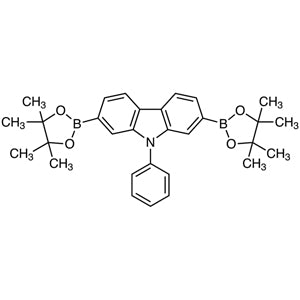
9-Phenyl-2,7-bis(4,4,5,5-tetramethyl-1,3,2-dioxaborolan-2-yl)-9H-carbazole TCI P2571
Regular price From Rp 1.724.100,00Regular price

![785051-54-9 9-[4-(4,4,5,5-Tetramethyl-1,3,2-dioxaborolan-2-yl)phenyl]-9H-carbazole - AMI Scientific](http://amiscientific.com/cdn/shop/files/TCI2510T3452.jpg?v=1769143736&width=533)

![870119-58-7 9-[3-(4,4,5,5-Tetramethyl-1,3,2-dioxaborolan-2-yl)phenyl]carbazole - AMI Scientific](http://amiscientific.com/cdn/shop/files/TCI2510T3386.jpg?v=1769143726&width=533)
![1391729-66-0 9-([1,1'-Biphenyl]-4-yl)-3-(4,4,5,5-tetramethyl-1,3,2-dioxaborolan-2-yl)-9H-carbazole - AMI Scientific](http://amiscientific.com/cdn/shop/files/TCI2510B5091.jpg?v=1769180123&width=533)
![1533406-38-0 9-([1,1'-Biphenyl]-3-yl)-3-(4,4,5,5-tetramethyl-1,3,2-dioxaborolan-2-yl)-9H-carbazole - AMI Scientific](http://amiscientific.com/cdn/shop/files/TCI2510B5054.jpg?v=1769055853&width=533)
![1533406-38-0 9-([1,1'-Biphenyl]-3-yl)-3-(4,4,5,5-tetramethyl-1,3,2-dioxaborolan-2-yl)-9H-carbazole - AMI Scientific](http://amiscientific.com/cdn/shop/files/TCI2510B5054_956311a4-4a22-40ff-ad97-e0eb025c60b9.jpg?v=1769145376&width=533)