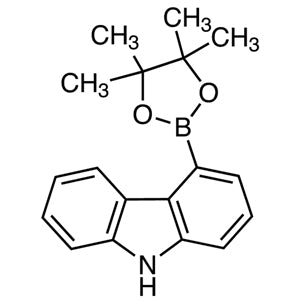
This chemical compound, 9-([1,1'-Biphenyl]-4-yl)-3-(4,4,5,5-tetramethyl-1,3,2-dioxaborolan-2-yl)-9H-carbazole, is a complex organoboron compound widely used in organic chemistry laboratories. It serves as a key reagent in various synthetic processes, particularly in the development of heterocyclic and aromatic compounds. Its unique structure enables it to participate in important reactions such as the Suzuki-Miyaura coupling and other cross-coupling reactions, which are essential in modern synthetic chemistry. Due to its reactivity and versatility, it is a valuable tool for researchers aiming to create new molecular structures with specific functional groups.
The compound's organoboron nature makes it a preferred choice for its ability to form stable intermediates in reaction pathways. Its molecular structure allows for strong interactions with aromatic systems, enhancing the efficiency of synthetic transformations. Additionally, its stability under certain conditions ensures that it remains effective even after multiple uses in laboratory settings. These properties make it an essential component in the synthesis of pharmaceuticals, materials, and other advanced chemical products.
In Indonesian laboratories, this compound is commonly used in academic and research institutions for the synthesis of complex organic molecules. It plays a crucial role in the development of new compounds with applications in pharmaceuticals, materials science, and industrial chemistry. Its reliability and performance make it a standard reagent in both teaching and research environments, supporting the advancement of chemical knowledge and innovation.
TCI brochures (PDF)
- Carbazoles 2025-06-27 · p. 6
- Boron Compounds 2025-10-07 · p. 18
- Building Blocks for Organic Semiconductor 2026-03-24 · p. 18
Related TCI products
- TCI T3747 1255309-13-7 4-(4,4,5,5-Tetramethyl-1,3,2-dioxaborolan-2-yl)-9H-carbazole
- TCI T3612 1345614-94-9 3-(4,4,5,5-Tetramethyl-1,3,2-dioxaborolan-2-yl)-9-(p-tolyl)-9H-carbazole
- TCI T3452 785051-54-9 9-[4-(4,4,5,5-Tetramethyl-1,3,2-dioxaborolan-2-yl)phenyl]-9H-carbazole
- TCI T3441 1242412-60-7 2-(4,4,5,5-Tetramethyl-1,3,2-dioxaborolan-2-yl)-9H-carbazole
- TCI T3386 870119-58-7 9-[3-(4,4,5,5-Tetramethyl-1,3,2-dioxaborolan-2-yl)phenyl]carbazole
- TCI B5054 1533406-38-0 9-([1,1'-Biphenyl]-3-yl)-3-(4,4,5,5-tetramethyl-1,3,2-dioxaborolan-2-yl)-9H-carbazole
- Synthesis of Heterocyclic Compounds: This compound is ideal for creating complex ring structures due to its ability to undergo coupling reactions with aromatic systems.
- Cross-Coupling Reactions: Its organoboron functionality makes it suitable for Suzuki-Miyaura and other coupling reactions that require high reactivity.
- Pharmaceutical Research: It is frequently used in the development of new drug molecules due to its capacity to form stable intermediates in synthetic pathways.
- Material Science Applications: The compound is employed in the synthesis of advanced materials, including polymers and functional coatings, due to its reactivity and structural versatility.
- Organic Chemistry Education: It is a valuable teaching tool in Indonesian universities for demonstrating the principles of organoboron chemistry and synthetic methodologies.
| Brand | TCI |
|---|---|
| CAS number | 1391729-66-0 |
| Molecular formula | — |
| Purity | — |
| Category | Chemistry > Organometallic Reagents > Organoboron [Organometallic Reagents] |
| Pack sizes | Available in various quantities as per standard laboratory supply |
| Physical form | Solid powder |
| Storage | Store in a cool, dry place away from moisture and direct light |
This compound should be stored in a cool, dry environment, away from moisture and direct sunlight to maintain its stability and reactivity. It is recommended to use airtight containers made of glass or polyethylene to prevent contamination and degradation. Due to its organoboron nature, it should be handled with care, using appropriate personal protective equipment such as gloves and safety goggles. Avoid exposure to strong oxidizing agents to prevent unwanted side reactions. In laboratory settings, it should be stored in a designated chemical storage area that is properly ventilated and accessible only to authorized personnel. Proper labeling and documentation are essential to ensure safe handling and usage.
—
Produk Terkait
-
4-(4,4,5,5-Tetramethyl-1,3,2-dioxaborolan-2-yl)-9H-carbazole TCI T3747
Regular price Rp 5.246.850,00Regular priceRp 3.684.450,00Sale price Rp 5.246.850,00 -
3-(4,4,5,5-Tetramethyl-1,3,2-dioxaborolan-2-yl)-9-(p-tolyl)-9H-carbazole TCI T3612
Regular price From Rp 1.113.000,00Regular priceRp 793.800,00Sale price From Rp 1.113.000,00 -
9-[4-(4,4,5,5-Tetramethyl-1,3,2-dioxaborolan-2-yl)phenyl]-9H-carbazole TCI T3452
Regular price From Rp 1.801.800,00Regular priceRp 1.275.750,00Sale price From Rp 1.801.800,00 -
2-(4,4,5,5-Tetramethyl-1,3,2-dioxaborolan-2-yl)-9H-carbazole TCI T3441
Regular price From Rp 2.597.700,00Regular priceRp 1.832.250,00Sale price From Rp 2.597.700,00 -
9-[3-(4,4,5,5-Tetramethyl-1,3,2-dioxaborolan-2-yl)phenyl]carbazole TCI T3386
Regular price From Rp 2.013.900,00Regular priceRp 1.423.800,00Sale price From Rp 2.013.900,00 -
9-([1,1'-Biphenyl]-3-yl)-3-(4,4,5,5-tetramethyl-1,3,2-dioxaborolan-2-yl)-9H-carbazole TCI B5054
Regular price From Rp 822.150,00Regular priceRp 590.100,00Sale price From Rp 822.150,00 -
9-Phenyl-3-[2-(4,4,5,5-tetramethyl-1,3,2-dioxaborolan-2-yl)phenyl]-9H-carbazole TCI P2772
Regular price From Rp 1.192.800,00Regular priceRp 849.450,00Sale price From Rp 1.192.800,00 -
9-Phenyl-2,7-bis(4,4,5,5-tetramethyl-1,3,2-dioxaborolan-2-yl)-9H-carbazole TCI P2571
Regular price From Rp 1.776.600,00Regular priceRp 1.257.900,00Sale price From Rp 1.776.600,00