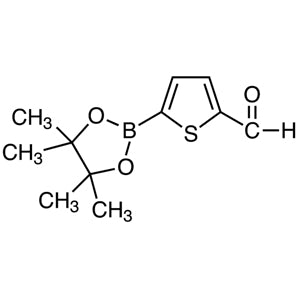
2-Phenyl-5-(4,4,5,5-tetramethyl-1,3,2-dioxaborolan-2-yl)pyridine from TCI is the boronic acid pinacol ester of 2-phenylpyridine, with the boron group at the 5-position of the pyridine ring. It is an organoboron reagent for Suzuki–Miyaura cross-coupling. In the laboratory, it lets researchers attach a 2-phenylpyridine fragment to a wide range of aryl or heteroaryl halides. 2-Phenylpyridine is widely known as a cyclometalating ligand in luminescent iridium and platinum complexes, so this reagent is a direct way to build or modify that type of ligand.
Researchers choose this reagent because it combines two functions in one molecule. The first is the pinacol boronate ester, a group that is generally stable and easy to handle. The second is the 2-phenylpyridine motif, which can coordinate to transition metals through the nitrogen atom and the ortho carbon of the phenyl ring. Coupling at the 5-position extends the ligand's conjugation without disturbing the coordination site, so researchers can tune the emission colour and solubility of the resulting complexes. Pyridine biaryl fragments are also common in medicinal chemistry, which makes this reagent useful outside coordination chemistry as well.
In Indonesia, this reagent is relevant to inorganic, organometallic, organic synthesis, and materials chemistry laboratories that study luminescent complexes, photocatalysts, and OLED materials. University research groups working on cyclometalated iridium or platinum complexes can use it to make ligand variants with extended conjugation. Synthetic laboratories can use it to build pyridine-containing biaryl scaffolds through standard palladium-catalysed cross-coupling. Because the boron group is supplied as a pinacol ester, it fits easily into established Suzuki–Miyaura procedures used in teaching and research laboratories across the country.
TCI brochures (PDF)
- Ligands 2025-12-01 · p. 16
- Boron Compounds 2025-10-07 · p. 19
- Building Blocks for Organic Semiconductor 2026-03-24 · p. 16
Related TCI products
- TCI T3400 1009033-87-7 4-[4-(4,4,5,5-Tetramethyl-1,3,2-dioxaborolan-2-yl)phenyl]pyridine
- TCI T3399 1009033-83-3 4-[3-(4,4,5,5-Tetramethyl-1,3,2-dioxaborolan-2-yl)phenyl]pyridine
- TCI T3313 939430-30-5 3-[3-(4,4,5,5-Tetramethyl-1,3,2-dioxaborolan-2-yl)phenyl]pyridine
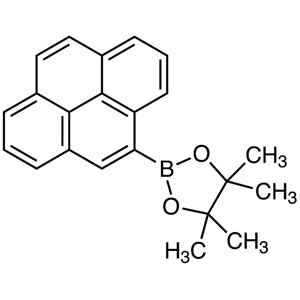
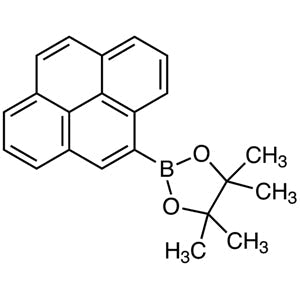
- TCI T3857 888950-09-2 4-(4,4,5,5-Tetramethyl-1,3,2-dioxaborolan-2-yl)pyrene
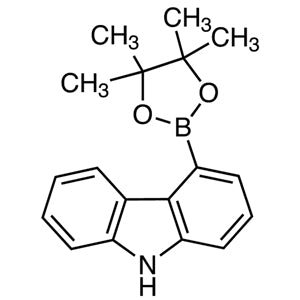
- TCI T3747 1255309-13-7 4-(4,4,5,5-Tetramethyl-1,3,2-dioxaborolan-2-yl)-9H-carbazole
- TCI T3612 1345614-94-9 3-(4,4,5,5-Tetramethyl-1,3,2-dioxaborolan-2-yl)-9-(p-tolyl)-9H-carbazole
- Suzuki–Miyaura cross-coupling: the pinacol boronate ester at the pyridine 5-position couples with aryl or heteroaryl halides to install a 2-phenylpyridine fragment on the target molecule.
- Cyclometalating ligand synthesis: the 2-phenylpyridine core coordinates through nitrogen and the ortho phenyl carbon, so coupled products serve directly as ligands for iridium and platinum complexes.
- Tuning luminescent complexes: coupling at the 5-position extends conjugation without disturbing the coordination site, which helps researchers adjust the emission colour and solubility of the final complexes.
- Photocatalyst and OLED material research: the reagent gives access to modified 2-phenylpyridine ligands of the kind used in luminescent metal complexes studied as photocatalysts and OLED emitters.
- Medicinal chemistry scaffold building: pyridine biaryl fragments are common in medicinal chemistry, and this boronate ester offers a convenient route to such biaryl structures by cross-coupling.
| Brand | TCI (product code P2384) |
|---|---|
| CAS number | 879291-27-7 |
| Molecular formula | — |
| Purity | — |
| Category | Chemistry > Organometallic Reagents > Organoboron [Organometallic Reagents] |
| Pack sizes | as listed in the current TCI catalogue for this product code |
| Physical form | — |
| Storage | follow the conditions on the TCI label and Safety Data Sheet |
- Chemical type: boronic acid pinacol ester of 2-phenylpyridine (boron at the pyridine 5-position)
Store the reagent in its original, tightly closed manufacturer container in a cool, dry place, away from moisture and direct light, and follow the storage temperature stated on the TCI label and Safety Data Sheet. Pinacol boronate esters are generally stable, but you should still keep exposure to air and humidity to a minimum. Reseal the container promptly after each use. Handle the material in a well-ventilated area or fume hood, and wear suitable gloves, safety glasses, and a lab coat. Avoid creating dust and avoid contact with skin, eyes, and clothing. Read the Safety Data Sheet before use, and dispose of residues and contaminated materials according to institutional and local chemical waste rules.
—
Product Categories
Produk Terkait
-
4-[4-(4,4,5,5-Tetramethyl-1,3,2-dioxaborolan-2-yl)phenyl]pyridine TCI T3400
Regular price From Rp 1.565.550,00Regular price -
4-[3-(4,4,5,5-Tetramethyl-1,3,2-dioxaborolan-2-yl)phenyl]pyridine TCI T3399
Regular price From Rp 1.908.900,00Regular price -
3-[3-(4,4,5,5-Tetramethyl-1,3,2-dioxaborolan-2-yl)phenyl]pyridine TCI T3313
Regular price From Rp 4.982.250,00Regular price -
4-(4,4,5,5-Tetramethyl-1,3,2-dioxaborolan-2-yl)pyrene TCI T3857
Regular price Rp 4.399.500,00Regular price -
4-(4,4,5,5-Tetramethyl-1,3,2-dioxaborolan-2-yl)-9H-carbazole TCI T3747
Regular price Rp 5.194.350,00Regular price -
3-(4,4,5,5-Tetramethyl-1,3,2-dioxaborolan-2-yl)-9-(p-tolyl)-9H-carbazole TCI T3612
Regular price From Rp 1.060.500,00Regular price -
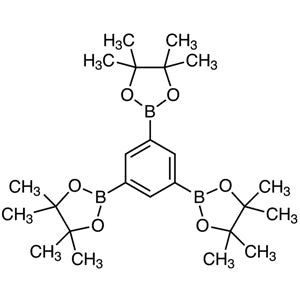
1,3,5-Tris(4,4,5,5-tetramethyl-1,3,2-dioxaborolan-2-yl)benzene TCI T3515
Regular price From Rp 2.279.550,00Regular price -
5-(4,4,5,5-Tetramethyl-1,3,2-dioxaborolan-2-yl)thiophene-2-carboxaldehyde TCI T3485
Regular price Rp 1.961.400,00Regular price
![1009033-87-7 4-[4-(4,4,5,5-Tetramethyl-1,3,2-dioxaborolan-2-yl)phenyl]pyridine - AMI Scientific](http://amiscientific.com/cdn/shop/files/TCI2510T3400.jpg?v=1769143727&width=533)
![1009033-83-3 4-[3-(4,4,5,5-Tetramethyl-1,3,2-dioxaborolan-2-yl)phenyl]pyridine - AMI Scientific](http://amiscientific.com/cdn/shop/files/TCI2510T3399.jpg?v=1769058221&width=533)
![939430-30-5 3-[3-(4,4,5,5-Tetramethyl-1,3,2-dioxaborolan-2-yl)phenyl]pyridine - AMI Scientific](http://amiscientific.com/cdn/shop/files/TCI2510T3313.jpg?v=1769058203&width=533)