


TCI P2401 3-Phenyl-9H-carbazole is a carbazole derivative that carries a phenyl substituent at the 3-position and keeps a free NH group at the 9-position. Carbazole is an electron-rich tricyclic aromatic system and forms the backbone of many organic semiconductor materials. In materials science laboratories, this compound is used as a small-molecule semiconductor building block. It is especially useful for synthesizing host materials, hole-transport materials and emitter components for OLEDs and other organic optoelectronic devices.
Researchers choose carbazole-based building blocks because carbazole is a good electron donor, conducts holes well and has high thermal and chemical stability. The phenyl group at the 3-position extends the conjugated system. It can also change frontier orbital energy levels, film morphology and intermolecular interactions in the final material. The free NH group at the 9-position is a useful point for functionalization. It can be arylated through Buchwald–Hartwig or Ullmann coupling, or it can be alkylated. This lets researchers build donor–acceptor molecules or host materials with structures designed for a specific purpose.
In Indonesian laboratories, this compound is mainly used in organic electronics, OLED and photovoltaic materials research at universities, research institutes and industrial R&D groups. Synthetic chemists use it as an intermediate in multistep routes toward functional carbazole-based molecules. Materials scientists then evaluate the photophysical, electrochemical and thermal behaviour of the resulting products. It suits academic thesis projects, collaborative device research and early-stage materials development that needs a reliable, well-defined carbazole scaffold.
TCI brochures (PDF)
- Building Blocks for Organic Semiconductor 2026-03-24 · p. 22
Related TCI products
- TCI T3882 6558-85-6 1,3,6,8-Tetramethyl-9H-carbazole
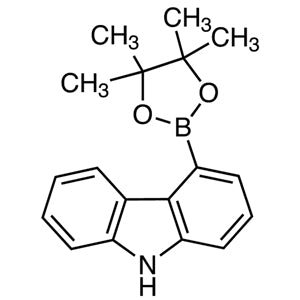
- TCI T3747 1255309-13-7 4-(4,4,5,5-Tetramethyl-1,3,2-dioxaborolan-2-yl)-9H-carbazole
- TCI T3642 1630723-98-6 N,N,N',N'-Tetrakis(4-methoxyphenyl)-9H-carbazole-3,6-diamine
- TCI T3612 1345614-94-9 3-(4,4,5,5-Tetramethyl-1,3,2-dioxaborolan-2-yl)-9-(p-tolyl)-9H-carbazole
- TCI T3452 785051-54-9 9-[4-(4,4,5,5-Tetramethyl-1,3,2-dioxaborolan-2-yl)phenyl]-9H-carbazole
- TCI T3441 1242412-60-7 2-(4,4,5,5-Tetramethyl-1,3,2-dioxaborolan-2-yl)-9H-carbazole
- OLED host material synthesis: the carbazole core offers high thermal stability and good hole-transport character, both of which matter in host matrices for emissive layers in organic light-emitting diodes.
- Hole-transport material development: carbazole is electron-rich and conducts holes efficiently, so this building block is a good starting point for hole-transport layers in OLEDs and other organic devices.
- Donor–acceptor molecule design: the free NH at the 9-position can be arylated or alkylated, so researchers can attach acceptor units and build tailored donor–acceptor architectures for emitters.
- N-functionalization studies with Buchwald–Hartwig or Ullmann coupling: the reactive NH group makes this compound a practical substrate for C–N bond formation and for methodology work on coupling reactions.
- Organic photovoltaic and optoelectronic research: the extended conjugation from the 3-phenyl group affects energy levels and film morphology, which makes the compound relevant to designing new organic semiconductor materials.
| Brand | TCI (product code P2401) |
|---|---|
| CAS number | 103012-26-6 |
| Molecular formula | — |
| Purity | — |
| Category | Materials Science > Material Building Blocks > Small Molecule Semiconductor Building Blocks |
| Pack sizes | available in the pack sizes listed on the product page; please check with our team for current options |
| Physical form | see the TCI product label, Certificate of Analysis and Safety Data Sheet for exact physical form and recommended storage conditions |
| Storage | — |
- Chemical name: 3-Phenyl-9H-carbazole
Keep 3-Phenyl-9H-carbazole in its original, tightly closed manufacturer container in a cool, dry, well-ventilated place, away from direct sunlight, heat sources and strong oxidizing agents. Always follow the storage conditions on the TCI label and Safety Data Sheet. When handling the compound, wear standard personal protective equipment: a laboratory coat, safety glasses and chemical-resistant gloves. Weigh and transfer the material in a fume hood or another well-ventilated area to avoid inhaling dust. Use clean, dry spatulas and glassware to prevent contamination. Close containers again right after use to protect the material from moisture and air, and dispose of waste according to local regulations and institutional safety procedures.
—
Produk Terkait
-
1,3,6,8-Tetramethyl-9H-carbazole TCI T3882
Regular price From Rp 4.056.150,00Regular price -
4-(4,4,5,5-Tetramethyl-1,3,2-dioxaborolan-2-yl)-9H-carbazole TCI T3747
Regular price Rp 5.194.350,00Regular price -
N,N,N',N'-Tetrakis(4-methoxyphenyl)-9H-carbazole-3,6-diamine TCI T3642
Regular price From Rp 9.726.150,00Regular price -
3-(4,4,5,5-Tetramethyl-1,3,2-dioxaborolan-2-yl)-9-(p-tolyl)-9H-carbazole TCI T3612
Regular price From Rp 1.060.500,00Regular price -
9-[4-(4,4,5,5-Tetramethyl-1,3,2-dioxaborolan-2-yl)phenyl]-9H-carbazole TCI T3452
Regular price From Rp 1.749.300,00Regular price -
2-(4,4,5,5-Tetramethyl-1,3,2-dioxaborolan-2-yl)-9H-carbazole TCI T3441
Regular price From Rp 2.545.200,00Regular price -
9-[3-(4,4,5,5-Tetramethyl-1,3,2-dioxaborolan-2-yl)phenyl]carbazole TCI T3386
Regular price From Rp 1.961.400,00Regular price -
9,9'-(5-Bromo-1,3-phenylene)bis(9H-carbazole) TCI B5502
Regular price From Rp 2.782.500,00Regular price



![785051-54-9 9-[4-(4,4,5,5-Tetramethyl-1,3,2-dioxaborolan-2-yl)phenyl]-9H-carbazole - AMI Scientific](http://amiscientific.com/cdn/shop/files/TCI2510T3452.jpg?v=1769143736&width=533)

![870119-58-7 9-[3-(4,4,5,5-Tetramethyl-1,3,2-dioxaborolan-2-yl)phenyl]carbazole - AMI Scientific](http://amiscientific.com/cdn/shop/files/TCI2510T3386.jpg?v=1769143726&width=533)
