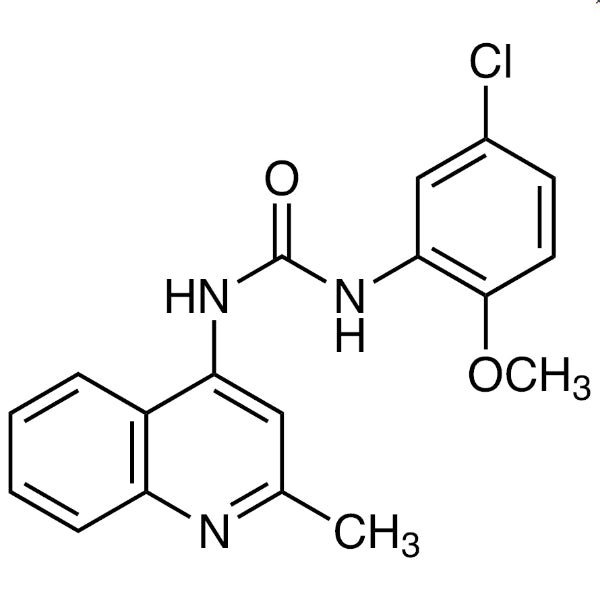
PQ401 from TCI is a small-molecule compound of the diarylurea class, known in the scientific literature as an inhibitor of the insulin-like growth factor 1 receptor (IGF-1R). In cancer research laboratories, it is used to inhibit IGF-1R autophosphorylation, which suppresses signaling pathways that support tumor cell growth and survival. This makes PQ401 a valuable tool for understanding how the IGF-1 axis contributes to cancer development. The product is intended for experimental research use only and is not for diagnostic or therapeutic applications.
Researchers choose PQ401 because it has been reported to inhibit proliferation and induce apoptosis in various cancer cell models, such as breast cancer cells, in in vitro studies. Its diarylurea structure is also of interest in medicinal chemistry, because this motif is common among kinase inhibitors. With PQ401, researchers can compare the effects of IGF-1R inhibition with the inhibition of other growth pathways, such as EGFR or the PI3K/Akt pathway, which gives a more complete picture of cellular signaling networks. Supply from the TCI brand also supports consistent results across experimental series.
In Indonesia, PQ401 is relevant to molecular oncology, cell biology, and pharmacology laboratories at universities, research institutes, and biomedical research centers. Typical users include academic research groups studying growth factor signaling, graduate students running cancer cell line experiments, and teams screening compounds that target receptor tyrosine kinases. It fits well into projects on mechanisms of tumor cell survival, comparative studies of pathway inhibitors, and preliminary in vitro work that supports wider cancer biology research programs across the country.
- IGF-1R signaling studies: PQ401 inhibits IGF-1R autophosphorylation, so researchers can study how blocking this receptor affects downstream signaling that drives tumor cell growth and survival.
- Cancer cell proliferation assays: PQ401 has been reported to inhibit proliferation in cancer cell models such as breast cancer cells, so it works as a reference inhibitor in in vitro growth studies.
- Apoptosis research: Because PQ401 has been reported to induce apoptosis in cancer cell models, it is useful for studying how IGF-1 axis inhibition affects programmed cell death.
- Comparative pathway inhibition studies: Researchers can compare IGF-1R inhibition by PQ401 with EGFR or PI3K/Akt pathway inhibition to build a more complete map of cellular signaling networks.
- Medicinal chemistry and kinase inhibitor research: The diarylurea scaffold of PQ401 is a motif common to many kinase inhibitors, so it is a useful reference structure for structure-activity investigations.
| Brand | TCI (product code P2479) |
|---|---|
| CAS number | 196868-63-0 |
| Molecular formula | — |
| Purity | — |
| Category | Life Science > Cell Biology > Cancer Research |
| Pack sizes | as offered by TCI for product P2479; please ask our team about available sizes |
| Physical form | please refer to the TCI product documentation and certificate of analysis |
| Storage | follow the storage conditions on the TCI label and Safety Data Sheet |
Store PQ401 in its original, tightly closed container, in the conditions stated on the TCI label and Safety Data Sheet. Keep it in a cool, dry, well-ventilated area, away from direct light, moisture, and incompatible materials. After preparing stock solutions, store them in suitable sealed vials with clear labels, and avoid repeated freeze-thaw cycles where possible. Handle the compound in a fume hood or another well-ventilated workspace, and wear standard personal protective equipment, including a lab coat, gloves, and safety glasses. Avoid inhaling dust and avoid contact with skin and eyes. Dispose of waste according to institutional and local chemical waste regulations. This product is for research use only.
—
Produk Terkait
-
TCI B5774 5,10-Bis(4,4,5,5-tetramethyl-1,3,2-dioxaborolan-2-yl)naphtho[1,2-c:5,6-c']bis([1,2,5]oxadiazole)
Regular price Rp 10.255.350,00Regular price -
Dihydroiodide TCI B6569
Regular price From Rp 1.936.200,00Regular price -
Trifluoromethanesulfonate TCI B7003
Regular price From Rp 1.936.200,00Regular price
![5,10-Bis(4,4,5,5-tetramethyl-1,3,2-dioxaborolan-2-yl)naphtho[1,2-c:5,6-c']bis([1,2,5]oxadiazole) - TCI B5774 - AMI Scientific](http://amiscientific.com/cdn/shop/files/TCI2510B5774.jpg?v=1769180228&width=533)