
![1219956-30-5 9-Phenyl-3-[4-(4,4,5,5-tetramethyl-1,3,2-dioxaborolan-2-yl)phenyl]-9H-carbazole - AMI Scientific](http://amiscientific.com/cdn/shop/files/TCI2510P2561.jpg?v=1768206172&width=1946)
![1219956-30-5 9-Phenyl-3-[4-(4,4,5,5-tetramethyl-1,3,2-dioxaborolan-2-yl)phenyl]-9H-carbazole - AMI Scientific](http://amiscientific.com/cdn/shop/files/TCI2510P2561.jpg?v=1768206172&width=1445)
9-Phenyl-3-[4-(4,4,5,5-tetramethyl-1,3,2-dioxaborolan-2-yl)phenyl]-9H-carbazole is a complex organoboron compound widely used in chemical laboratories for its reactivity and versatility. This compound is a key reagent in various synthetic processes, especially in the field of organic chemistry. Its unique molecular structure, featuring a boronic acid group, makes it an essential component in coupling reactions such as the Suzuki and Stille reactions. These reactions are fundamental in the synthesis of complex organic molecules, which are often used in pharmaceutical and materials science research.
The compound’s organoboron functionality provides high reactivity, particularly in reactions involving transition metal activation. Its stability under certain conditions allows for controlled chemical transformations, making it a preferred choice for precise synthetic applications. The presence of the boron group enables the formation of diverse molecular architectures, which are critical in developing new drugs and advanced materials. Its chemical stability and reactivity make it a reliable and efficient reagent for researchers aiming at high-precision synthesis.
In Indonesian laboratories, this compound is extensively used in organic chemistry research, especially in the development of pharmaceutical compounds and innovative materials. Its complex structure and reactivity make it a valuable tool for scientists working on drug discovery and material synthesis. The compound’s role in creating structurally specific molecules supports its application in both academic and industrial research settings. Its use is widespread due to its effectiveness in achieving desired chemical outcomes with high accuracy.
TCI brochures (PDF)
- Boron Compounds 2025-10-07 · p. 17
- Building Blocks for Organic Semiconductor 2026-03-24 · p. 22
Related TCI products
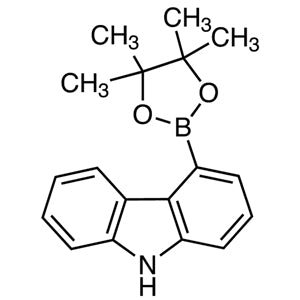
- TCI T3747 1255309-13-7 4-(4,4,5,5-Tetramethyl-1,3,2-dioxaborolan-2-yl)-9H-carbazole
- TCI T3612 1345614-94-9 3-(4,4,5,5-Tetramethyl-1,3,2-dioxaborolan-2-yl)-9-(p-tolyl)-9H-carbazole
- TCI T3452 785051-54-9 9-[4-(4,4,5,5-Tetramethyl-1,3,2-dioxaborolan-2-yl)phenyl]-9H-carbazole
- TCI T3441 1242412-60-7 2-(4,4,5,5-Tetramethyl-1,3,2-dioxaborolan-2-yl)-9H-carbazole
- TCI T3386 870119-58-7 9-[3-(4,4,5,5-Tetramethyl-1,3,2-dioxaborolan-2-yl)phenyl]carbazole
- TCI B5091 1391729-66-0 9-([1,1'-Biphenyl]-4-yl)-3-(4,4,5,5-tetramethyl-1,3,2-dioxaborolan-2-yl)-9H-carbazole
- Organic synthesis applications benefit from this compound’s reactivity in coupling reactions, enabling the formation of complex molecular structures with high precision.
- Pharmaceutical research utilizes this compound for the synthesis of drug molecules, leveraging its boronic acid functionality for efficient cross-coupling reactions.
- Material science applications rely on its ability to form stable and functional molecular frameworks, supporting the development of advanced polymers and nanomaterials.
- Academic research in chemistry uses it as a key reagent for exploring new synthetic pathways and understanding reaction mechanisms in organoboron chemistry.
- Industrial chemical processes incorporate it for the production of specialty chemicals, where its reactivity and stability contribute to scalable and efficient synthesis protocols.
| Brand | TCI |
|---|---|
| CAS number | 1219956-30-5 |
| Molecular formula | — |
| Purity | — |
| Category | Chemistry > Organometallic Reagents > Organoboron [Organometallic Reagents] |
| Pack sizes | Available in various quantities as per supplier specifications |
| Physical form | Solid (exact form may vary depending on supplier) |
| Storage | Store in a cool, dry place away from moisture and direct sunlight |
This compound should be stored in a cool, dry environment, away from moisture and direct sunlight to maintain its chemical stability. It is recommended to use airtight containers made of glass or polyethylene to prevent exposure to air and moisture. Due to its reactivity, it should be handled in a well-ventilated area, preferably under a fume hood, to minimize exposure. Laboratory personnel should wear appropriate personal protective equipment, including gloves and safety goggles, when handling the compound. Proper disposal should follow standard chemical waste protocols to ensure environmental safety. The compound is not inherently hazardous under normal storage conditions but requires careful handling to maintain its effectiveness and safety in laboratory settings.
—
Produk Terkait
-
4-(4,4,5,5-Tetramethyl-1,3,2-dioxaborolan-2-yl)-9H-carbazole TCI T3747
Regular price Rp 5.194.350,00Regular price -
3-(4,4,5,5-Tetramethyl-1,3,2-dioxaborolan-2-yl)-9-(p-tolyl)-9H-carbazole TCI T3612
Regular price From Rp 1.060.500,00Regular price -
9-[4-(4,4,5,5-Tetramethyl-1,3,2-dioxaborolan-2-yl)phenyl]-9H-carbazole TCI T3452
Regular price From Rp 1.749.300,00Regular price -
2-(4,4,5,5-Tetramethyl-1,3,2-dioxaborolan-2-yl)-9H-carbazole TCI T3441
Regular price From Rp 2.545.200,00Regular price -
9-[3-(4,4,5,5-Tetramethyl-1,3,2-dioxaborolan-2-yl)phenyl]carbazole TCI T3386
Regular price From Rp 1.961.400,00Regular price -
9-([1,1'-Biphenyl]-4-yl)-3-(4,4,5,5-tetramethyl-1,3,2-dioxaborolan-2-yl)-9H-carbazole TCI B5091
Regular price From Rp 2.359.350,00Regular price -
9-([1,1'-Biphenyl]-3-yl)-3-(4,4,5,5-tetramethyl-1,3,2-dioxaborolan-2-yl)-9H-carbazole TCI B5054
Regular price From Rp 769.650,00Regular price -
9-Phenyl-3-[2-(4,4,5,5-tetramethyl-1,3,2-dioxaborolan-2-yl)phenyl]-9H-carbazole TCI P2772
Regular price From Rp 1.140.300,00Regular price

![785051-54-9 9-[4-(4,4,5,5-Tetramethyl-1,3,2-dioxaborolan-2-yl)phenyl]-9H-carbazole - AMI Scientific](http://amiscientific.com/cdn/shop/files/TCI2510T3452.jpg?v=1769143736&width=533)

![870119-58-7 9-[3-(4,4,5,5-Tetramethyl-1,3,2-dioxaborolan-2-yl)phenyl]carbazole - AMI Scientific](http://amiscientific.com/cdn/shop/files/TCI2510T3386.jpg?v=1769143726&width=533)
![1391729-66-0 9-([1,1'-Biphenyl]-4-yl)-3-(4,4,5,5-tetramethyl-1,3,2-dioxaborolan-2-yl)-9H-carbazole - AMI Scientific](http://amiscientific.com/cdn/shop/files/TCI2510B5091.jpg?v=1769180123&width=533)
![1533406-38-0 9-([1,1'-Biphenyl]-3-yl)-3-(4,4,5,5-tetramethyl-1,3,2-dioxaborolan-2-yl)-9H-carbazole - AMI Scientific](http://amiscientific.com/cdn/shop/files/TCI2510B5054.jpg?v=1769055853&width=533)
![1533406-38-0 9-([1,1'-Biphenyl]-3-yl)-3-(4,4,5,5-tetramethyl-1,3,2-dioxaborolan-2-yl)-9H-carbazole - AMI Scientific](http://amiscientific.com/cdn/shop/files/TCI2510B5054_956311a4-4a22-40ff-ad97-e0eb025c60b9.jpg?v=1769145376&width=533)
![1628817-49-1 9-Phenyl-3-[2-(4,4,5,5-tetramethyl-1,3,2-dioxaborolan-2-yl)phenyl]-9H-carbazole - AMI Scientific](http://amiscientific.com/cdn/shop/files/TCI2510P2772.jpg?v=1769057559&width=533)