

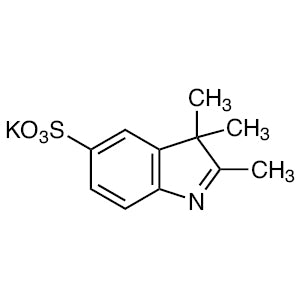
Potassium 2,3,3-trimethyl-3H-indole-5-sulfonate is the potassium salt of an indolenine derivative with a sulfonate group at the 5-position of the aromatic ring. TCI supplies it under product code P2824 as a heterocyclic building block. In the laboratory, it is best known as a key precursor for water-soluble cyanine dyes, a family of fluorescent dyes widely used to label biomolecules. The 2-methyl group of the indolenine is the reactive site. After the ring nitrogen is quaternized, this methyl group can take part in condensation reactions that build the polymethine chain characteristic of cyanine dyes.
What sets this compound apart is its sulfonate group, which makes the finished dye soluble in water. Cyanine dyes without sulfonation tend to aggregate in aqueous solution. This aggregation lowers fluorescence intensity and makes conjugation to proteins or nucleic acids more difficult. Researchers who start their synthesis from a sulfonated indolenine get dyes that dissolve more readily in biological buffers and are less likely to aggregate. The potassium salt is also easier to handle as a solid than the free acid, which makes weighing, storage, and routine preparative work simpler for synthetic chemists.
In Indonesia, demand for fluorescent dyes in biological research is growing in university chemistry departments, biotechnology research centers, and molecular biology laboratories. Some research groups prefer to synthesize their own labeling dyes, or to modify existing structures for specific needs. For them, a reliable supply of sulfonated indolenine precursors is an important starting point. AMI Scientific supplies this TCI reagent to support synthetic organic chemistry, dye development, and bioconjugation projects at Indonesian research institutions.
Related TCI products
- TCI T4294 63666-10-4 3-(1,1,2-Trimethyl-1H-benzo[e]indol-3-ium-3-yl)propane-1-sulfonate
- TCI T4293 1,1,2-Trimethyl-1H-benzo[e]indole-7-sulfonic Acid Monohydrate
- TCI T4291 63149-24-6 4-(1,1,2-Trimethyl-1H-benzo[e]indol-3-ium-3-yl)butane-1-sulfonate
- TCI T3119 881219-73-4 1,2,3-Trimethyl-3H-benzo[e]indole
- TCI T2601 74470-85-2 2,3,3-Trimethyl-3H-benzo[g]indole
- TCI T1714 41532-84-7 1,1,2-Trimethyl-1H-benzo[e]indole
- Synthesis of water-soluble cyanine dyes: the sulfonated indolenine core gives the final polymethine dye good solubility in water, so it can be used in aqueous labeling protocols.
- Preparation of fluorescent labels for biomolecules: dyes built from this precursor aggregate less in buffer, which helps preserve fluorescence intensity when they are conjugated to proteins or nucleic acids.
- Quaternization and condensation studies: the reactive 2-methyl group becomes active after nitrogen quaternization, making this a useful substrate for exploring the condensation steps of polymethine dye synthesis.
- Heterocyclic building block research: as a functionalized indolenine, it gives medicinal and synthetic chemists a sulfonated heterocyclic scaffold to elaborate further into new structures.
- Development of custom dye structures: research groups can modify the indolenine-based dye framework while keeping the water solubility that the sulfonate group provides.
| Brand | TCI (product code P2824) |
|---|---|
| CAS number | 184351-56-2 |
| Molecular formula | — |
| Purity | — |
| Category | Chemistry > Building Blocks > Heterocyclic Building Blocks |
| Pack sizes | TCI standard pack sizes; please confirm with AMI Scientific which pack sizes are currently available |
| Physical form | Solid (potassium salt) |
| Storage | Keep tightly closed in a cool, dry place; follow the storage conditions on the TCI label and Safety Data Sheet |
Keep this reagent in its original, tightly sealed container in a cool, dry, well-ventilated area away from moisture and direct light. Close the container promptly after each use so the solid does not absorb humidity, and use clean, dry spatulas when weighing. Wear standard personal protective equipment, including a lab coat, safety glasses, and chemical-resistant gloves. Weigh the powder in a fume hood or ventilated enclosure to avoid inhaling dust. Keep it away from incompatible materials, such as strong oxidizing agents. Before use, read the TCI Safety Data Sheet for complete hazard, first-aid, and disposal information. Dispose of waste according to local regulations and your institution's procedures.
—
Produk Terkait
-
3-(1,1,2-Trimethyl-1H-benzo[e]indol-3-ium-3-yl)propane-1-sulfonate TCI T4294
Regular price Rp 557.550,00Regular priceRp 405.300,00Sale price Rp 557.550,00 -
AcidMonohydrate TCI T4293
Regular price Rp 1.749.300,00Regular priceRp 1.239.000,00Sale price Rp 1.749.300,00 -
4-(1,1,2-Trimethyl-1H-benzo[e]indol-3-ium-3-yl)butane-1-sulfonate TCI T4291
Regular price Rp 557.550,00Regular priceRp 405.300,00Sale price Rp 557.550,00 -
1,2,3-Trimethyl-3H-benzo[e]indole TCI T3119
Regular price Rp 1.087.800,00Regular priceRp 775.950,00Sale price Rp 1.087.800,00 -
2,3,3-Trimethyl-3H-benzo[g]indole TCI T2601
Regular price Rp 4.504.500,00Regular priceRp 3.165.750,00Sale price Rp 4.504.500,00 -
1,1,2-Trimethyl-1H-benzo[e]indole TCI T1714
Regular price Rp 1.351.350,00Regular priceRp 960.750,00Sale price Rp 1.351.350,00 -
Sodium8-Ethoxyquinoline-5-sulfonate TCI E0338
Regular price Rp 1.113.000,00Regular priceRp 793.800,00Sale price Rp 1.113.000,00 -
2,2,4-Trimethyl-1,2-dihydroquinoline TCI T4332
Regular price Rp 2.914.800,00Regular priceRp 2.053.800,00Sale price Rp 2.914.800,00
![63666-10-4 3-(1,1,2-Trimethyl-1H-benzo[e]indol-3-ium-3-yl)propane-1-sulfonate - AMI Scientific](http://amiscientific.com/cdn/shop/files/TCI2510T4294.jpg?v=1767145030&width=533)
![1,1,2-Trimethyl-1H-benzo[e]indole-7-sulfonic Acid Monohydrate - AMI Scientific](http://amiscientific.com/cdn/shop/files/TCI2510T4293.jpg?v=1767145027&width=533)
![63149-24-6 4-(1,1,2-Trimethyl-1H-benzo[e]indol-3-ium-3-yl)butane-1-sulfonate - AMI Scientific](http://amiscientific.com/cdn/shop/files/TCI2510T4291.jpg?v=1767145022&width=533)
![881219-73-4 1,2,3-Trimethyl-3H-benzo[e]indole - AMI Scientific](http://amiscientific.com/cdn/shop/files/TCI2510T3119.jpg?v=1767143808&width=533)
![74470-85-2 2,3,3-Trimethyl-3H-benzo[g]indole - AMI Scientific](http://amiscientific.com/cdn/shop/files/TCI2510T2601.jpg?v=1767143100&width=533)
![41532-84-7 1,1,2-Trimethyl-1H-benzo[e]indole - AMI Scientific](http://amiscientific.com/cdn/shop/files/TCI2510T1714.jpg?v=1767142081&width=533)

