

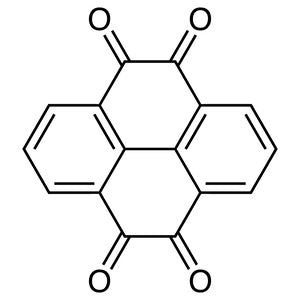
Pyrene-4,5,9,10-tetraone from TCI is a quinone derivative of pyrene. It carries four carbonyl groups at the K-region positions of the pyrene core: positions 4, 5, 9 and 10. Structurally, it can be described as two ortho-quinone units built into the flat aromatic pyrene framework. In the chemistry laboratory it serves as a building block for larger conjugated aromatic molecules, as a redox-active material in electrochemical research, and as a monomer for functional organic materials. This makes it a useful starting point for synthetic and materials chemistry programmes.
The main advantage of this compound is its four redox-active carbonyl groups, which are arranged symmetrically. These groups can accept electrons in a stepwise manner, so the compound is widely studied as an organic electrode material for rechargeable batteries. Its paired 1,2-dicarbonyl groups also undergo condensation readily with aromatic diamines to form fused pyrazine systems, such as azaacenes and covalent organic frameworks (COFs). In addition, the planar pyrene backbone supports π-π stacking, which is important for the electronic properties of the resulting materials. Together, these features make it a versatile and well-defined choice for researchers designing new functional molecules.
In Indonesia, interest in energy storage keeps growing, including lithium batteries and alternative battery chemistries. University chemistry departments, materials science groups and research institutes working on organic electrodes, conjugated polymers and porous frameworks can use this compound as a reliable starting material. The 1g pack is suited to research-scale synthesis, so laboratories can run exploratory reactions, screen electrode formulations or prepare new framework materials without having to buy bulk quantities. It also fits well into graduate research projects and collaborative studies on next-generation energy materials.
Related TCI products
- TCI T4089 1415238-25-3 4,4',4'',4'''-(Pyrene-1,3,6,8-tetrayl)tetrabenzaldehyde
- TCI D5970 131891-42-4 Decahydro-1H,3H-4,10:5,9-dimethanonaphtho[2,3-c:6,7-c']difuran-1,3,6,8-tetraone
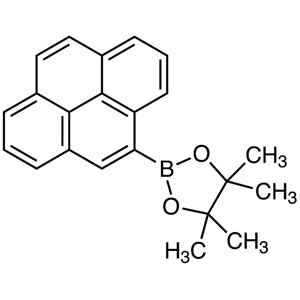
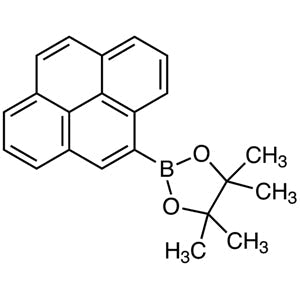
- TCI T3857 888950-09-2 4-(4,4,5,5-Tetramethyl-1,3,2-dioxaborolan-2-yl)pyrene
- TCI P3004 6217-22-7 Pyrene-4,5-dione
- TCI B6006 950779-13-2 1,6-Bis(4,4,5,5-tetramethyl-1,3,2-dioxaborolan-2-yl)pyrene
- TCI T4192 1,1',1''-[(1,3,5-Triazine-2,4,6-triyl)tris(benzene-4,1-diyl)]triurea
- Organic electrode research: its four symmetrically arranged carbonyl groups accept electrons stepwise, which makes it a strong candidate for studying organic cathode materials in rechargeable batteries.
- Covalent organic framework (COF) synthesis: the paired 1,2-dicarbonyl units condense readily with aromatic diamines, forming the fused pyrazine linkages used to build ordered, porous framework structures.
- Azaacene and extended π-system construction: condensation with aromatic diamines gives fused pyrazine rings, letting chemists extend the conjugated pyrene core into larger nitrogen-containing aromatic molecules.
- Functional organic material development: as a monomer with a planar pyrene backbone, it supports π-π stacking, which is important for tuning the electronic behaviour of semiconducting and redox-active materials.
- Electrochemical studies of quinone systems: its two ortho-quinone units on a rigid aromatic framework make it a well-defined model compound for investigating multi-electron redox processes in research laboratories.
| Brand | TCI (product code P2947) |
|---|---|
| CAS number | 14727-71-0 |
| Molecular formula | — |
| Purity | — |
| Category | Chemistry > Building Blocks > Non-Heterocyclic Building Blocks |
| Pack sizes | 1g |
| Physical form | refer to the manufacturer's Certificate of Analysis and Safety Data Sheet |
| Storage | follow the storage conditions stated on the TCI label and Safety Data Sheet |
Keep Pyrene-4,5,9,10-tetraone in its original tightly closed container, in a cool, dry and well-ventilated place away from direct light, heat sources and incompatible substances such as strong reducing agents. Always follow the storage conditions on the TCI label and Safety Data Sheet. Handle the material in a fume hood or another well-ventilated area, and wear laboratory gloves, safety glasses and a lab coat. Avoid creating dust, as well as inhaling it or letting it touch your skin or eyes. Reseal the container promptly after use, label any transferred portions clearly, and dispose of residues according to institutional and local chemical waste regulations.
—
Product Categories
- Material Building BlocksCovalent Organic Frameworks (COFs) LinkersLinkers (Others) [Covalent Organic Frameworks (COFs) Linkers]
- Material Building BlocksSmall Molecule Semiconductor Building BlocksPyrenes [Small Molecule Semiconductor Building Blocks]
- Polymer/Macromolecule ReagentsCovalent Organic Frameworks (COFs) LinkersLinkers (Others) [Covalent Organic Frameworks (COFs) Linkers]
Produk Terkait
-
4,4',4'',4'''-(Pyrene-1,3,6,8-tetrayl)tetrabenzaldehyde TCI T4089
Regular price Rp 5.062.050,00Regular price -
Decahydro-1H,3H-4,10:5,9-dimethanonaphtho[2,3-c:6,7-c']difuran-1,3,6,8-tetraone TCI D5970
Regular price Rp 5.062.050,00Regular price -
4-(4,4,5,5-Tetramethyl-1,3,2-dioxaborolan-2-yl)pyrene TCI T3857
Regular price Rp 4.399.500,00Regular price -
Pyrene-4,5-dione TCI P3004
Regular price Rp 4.771.200,00Regular price -
1,6-Bis(4,4,5,5-tetramethyl-1,3,2-dioxaborolan-2-yl)pyrene TCI B6006
Regular price From Rp 4.691.400,00Regular price -
TCI T4192 1,1',1''-[(1,3,5-Triazine-2,4,6-triyl)tris(benzene-4,1-diyl)]triurea
Regular price Rp 3.817.800,00Regular price -
HydrazinecarbohydrazonohydrazideHydrochloride TCI T4080
Regular price From Rp 2.625.000,00Regular price -
4-Aminobenzohydrazide TCI A1211
Regular price Rp 2.254.350,00Regular price

![Decahydro-1H,3H-4,10:5,9-dimethanonaphtho[2,3-c:6,7-c']difuran-1,3,6,8-tetraone (CAS 131891-42-4) - TCI D5970 - AMI Scientific](http://amiscientific.com/cdn/shop/files/TCI2510D5970.jpg?v=1767109510&width=533)


![1,1',1''-[(1,3,5-Triazine-2,4,6-triyl)tris(benzene-4,1-diyl)]triurea - AMI Scientific](http://amiscientific.com/cdn/shop/files/TCI2510T4192.jpg?v=1769181367&width=533)

