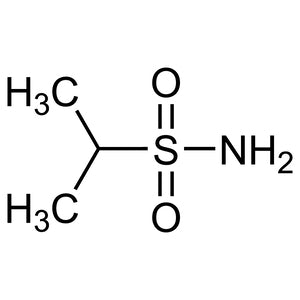
TCI P3324 Propane-2-sulfonamide, also known as isopropylsulfonamide, is a simple aliphatic sulfonamide classified as a non-heterocyclic building block. The molecule has a primary sulfonamide group (–SO2NH2) attached to an isopropyl group. In synthesis laboratories, chemists use it as a starting material to introduce an isopropylsulfonyl fragment into larger molecules, mainly in medicinal chemistry and agrochemical development. It is a useful reagent for researchers who need a small, well-defined sulfonamide unit when designing and building new target compounds.
Sulfonamide groups appear in many drug molecules because they form hydrogen bonds and influence solubility and pharmacokinetic properties. Propane-2-sulfonamide adds a compact, branched alkyl fragment, which lets medicinal chemists adjust the lipophilicity and steric bulk of a target molecule. Its sulfonamide nitrogen can be acylated, alkylated, or coupled with aryl halides to form N-acylsulfonamides, sulfonylureas, and N-arylsulfonamides. This range of reactions makes it a practical choice when a project calls for a dependable sulfonamide starting material.
In Indonesia, organic chemistry laboratories at universities, research institutes, and pharmaceutical R&D units need building blocks like this one when they assemble compound libraries or optimize lead compounds. Graduate students and academic researchers can use it in synthetic methodology work and in thesis projects on sulfonamide chemistry. Industrial R&D teams can use it to prepare analogues during structure–activity relationship studies. The 1 g and 5 g packs suit research-scale synthesis, which is how this material is typically used in Indonesian laboratories.
Related TCI products
- TCI A1031 98-32-8 2-Aminophenol-4-sulfonamide
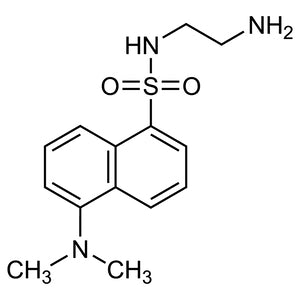
- TCI D6499 35060-08-3 N-(2-Aminoethyl)-5-(dimethylamino)naphthalene-1-sulfonamide
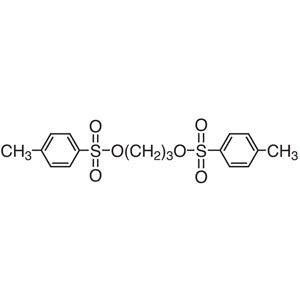
- TCI B1875 5469-66-9 1,3-Bis(tosyloxy)propane
- TCI T3007 72811-73-5 4-(m-Tolylamino)pyridine-3-sulfonamide
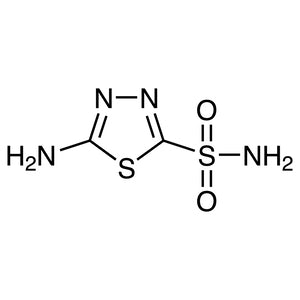
- TCI A3569 14949-00-9 5-Amino-1,3,4-thiadiazole-2-sulfonamide
- TCI A2416 88519-57-7 N-(4-Aminobutyl)-5-chloronaphthalene-2-sulfonamide Hydrochloride
- Medicinal chemistry fragment introduction: chemists use it to install a compact isopropylsulfonyl unit into drug-like molecules and tune their hydrogen bonding, solubility, and pharmacokinetic behavior during lead optimization.
- N-acylsulfonamide synthesis: its primary sulfonamide nitrogen can be acylated, giving researchers a direct route to N-acylsulfonamide motifs that are often studied in medicinal chemistry programs.
- Sulfonylurea preparation: the sulfonamide nitrogen can be converted into sulfonylurea structures, so it is a suitable starting material for exploratory work on this compound class in pharmaceutical and agrochemical research.
- N-arylsulfonamide formation by coupling: the sulfonamide can be coupled with aryl halides to build N-arylsulfonamides, which is useful when designing analogue series for structure–activity relationship studies.
- Compound library construction: as a small, branched, non-heterocyclic building block, it helps university and industrial R&D groups vary lipophilicity and steric bulk across a series of related compounds.
| Brand | TCI (product code P3324) |
|---|---|
| CAS number | 81363-76-0 |
| Molecular formula | — |
| Purity | — |
| Category | Chemistry > Building Blocks > Non-Heterocyclic Building Blocks |
| Pack sizes | 1 g and 5 g |
| Physical form | refer to the product label and the manufacturer's certificate of analysis |
| Storage | follow the storage conditions on the manufacturer's label and safety data sheet |
Store Propane-2-sulfonamide in its original, tightly closed container, away from moisture, heat, and direct sunlight, and follow the storage conditions stated on the TCI label and safety data sheet. Keep the container well labeled and away from incompatible substances such as strong oxidizing agents. Handle the material in a well-ventilated area or a fume hood. Wear standard personal protective equipment, including a lab coat, safety glasses, and chemical-resistant gloves. Avoid creating dust and avoid contact with skin, eyes, and clothing. Reseal the container right after each use, and dispose of waste according to institutional and local regulations.
—
Produk Terkait
-
2-Aminophenol-4-sulfonamide TCI A1031
Regular price From Rp 2.016.000,00Regular price -
N-(2-Aminoethyl)-5-(dimethylamino)naphthalene-1-sulfonamide TCI D6499
Regular price Rp 1.936.200,00Regular price -
1,3-Bis(tosyloxy)propane TCI B1875
Regular price From Rp 689.850,00Regular price -
4-(m-Tolylamino)pyridine-3-sulfonamide TCI T3007
Regular price Rp 2.332.050,00Regular price -
5-Amino-1,3,4-thiadiazole-2-sulfonamide TCI A3569
Regular price Rp 6.042.750,00Regular price -
N-(4-Aminobutyl)-5-chloronaphthalene-2-sulfonamideHydrochloride TCI A2416
Regular price Rp 20.509.650,00Regular price -
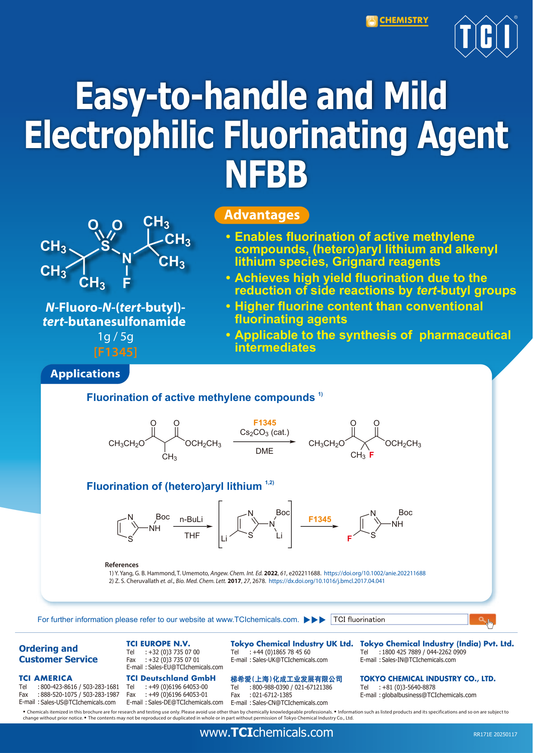
N-(tert-Butyl)-N-fluoro-2-methylpropane-2-sulfonamide TCI F1345
Regular price From Rp 3.870.300,00Regular price -
N,N-Dimethyl-1H-imidazole-1-sulfonamide TCI D5437
Regular price From Rp 743.400,00Regular price