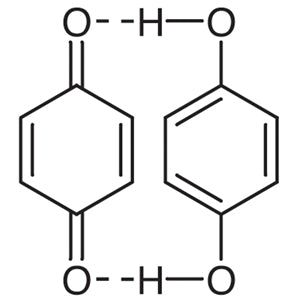
Quinhydrone is a chemical compound widely used in various laboratory reactions due to its unique molecular structure and versatile chemical properties. Composed of two quinone molecules covalently bonded, it offers both stability and reactivity, making it a valuable tool in synthetic chemistry. This compound is commonly found in organic and analytical laboratories, where it serves as a key building block for the synthesis of complex molecules. Its ability to participate in oxidation and reduction reactions further enhances its applicability in diverse chemical processes.
Quinhydrone is preferred for its ability to undergo controlled chemical transformations under specific conditions. Its solubility in organic solvents such as ethyl acetate and acetone facilitates efficient dissolution and reaction processes. The compound's reactivity and stability make it ideal for applications requiring precise chemical control. Additionally, its ability to act as both an oxidizing and reducing agent broadens its utility in different types of chemical reactions. These properties make it a reliable choice for researchers seeking consistent and predictable results.
In Indonesian laboratories, quinhydrone is extensively used in scientific research, particularly in organic and analytical chemistry. It is a common reagent in university and research laboratory settings, where it supports the development of new compounds and analytical methods. Its availability and reliability have made it a staple in the chemical supply chain, supporting both academic and industrial research efforts.
- Organic synthesis where quinhydrone acts as a versatile intermediate due to its ability to participate in both oxidation and reduction reactions.
- Analytical chemistry applications where its stability and reactivity aid in the detection and quantification of various compounds.
- Research in polymer science where its chemical properties contribute to the development of new materials and structures.
- Pharmaceutical research where quinhydrone is used as a building block for the synthesis of complex drug molecules.
- Environmental analysis where its solubility and reactivity make it useful for studying chemical interactions in different media.
| Brand | TCI |
|---|---|
| CAS number | 106-34-3 |
| Molecular formula | — |
| Purity | — |
| Category | Chemistry > Building Blocks > Non-Heterocyclic Building Blocks |
| Pack sizes | Available in various sizes as per supplier specifications |
| Physical form | Solid |
| Storage | Store in a cool, dry place away from light and moisture |
Quinhydrone should be stored in a cool, dry environment to maintain its chemical integrity and prevent degradation. It is recommended to keep it in airtight containers to minimize exposure to moisture and air, which could affect its stability. Due to its chemical reactivity, it should be handled with care, using appropriate personal protective equipment such as gloves and safety goggles. It is important to store it away from incompatible substances to avoid any potential chemical reactions. Proper labeling of storage containers is essential for safe handling and to ensure that all laboratory personnel are aware of its properties and handling requirements.
—
Produk Terkait
-
TCI B5774 5,10-Bis(4,4,5,5-tetramethyl-1,3,2-dioxaborolan-2-yl)naphtho[1,2-c:5,6-c']bis([1,2,5]oxadiazole)
Regular price Rp 10.255.350,00Regular price -
Dihydroiodide TCI B6569
Regular price From Rp 1.936.200,00Regular price -
Trifluoromethanesulfonate TCI B7003
Regular price From Rp 1.936.200,00Regular price
![5,10-Bis(4,4,5,5-tetramethyl-1,3,2-dioxaborolan-2-yl)naphtho[1,2-c:5,6-c']bis([1,2,5]oxadiazole) - TCI B5774 - AMI Scientific](http://amiscientific.com/cdn/shop/files/TCI2510B5774.jpg?v=1769180228&width=533)