


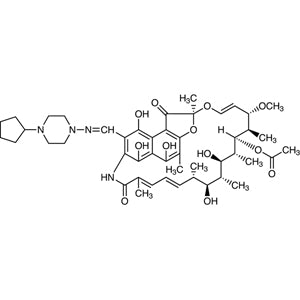
Rifapentine is a chemical compound classified under antibiotics, specifically the rifamycin family. It plays a crucial role in laboratory settings, particularly in microbiology and pharmacology research. This compound is widely used for its ability to inhibit the growth of bacteria, especially *Mycobacterium tuberculosis*, making it an essential tool in antibiotic research. Its effectiveness in targeting bacterial growth has led to its application in various experimental studies aimed at understanding bacterial resistance and developing new therapeutic approaches.
Rifapentine is favored for its chemical stability and complex molecular structure, which allows it to interact with key enzymes and proteins in bacterial cells. Its ability to block fatty acid synthesis in bacteria makes it a powerful agent in inhibiting cellular growth. These properties make Rifapentine a preferred choice for researchers looking to develop new antibiotics or study the mechanisms of bacterial resistance. Its reliability and consistent performance in laboratory conditions further enhance its appeal in scientific research.
In Indonesian laboratories, Rifapentine is commonly used in scientific research, including antibiotic efficacy testing, drug development, and infection therapy studies. Its application extends to both academic and industrial research settings, where it supports the advancement of microbiological and pharmacological knowledge. The compound’s versatility and effectiveness have made it a valuable resource for researchers in Indonesia.
TCI brochures (PDF)
- Antimicrobials and Antitumor Agents for Research and Experimental Use 2025-04-24 · p. 4
- Pharmaceutical Ingredients for Research and Experimental Use 2026-03-09 · p. 4
- Antibiotic Efficacy Testing: Rifapentine is used to assess the effectiveness of antibiotics against *Mycobacterium tuberculosis*, aiding in the development of new treatment strategies.
- Drug Development: It serves as a key component in the formulation of antibiotics, supporting the creation of new therapeutic agents for bacterial infections.
- Bacterial Sensitivity Testing: Rifapentine is employed to determine how susceptible different bacterial strains are to antibiotic treatment, helping in the selection of appropriate therapies.
- Infection Therapy Research: It is used in studies focused on the treatment of tuberculosis and other bacterial infections, contributing to the understanding of therapeutic mechanisms.
- Microbial Growth Inhibition Studies: Rifapentine is utilized to investigate its impact on bacterial growth, providing insights into its mode of action and potential applications.
| Brand | TCI |
|---|---|
| CAS number | 61379-65-5 |
| Molecular formula | — |
| Purity | — |
| Category | Life Science > Biochemicals and Reagents > Antibiotics |
| Pack sizes | Available in various quantities as per standard laboratory requirements |
| Physical form | Solid |
| Storage | Store in a cool, dry place away from light and moisture |
Rifapentine should be stored in a cool, dry environment, away from direct light and moisture to maintain its chemical stability. It is recommended to use airtight containers to prevent contamination and degradation. Due to its potential reactivity, it should be handled with care, using appropriate personal protective equipment such as gloves and safety goggles. In laboratory settings, it is important to follow standard safety protocols to ensure safe handling and minimize exposure. Proper labeling and storage conditions are essential to maintain the integrity of the compound and ensure its effectiveness in research applications.
—
Product Categories
- Biochemicals and ReagentsAntibioticsAntibiotics (Chemical Structure Class)
- Biochemicals and ReagentsPharmaceutical Research Reagents (for Experimental Use)Antimicrobial Ingredients (for Research and Experimental Use)
- MicrobiologyAntibioticsAntibiotics (Chemical Structure Class)
- Pharmaceutical Development and Drug Discovery ResearchPharmaceutical Research Reagents (for Experimental Use)Antimicrobial Ingredients (for Research and Experimental Use)
- Pharmaceutical Development and Drug Discovery ResearchAntibioticsAntibiotics (Chemical Structure Class)
Produk Terkait
-
4-AminosalicylicAcid TCI A0420
Regular price From Rp 822.150,00Regular priceRp 590.100,00Sale price From Rp 822.150,00 -
Sodium4-AminosalicylateDihydrate TCI A0423
Regular price From Rp 928.200,00Regular priceRp 664.650,00Sale price From Rp 928.200,00 -
Wortmannin TCI W0007
Regular price Rp 11.632.950,00Regular priceRp 8.150.100,00Sale price Rp 11.632.950,00 -
ValganciclovirHydrochloride TCI V0158
Regular price From Rp 1.618.050,00Regular priceRp 1.146.600,00Sale price From Rp 1.618.050,00 -
ValnemulinHydrochloride TCI V0144
Regular price From Rp 4.982.250,00Regular priceRp 3.499.650,00Sale price From Rp 4.982.250,00 -
Sulfamerazine TCI U0176
Regular price From Rp 2.411.850,00Regular priceRp 1.702.050,00Sale price From Rp 2.411.850,00 -
SulfadiazineSodium TCI U0171
Regular price Rp 1.220.100,00Regular priceRp 868.350,00Sale price Rp 1.220.100,00 -
Sulfaphenazole TCI U0170
Regular price Rp 3.445.050,00Regular priceRp 2.424.450,00Sale price Rp 3.445.050,00


