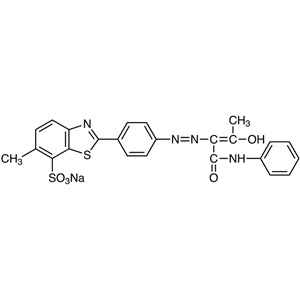
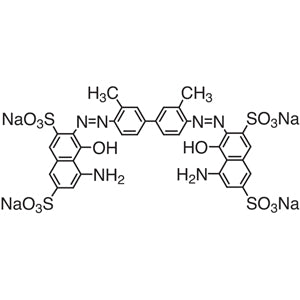
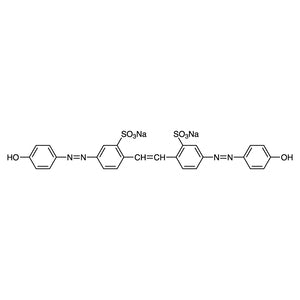
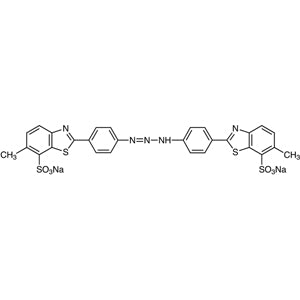
Direct Yellow 44 from TCI is a yellow direct dye belonging to the azo class of colorants. Direct dyes are designed to bind directly to cellulosic fibers such as cotton, paper, and viscose without the need for a mordant. In the TCI catalog, this product is listed under Stains and Dyes for research and experimental use. In the laboratory, it is used for dyeing research, dye adsorption studies, the development of textile wastewater treatment methods, and as a reference dye in a wide range of experiments.
Direct dyes such as Direct Yellow 44 generally have relatively long, planar molecules that carry sulfonate groups. This structure makes the molecule water-soluble while also giving it a high affinity for cellulose chains through hydrogen bonding and van der Waals forces. These characteristics are why it is chosen for studies of how dyes interact with fibers or adsorbents. Its strong color also makes it easy to track concentration by UV-Vis spectrophotometry. As a result, the dye is very practical as a model compound in research on adsorption, photodegradation, and water treatment.
In Indonesia, the textile and paper industries are important sectors, and their wastewater often contains residual direct dyes. University research groups, environmental laboratories, and industrial R&D teams therefore often use dyes such as Direct Yellow 44 to test new adsorbents, evaluate degradation processes, and compare treatment performance under controlled conditions. Academic laboratories also use it in teaching and student research projects on dye chemistry, fiber interactions, and spectrophotometric analysis, where a well-characterized commercial dye supports reproducible results.
- Dye adsorption studies: its water solubility and strong affinity for cellulose-like surfaces make it a useful model dye for testing activated carbon, biosorbents, clays, and other new adsorbent materials.
- Textile wastewater treatment research: as a representative direct azo dye, it helps researchers simulate real textile effluent and test coagulation, filtration, and oxidation treatment methods under controlled conditions.
- Photodegradation and advanced oxidation experiments: its intense yellow color lets researchers track how fast the dye breaks down under photocatalysts or oxidants by monitoring the loss of absorbance with UV-Vis.
- Cellulose fiber dyeing research: because direct dyes bind to cotton, paper, and viscose without a mordant, it is well suited to studying dye uptake, fiber affinity, and dyeing behavior.
- Reference dye in spectrophotometric work: its strong, easily measured absorbance makes it a convenient comparison standard when building calibration curves and validating analytical procedures in dye-related experiments.
| Brand | TCI (product code S0143) |
|---|---|
| CAS number | 8005-52-5 |
| Molecular formula | — |
| Purity | — |
| Category | Chemistry > Stains and Dyes (for Research and Experimental Use) > Direct Dyes (for Research and Experimental Use) |
| Pack sizes | see the available TCI pack options on the product listing |
| Physical form | — |
| Storage | keep tightly closed in a cool, dry place away from light; follow the TCI label and SDS |
- Dye class: direct dye, azo type, yellow
Store Direct Yellow 44 in its original, tightly sealed container in a cool, dry, well-ventilated area, away from direct sunlight, moisture, and incompatible substances such as strong oxidizing agents. Keep the container clearly labeled and close it right after each use so the material does not absorb moisture or become contaminated. When handling the dye, wear standard laboratory protective equipment, including gloves, safety glasses, and a lab coat. Avoid creating or breathing in dust, and avoid contact with skin and eyes. Weigh and prepare solutions in a well-ventilated area or under a fume hood. Dye solutions stain surfaces and clothing easily, so clean up spills promptly. Dispose of dye-containing waste according to local regulations, and always check the product's Safety Data Sheet for full hazard and handling information.
—
Produk Terkait
-
DirectYellow26 TCI D1473
Regular price Rp 2.174.550,00Regular priceRp 1.520.400,00Sale price Rp 2.174.550,00 -
DirectYellow8 TCI D1113
Regular price Rp 1.961.400,00Regular priceRp 1.371.300,00Sale price Rp 1.961.400,00 -
DirectBlue14 TCI T0556
Regular price Rp 1.087.800,00Regular priceRp 760.200,00Sale price Rp 1.087.800,00 -
DirectRed80 TCI D3273
Regular price Rp 1.485.750,00Regular priceRp 1.038.450,00Sale price Rp 1.485.750,00 -
DirectBlue6 TCI D0235
Regular price Rp 1.803.900,00Regular priceRp 1.261.050,00Sale price Rp 1.803.900,00 -
DirectBlue86 TCI C1118
Regular price From Rp 795.900,00Regular priceRp 556.500,00Sale price From Rp 795.900,00 -
BrilliantYellow TCI B0783
Regular price Rp 4.320.750,00Regular priceRp 3.020.850,00Sale price Rp 4.320.750,00 -
TitanYellow TCI C0549
Regular price Rp 2.916.900,00Regular priceRp 2.039.100,00Sale price Rp 2.916.900,00