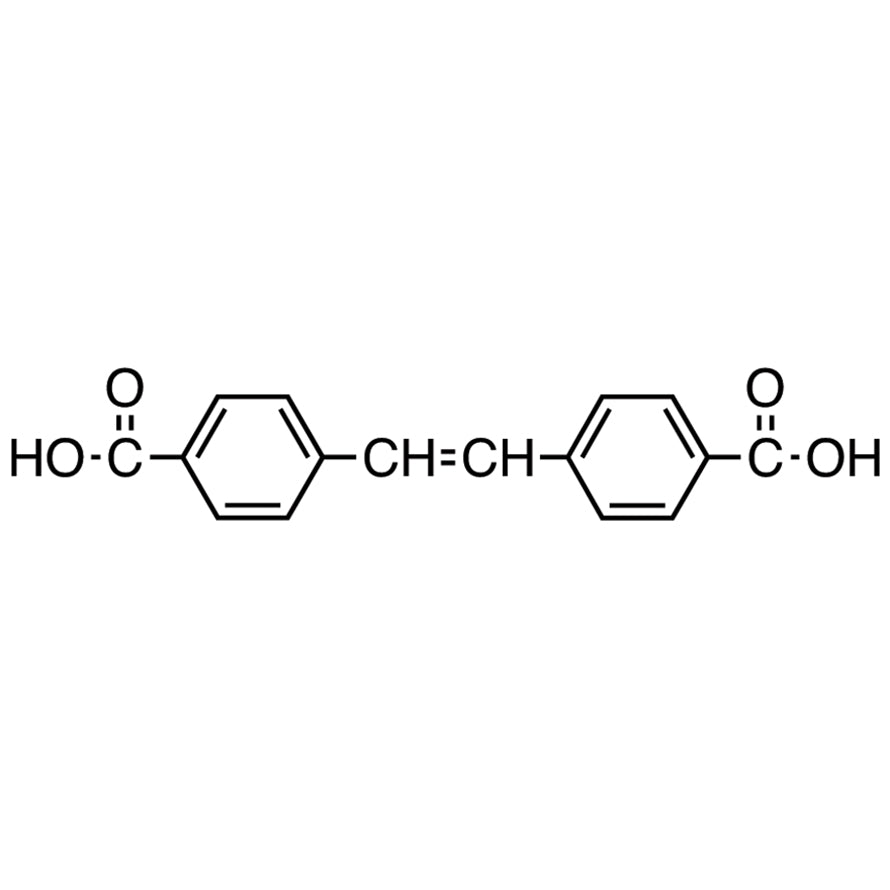
4,4'-Stilbenedicarboxylic Acid is a chemical compound widely used in scientific experiments, particularly in the fields of materials science and polymer chemistry. It serves as a key reagent in the synthesis of polymers and composites, playing a vital role in the development of advanced materials. This compound is commonly utilized in laboratory settings where researchers aim to create new materials or modify existing ones through polymerization reactions. Its versatility makes it an essential component in various chemical processes.
One of the main reasons for its popularity is its chemical stability and the presence of two carboxylic acid groups, which allow for multiple reaction possibilities. These functional groups enable the compound to interact with a variety of reagents, making it adaptable to different synthetic pathways. Its stability also ensures that it remains effective over time, reducing the risk of degradation during storage or experimentation. This reliability is crucial for maintaining consistent results in laboratory research.
In Indonesian laboratories, 4,4'-Stilbenedicarboxylic Acid is frequently used in material science and polymer chemistry research. It is a preferred choice for studies involving the development of new materials or the modification of existing ones. Researchers in Indonesia continue to explore its applications in both academic and industrial contexts, leveraging its chemical properties for practical and innovative purposes.
TCI brochures (PDF)
- Monomers 2025-05-28 · p. 36
- Polymer synthesis and composite development due to its ability to act as a monomer in polymerization reactions.
- Molecular structure characterization as it provides a stable base for analytical techniques like NMR and IR spectroscopy.
- Material modification studies because of its reactive carboxylic acid groups that can be functionalized for specific applications.
- Research into advanced materials for industrial applications where chemical stability and reactivity are required.
- Educational and experimental use in academic institutions for teaching and demonstrating polymer chemistry concepts.
| Brand | TCI |
|---|---|
| CAS number | 100-31-2 |
| Molecular formula | — |
| Purity | — |
| Category | Materials Science > Polymer/Macromolecule Reagents > Monomers |
| Pack sizes | As per supplier specifications |
| Physical form | Solid (as per standard product description) |
| Storage | Store in a cool, dry place away from direct sunlight |
4,4'-Stilbenedicarboxylic Acid should be stored in a cool, dry environment to maintain its chemical stability. It is recommended to keep the compound in airtight containers to prevent moisture absorption, which could affect its reactivity. Laboratory personnel should handle the material with care, using appropriate personal protective equipment such as gloves and safety goggles. Since it is a solid, it is typically stored in sealed containers to avoid contamination. Proper labeling of storage areas is essential for safe handling and easy identification. Regular inspection of storage conditions ensures that the material remains in optimal condition for use in experiments.
—
Produk Terkait
-
trans-AconiticAcid TCI A0127
Regular price Rp 2.121.000,00Regular priceRp 1.498.350,00Sale price Rp 2.121.000,00 -
AzelaicAcid TCI A0561
Regular price Rp 557.550,00Regular priceRp 405.300,00Sale price Rp 557.550,00 -
AdipicAcid TCI A0161
Regular price Rp 452.550,00Regular priceRp 316.050,00Sale price Rp 452.550,00 -
AcetylenedicarboxylicAcid TCI A0088
Regular price Rp 1.220.100,00Regular priceRp 868.350,00Sale price Rp 1.220.100,00 -
alpha,alpha,alpha',alpha'-Tetramethyl-1,3-benzenedipropionicAcid TCI T3420
Regular price Rp 3.472.350,00Regular priceRp 2.427.600,00Sale price Rp 3.472.350,00 -
TetrafluorosuccinicAcid TCI T1621
Regular price Rp 2.702.700,00Regular priceRp 1.905.750,00Sale price Rp 2.702.700,00 -
TetrafluoroisophthalicAcid TCI T1374
Regular price Rp 2.625.000,00Regular priceRp 1.835.400,00Sale price Rp 2.625.000,00 -
Benzophenone-4,4'-dicarboxylicAcid TCI B1741
Regular price Rp 6.413.400,00Regular priceRp 4.500.300,00Sale price Rp 6.413.400,00