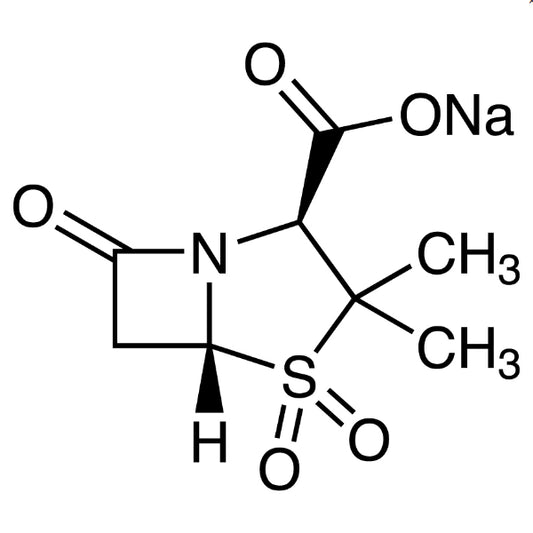
Sulbactam is a chemical compound classified under the category of antibiotics, specifically beta-lactam antibiotics. It plays a crucial role in laboratory settings by inhibiting bacterial growth, particularly in strains resistant to other antibiotics. As an active component in several antibiotic drugs, Sulbactam is widely used in microbiological and pharmacological research to evaluate antibiotic efficacy and develop new therapeutic approaches. Its importance in laboratory experiments lies in its ability to test antibacterial activity and study antibiotic interactions.
Sulbactam is chemically stable and dissolves well in organic solvents such as ethyl acetate and acetone. Its favorable reactivity with beta-lactamase enzymes makes it effective against bacteria producing these enzymes. The compound is non-toxic and easy to handle, making it a preferred choice for laboratory use. Its solid form and ease of storage further enhance its practicality in various experimental setups.
In Indonesian laboratories, Sulbactam is commonly used in public health-related research. It supports studies on antibiotic resistance and microbial behavior. Its availability in solid form and straightforward storage conditions make it a reliable material for ongoing research projects. Researchers in Indonesia rely on Sulbactam for its consistent performance and safety in experimental protocols.
TCI brochures (PDF)
- Antibiotic Ingredients for Drug-Resistant Pathogens 2026-10-01 · p. 1
- Antimicrobials and Antitumor Agents for Research and Experimental Use 2025-04-24 · p. 8
- Pharmaceutical Ingredients for Research and Experimental Use 2026-03-09 · p. 8
- Microbiological research for testing antibiotic resistance and bacterial inhibition due to its effectiveness against beta-lactamase-producing bacteria.
- Pharmacological studies to evaluate the efficacy of antibiotic compounds in drug development and therapeutic applications.
- Antimicrobial activity screening to identify the potency of Sulbactam against various bacterial strains in controlled environments.
- Development of new antibiotic therapies by analyzing how Sulbactam interacts with other antimicrobial agents in combination studies.
- Public health research focusing on bacterial resistance patterns and the role of Sulbactam in combating drug-resistant infections.
| Brand | TCI |
|---|---|
| CAS number | 68373-14-8 |
| Molecular formula | — |
| Purity | — |
| Category | Life Science > Biochemicals and Reagents > Antibiotics |
| Pack sizes | Available in various quantities as per standard laboratory requirements |
| Physical form | Solid powder |
| Storage | Store in a cool, dry place away from direct sunlight and moisture |
Sulbactam should be stored in a cool, dry environment to maintain its chemical stability. It is recommended to keep it in a sealed container to prevent moisture absorption and contamination. Due to its non-toxic nature, it is generally safe to handle, but standard laboratory safety practices should still be followed. Avoid exposure to extreme temperatures and direct sunlight to preserve its effectiveness. Proper labeling and storage conditions ensure the material remains suitable for use in research applications. Always ensure that the container is tightly closed when not in use to maintain its integrity and prevent any potential degradation.
—
Product Categories
- Biochemicals and ReagentsAntibioticsAntibiotics (Chemical Structure Class)
- Biochemicals and ReagentsPharmaceutical Research Reagents (for Experimental Use)Antimicrobial Ingredients (for Research and Experimental Use)
- MicrobiologyAntibioticsAntibiotics (Chemical Structure Class)
- Pharmaceutical Development and Drug Discovery ResearchPharmaceutical Research Reagents (for Experimental Use)Antimicrobial Ingredients (for Research and Experimental Use)
- Pharmaceutical Development and Drug Discovery ResearchAntibioticsAntibiotics (Chemical Structure Class)
Produk Terkait
-
SulbactamSodium TCI U0159
Regular price From Rp 3.551.100,00Regular priceRp 2.499.000,00Sale price From Rp 3.551.100,00 -
4-AminosalicylicAcid TCI A0420
Regular price From Rp 822.150,00Regular priceRp 590.100,00Sale price From Rp 822.150,00 -
Sodium4-AminosalicylateDihydrate TCI A0423
Regular price From Rp 928.200,00Regular priceRp 664.650,00Sale price From Rp 928.200,00 -
Wortmannin TCI W0007
Regular price Rp 11.632.950,00Regular priceRp 8.150.100,00Sale price Rp 11.632.950,00 -
ValganciclovirHydrochloride TCI V0158
Regular price From Rp 1.618.050,00Regular priceRp 1.146.600,00Sale price From Rp 1.618.050,00 -
ValnemulinHydrochloride TCI V0144
Regular price From Rp 4.982.250,00Regular priceRp 3.499.650,00Sale price From Rp 4.982.250,00 -
Sulfamerazine TCI U0176
Regular price From Rp 2.411.850,00Regular priceRp 1.702.050,00Sale price From Rp 2.411.850,00 -
SulfadiazineSodium TCI U0171
Regular price Rp 1.220.100,00Regular priceRp 868.350,00Sale price Rp 1.220.100,00