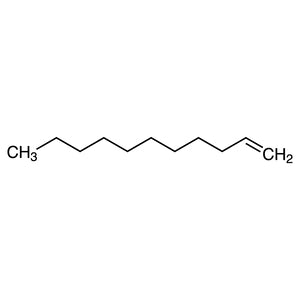
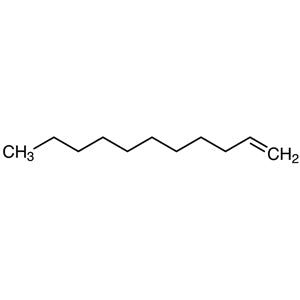
1-Tetradecene from TCI (product code T0087) is a linear fourteen-carbon alkene with its double bond at the end of the chain. Compounds of this type are called alpha-olefins. In the laboratory it works as a versatile non-heterocyclic building block. The terminal double bond can be converted into many functional groups, including alcohols, aldehydes, epoxides, and sulfur- or silicon-containing derivatives. Its long hydrocarbon chain gives final products a strongly hydrophobic character, which makes it relevant to research on surfactants, lubricants, and materials.
Researchers choose 1-Tetradecene because a double bond at the end of the chain makes its reactions easier to control and more selective than those of internal alkenes. Hydroboration, hydroformylation, hydrosilylation, epoxidation, and thiol-ene addition all take place at a clearly defined position, so the products are more uniform. Because the chain is linear and unbranched, its derivatives also have more predictable physical properties. This matters in structure-property studies of surfactants, self-assembled monolayers, and hydrophobic coatings, where small changes in chain architecture can change the results.
In Indonesian laboratories, 1-Tetradecene is mainly used in university research groups, polymer and materials research centres, and industrial R&D units working on oleochemicals, surface-active agents, and specialty coatings. Synthetic chemists use it as a dependable source of a C14 alkyl chain when building model compounds. Materials scientists use it to make hydrophobic modifiers and surface-functionalisation agents. Its well-defined structure also makes it useful in teaching laboratories that demonstrate selective alkene chemistry.
Related TCI products
- Hydroboration-oxidation: the terminal double bond reacts with predictable anti-Markovnikov selectivity to give the primary long-chain alcohol, a useful intermediate for further synthesis.
- Hydroformylation studies: the alpha-olefin structure makes it a clear model substrate for evaluating catalysts and controlling the ratio of linear to branched aldehyde products.
- Hydrosilylation and surface modification: adding silanes to the terminal alkene gives long-chain silicon derivatives used to make hydrophobic coatings and modified surfaces.
- Thiol-ene addition chemistry: the accessible terminal double bond takes part readily in thiol-ene reactions, giving sulfur-containing derivatives for materials and monolayer research.
- Surfactant and lubricant research: the linear C14 hydrocarbon chain provides strong, predictable hydrophobic character, which supports systematic structure-property studies of surface-active compounds and lubricant additives.
| Brand | TCI (product code T0087) |
|---|---|
| CAS number | 1120-36-1 |
| Molecular formula | — |
| Purity | — |
| Category | Chemistry > Building Blocks > Non-Heterocyclic Building Blocks |
| Pack sizes | as listed on the product page; contact AMI Scientific for availability |
| Physical form | liquid at room temperature (see the TCI specification sheet for exact physical data) |
| Storage | keep the container tightly closed in a cool, dry, well-ventilated place away from ignition sources |
Store 1-Tetradecene in its original tightly sealed container in a cool, dry, well-ventilated area, away from heat, sparks, open flames, and strong oxidising agents. Use glass or other chemically compatible containers when transferring the material, and label them clearly. Because it is an organic hydrocarbon, handle it in a fume hood or a well-ventilated workspace. Wear suitable gloves, safety glasses, and a lab coat to avoid contact with skin and eyes. Clean up spills with an inert absorbent and dispose of waste according to local regulations. Always read the TCI Safety Data Sheet before use for detailed hazard and handling information.
—
Produk Terkait
-
1-Tetradecene[StandardMaterialforGC] TCI S0344
Regular price Rp 2.625.000,00Regular priceRp 1.835.400,00Sale price Rp 2.625.000,00 -
9-Vinylanthracene TCI V0130
Regular price From Rp 2.545.200,00Regular priceRp 1.779.750,00Sale price From Rp 2.545.200,00 -
5-Vinylbicyclo[221]hept-2-ene(stabilizedwithBHT) TCI V0062
Regular price From Rp 769.650,00Regular priceRp 537.600,00Sale price From Rp 769.650,00 -
1,3,5-Undecatriene(mixtureofisomers) TCI U0062
Regular price From Rp 3.155.250,00Regular priceRp 2.206.050,00Sale price From Rp 3.155.250,00 -
1-Undecene TCI U0052
Regular price From Rp 2.068.500,00Regular priceRp 1.445.850,00Sale price From Rp 2.068.500,00 -
1-Undecene TCI U0025
Regular price Rp 1.060.500,00Regular priceRp 741.300,00Sale price Rp 1.060.500,00 -
1,10-Undecadiene TCI U0024
Regular price From Rp 2.491.650,00Regular priceRp 1.741.950,00Sale price From Rp 2.491.650,00 -
1,4,4a,5,8,8a-Hexahydro-1,4:5,8-dimethanonaphthalene(mixtureofisomers)(stabilizedwithBHT) TCI T4428
Regular price From Rp 4.056.150,00Regular priceRp 2.836.050,00Sale price From Rp 4.056.150,00