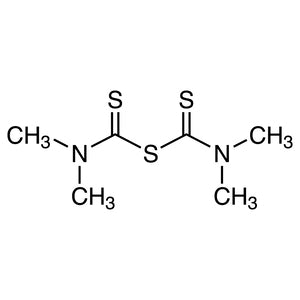
Tetramethylthiuram Monosulfide (TMTM) from TCI is an organosulfur compound in the thiuram family. Its structure consists of two dimethylthiocarbamoyl units linked by a single sulfur atom. TMTM is best known as a rubber vulcanization accelerator, meaning it speeds up the formation of sulfur crosslinks between rubber polymer chains. In the laboratory, it is used in rubber compound formulation research, as an organosulfur building block in synthesis, and as a reference compound when analysing rubber additive chemicals.
TMTM differs from tetramethylthiuram disulfide (TMTD) because it has only one bridging sulfur atom, so it does not act as a sulfur donor. For this reason, researchers choose TMTM when they need a fast accelerator but still want to supply sulfur separately. This lets them control crosslink density and pre-vulcanization time (scorch) more precisely. Its thiocarbamoyl groups can also coordinate with metal ions, which makes TMTM relevant to work on dithiocarbamate complexes and to studies of the biological activity of thiuram compounds.
Indonesia is one of the world's largest producers of natural rubber, so TMTM is especially relevant to Indonesian rubber research laboratories, university polymer and chemistry departments, and the quality control laboratories of rubber processing and product manufacturers. Researchers use it to develop and compare vulcanization systems for natural rubber compounds. Analytical laboratories use it as a reference material when identifying accelerator residues in rubber goods. Academic groups use it in coursework and in research on organosulfur and coordination chemistry.
- Rubber compound formulation research: TMTM is a fast vulcanization accelerator, so researchers can study how it speeds sulfur crosslinking in natural and synthetic rubber compounds.
- Controlling crosslink density and scorch: TMTM does not donate sulfur, so researchers can set the sulfur level separately and tune crosslink density and scorch time more precisely.
- Organosulfur building block: its two dimethylthiocarbamoyl units joined by one sulfur atom make it a useful starting material for synthesis work in organosulfur chemistry.
- Reference compound in additive analysis: as an established thiuram accelerator, TMTM is a suitable reference for identifying and comparing rubber additive chemicals in analytical work.
- Dithiocarbamate and metal complex studies: its thiocarbamoyl groups can coordinate with metal ions, which supports research on dithiocarbamate complexes and on the biological activity of thiuram compounds.
| Brand | TCI (product code T0157) |
|---|---|
| CAS number | 97-74-5 |
| Molecular formula | — |
| Purity | — |
| Category | Chemistry > Building Blocks > Non-Heterocyclic Building Blocks |
| Pack sizes | see the available options on the product page |
| Physical form | — |
| Storage | keep tightly closed in a cool, dry place, following the manufacturer's label and SDS |
- Chemical name: Tetramethylthiuram Monosulfide (TMTM)
Store Tetramethylthiuram Monosulfide in its original, tightly sealed container in a cool, dry, well-ventilated area. Keep it away from heat, direct sunlight, moisture, and incompatible substances such as strong oxidizing agents. Always follow the storage conditions on the TCI label and Safety Data Sheet (SDS). Handle the material in a fume hood or another well-ventilated area, and wear suitable personal protective equipment, including chemical-resistant gloves, safety glasses, and a lab coat. Avoid breathing in dust and avoid contact with skin and eyes. Label every container clearly, reseal it promptly after use, and dispose of waste according to local regulations and your institution's chemical safety procedures.
—
Produk Terkait
-
TetraethylthiuramDisulfide TCI B0479
Regular price From Rp 557.550,00Regular priceRp 405.300,00Sale price From Rp 557.550,00 -
TetraisopropylthiuramDisulfide TCI T1555
Regular price From Rp 4.691.400,00Regular priceRp 3.295.950,00Sale price From Rp 4.691.400,00 -
TetrabutylthiuramDisulfide TCI T0635
Regular price From Rp 505.050,00Regular priceRp 368.550,00Sale price From Rp 505.050,00