


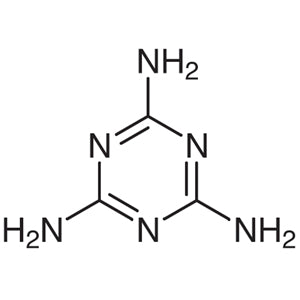
Melamine Monomer (108-78-1) is a chemical compound widely used as a foundational material in laboratory synthesis, particularly in the development of heterocyclic compounds. This compound is composed of three amino groups attached to an aromatic ring, making it a versatile building block for various chemical reactions. Its role in the laboratory is critical for the synthesis of complex molecules such as melamine formaldehyde, which finds applications in both industrial and scientific fields. Due to its structural simplicity and chemical stability, it is a preferred choice for researchers aiming to create new materials or compounds with specific properties.
The chemical properties of Melamine Monomer make it a preferred choice in laboratory settings. It exhibits high stability under normal conditions, allowing for reliable use in a variety of experimental setups. Its controlled reactivity enables it to participate in multiple chemical reactions, including polymerization and heterocyclic synthesis, without undergoing unintended side reactions. Additionally, its ability to form strong chemical bonds contributes to its effectiveness in creating durable and functional materials. These characteristics make it a reliable and efficient reagent for chemical synthesis.
In Indonesian laboratories, Melamine Monomer is commonly used in research and development projects involving polymer science, material chemistry, and industrial chemistry. Its stability and reactivity make it suitable for a wide range of applications, from academic research to industrial production. It is frequently utilized in laboratories that focus on the development of new materials and chemical compounds, supporting both educational and commercial scientific endeavors.
Advantages (TCI brochure)
- Can be used as a synthetic raw material for g-C3N4
- Can be used as a partial substructure of g-C3N4
TCI brochures (PDF)
- Graphitic Carbon Nitride (g-C3N4) Related Reagents 2025-08-07 · p. 1
- Covalent Organic Framework (COF) Linkers 2026-05-18 · p. 4
Related TCI products
- TCI T3695 14544-47-9 4,4',4''-(1,3,5-Triazine-2,4,6-triyl)trianiline
- TCI M3538 1502-47-2 Melem
- TCI B6846 1203707-77-0 4,4'-(Benzo[c][1,2,5]thiadiazole-4,7-diyl)dianiline
- TCI A0144 103-11-7 2-Ethylhexyl Acrylate Monomer (stabilized with MEHQ)
- TCI A0139 79-06-1 Acrylamide Monomer
- TCI A0045 108-05-4 Vinyl Acetate Monomer (stabilized with HQ)
- Polymer synthesis for creating durable and heat-resistant materials due to its ability to form strong chemical bonds.
- Heterocyclic compound development for pharmaceutical and industrial applications because of its stable structure and reactivity.
- Industrial chemical production for manufacturing melamine-based resins and adhesives due to its compatibility with formaldehyde.
- Material science research for developing new composite materials with enhanced mechanical properties.
- Educational experiments in chemistry courses to demonstrate the synthesis of complex organic compounds.
From the TCI brochure
- Synthetic raw material for g-C3N4
| Brand | TCI |
|---|---|
| CAS number | 108-78-1 |
| Molecular formula | — |
| Purity | — |
| Category | Chemistry > Building Blocks > Heterocyclic Building Blocks |
| Pack sizes | Available in various quantities as per supplier specifications |
| Physical form | Solid powder |
| Storage | Store in a cool, dry place away from moisture and direct sunlight |
Melamine Monomer should be stored in a cool, dry environment to maintain its chemical stability. It is recommended to keep it in airtight containers to prevent exposure to moisture and air, which could affect its reactivity. Due to its potential for chemical reactions with acids, bases, and other reactive substances, it should be handled with care and stored separately from incompatible materials. In laboratory settings, it is advisable to use appropriate personal protective equipment such as gloves and safety goggles when handling this compound. Proper labeling of storage containers is essential to ensure safe handling and prevent accidental exposure. Regular inspection of storage conditions is also recommended to maintain the integrity of the material.
—
Product Categories
Produk Terkait
-
4,4',4''-(1,3,5-Triazine-2,4,6-triyl)trianiline TCI T3695
Regular price From Rp 4.504.500,00Regular priceRp 3.165.750,00Sale price From Rp 4.504.500,00 -
Melem TCI M3538
Regular price Rp 3.683.400,00Regular priceRp 2.591.400,00Sale price Rp 3.683.400,00 -
4,4'-(Benzo[c][1,2,5]thiadiazole-4,7-diyl)dianiline TCI B6846
Regular price From Rp 2.702.700,00Regular priceRp 1.905.750,00Sale price From Rp 2.702.700,00 -
2-EthylhexylAcrylateMonomer(stabilizedwithMEHQ) TCI A0144
Regular price From Rp 505.050,00Regular priceRp 352.800,00Sale price From Rp 505.050,00 -
AcrylamideMonomer TCI A0139
Regular price From Rp 505.050,00Regular priceRp 352.800,00Sale price From Rp 505.050,00 -
VinylAcetateMonomer(stabilizedwithHQ) TCI A0045
Regular price Rp 477.750,00Regular priceRp 333.900,00Sale price Rp 477.750,00 -
VinyltolueneMonomer(m-andp-mixture)(stabilizedwithTBC) TCI V0028
Regular price From Rp 452.550,00Regular priceRp 316.050,00Sale price From Rp 452.550,00 -
tert-ButylMethacrylateMonomer(stabilizedwithMEHQ) TCI M0326
Regular price From Rp 505.050,00Regular priceRp 352.800,00Sale price From Rp 505.050,00


