


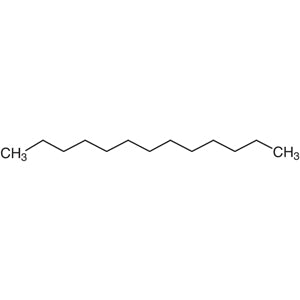
Tridecane is a hydrocarbon compound widely used in laboratory settings for its versatility and stability. As a non-heterocyclic building block, it plays a crucial role in the synthesis of complex organic molecules. Its chemical inertness makes it an ideal choice for a variety of chemical processes, including separation techniques and as an intermediate in various reactions. In the laboratory, Tridecane is often used to test the performance of analytical instruments such as gas chromatography and spectroscopy equipment. Its reliability and consistent behavior under different experimental conditions make it a trusted material for researchers.
Tridecane is valued for its chemical stability and non-reactive nature, which allows it to remain unchanged under a wide range of laboratory conditions. It has a high boiling point and melting point, which facilitates its use in purification and isolation processes. Its non-polar characteristics make it an effective solvent for certain organic compounds, while its low toxicity ensures safety during handling. These properties collectively make Tridecane a preferred choice for both routine and specialized laboratory applications.
In Indonesian laboratories, Tridecane is commonly used in research and development activities. It is a key component in the testing of analytical methods and the synthesis of new chemical compounds. Due to its reliability and ease of use, it is often selected for experiments requiring a stable and inert material. Its presence in Indonesian laboratories highlights its importance in both academic and industrial research settings.
- Gas Chromatography Analysis - Tridecane is used as a standard compound for calibrating gas chromatography systems due to its stable and predictable retention time.
- Organic Synthesis - It serves as a building block for the synthesis of more complex organic molecules, providing a reliable and inert starting material.
- Solvent for Non-Polar Compounds - Its non-polar nature makes it suitable for dissolving and isolating organic compounds that are not soluble in water.
- Analytical Testing - It is frequently used in testing the performance of analytical instruments such as mass spectrometers and infrared spectroscopy.
- Research and Development - Tridecane is a common choice in R&D settings where a stable and non-reactive compound is required for experimental protocols.
| Brand | TCI |
|---|---|
| CAS number | 629-50-5 |
| Molecular formula | — |
| Purity | — |
| Category | Chemistry > Building Blocks > Non-Heterocyclic Building Blocks |
| Pack sizes | 500 ml, 1 L |
| Physical form | Colorless liquid |
| Storage | Store in a cool, dark place away from heat and direct sunlight |
Tridecane should be stored in a cool, dark place to maintain its chemical stability. It is recommended to use airtight containers made of glass or high-density polyethylene to prevent contamination and evaporation. Due to its non-polar nature, it does not react with most common laboratory reagents, but it should be handled with care to avoid exposure to high temperatures. In laboratory settings, it is important to ensure proper ventilation when working with Tridecane, as it may evaporate and affect air quality. Always follow standard safety protocols when handling chemical substances to ensure a safe working environment.
—
Produk Terkait
-
Tridecane[StandardMaterialforGC] TCI S0285
Regular price Rp 1.724.100,00Regular priceRp 1.205.400,00Sale price Rp 1.724.100,00 -
Undecylcyclohexane TCI U0037
Regular price Rp 6.599.250,00Regular priceRp 4.614.750,00Sale price Rp 6.599.250,00 -
Undecane TCI U0002
Regular price From Rp 505.050,00Regular priceRp 352.800,00Sale price From Rp 505.050,00 -
1,3,5-Trimethyladamantane TCI T3872
Regular price From Rp 2.199.750,00Regular priceRp 1.538.250,00Sale price From Rp 2.199.750,00 -
Tetratriacontane TCI T2938
Regular price From Rp 3.260.250,00Regular priceRp 2.279.550,00Sale price From Rp 3.260.250,00 -
exo-Tetrahydrodicyclopentadiene TCI T1994
Regular price From Rp 1.246.350,00Regular priceRp 871.500,00Sale price From Rp 1.246.350,00 -
1,1,2,2-Tetramethylcyclopropane TCI T1721
Regular price Rp 3.180.450,00Regular priceRp 2.223.900,00Sale price Rp 3.180.450,00 -
1,1,3,5-Tetramethylcyclohexane TCI T1717
Regular price Rp 6.148.800,00Regular priceRp 4.299.750,00Sale price Rp 6.148.800,00


