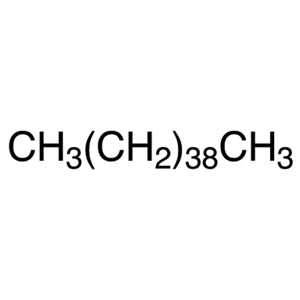
Tetratetracontane is a chemical compound classified as an alkane with a very long carbon chain. It is a fundamental building block in organic chemistry, widely used in laboratory settings to construct complex molecular structures or as a helper in the synthesis of organic compounds. This compound plays a crucial role in experiments where stability and non-reactivity are essential. Its inert nature makes it ideal for applications requiring a reliable and consistent chemical environment. Due to its chemical stability and resistance to decomposition, it is a trusted choice for researchers and students alike.
Tetratetracontane is known for its exceptional chemical stability and non-reactive properties, which make it a preferred choice in laboratory work. It does not corrode or pose toxic risks, ensuring a safe working environment. Its high boiling point and strong non-polar characteristics are particularly valuable in experiments involving high-temperature processes or interactions with non-polar substances. These properties contribute to its reliability in various chemical applications, especially in environments where long-term stability is necessary.
In Indonesian laboratories, Tetratetracontane is commonly used as a reagent or auxiliary material in organic synthesis and structural analysis. It is particularly favored in research settings where a stable and non-reactive compound is required. Its availability in small quantities, such as 100mg and 1g, makes it suitable for both educational and experimental purposes. Its safe handling profile and chemical inertness make it a popular choice among scientists and students in the field of chemistry.
- Organic synthesis experiments benefit from Tetratetracontane due to its non-reactive nature and stability, making it ideal for creating complex molecular structures without unwanted side reactions.
- It is used in the preparation of high-boiling-point compounds, as its thermal properties support processes requiring elevated temperatures without decomposition.
- Tetratetracontane serves as a solvent in non-polar reactions, providing a stable and inert medium for chemical interactions without interfering with the reaction pathway.
- It is employed in structural analysis techniques such as spectroscopy, where its predictable behavior ensures accurate and reliable results.
- In educational settings, it is used for teaching fundamental concepts in organic chemistry, offering students a safe and stable material for hands-on experimentation.
| Brand | TCI |
|---|---|
| CAS number | 7098-22-8 |
| Molecular formula | — |
| Purity | — |
| Category | Chemistry > Building Blocks > Non-Heterocyclic Building Blocks |
| Pack sizes | 100mg, 1g |
| Physical form | Solid (wax-like) |
| Storage | — |
Tetratetracontane should be stored in a cool, dry, and well-ventilated area away from direct sunlight and sources of heat. It is recommended to use airtight containers to prevent moisture absorption and contamination. Due to its non-reactive nature, it does not require special handling beyond standard laboratory safety protocols. It is important to ensure that the storage area is secure and accessible only to authorized personnel. Regular inspections of the storage conditions are advised to maintain the integrity of the compound. Its inert properties make it safe to handle in standard laboratory environments, provided proper care is taken during use and storage.
—
Produk Terkait
-
Tetracontane TCI T0449
Regular price From Rp 2.491.650,00Regular priceRp 1.741.950,00Sale price From Rp 2.491.650,00 -
Undecylcyclohexane TCI U0037
Regular price Rp 6.599.250,00Regular priceRp 4.614.750,00Sale price Rp 6.599.250,00 -
Undecane TCI U0002
Regular price From Rp 505.050,00Regular priceRp 352.800,00Sale price From Rp 505.050,00 -
1,3,5-Trimethyladamantane TCI T3872
Regular price From Rp 2.199.750,00Regular priceRp 1.538.250,00Sale price From Rp 2.199.750,00 -
Tetratriacontane TCI T2938
Regular price From Rp 3.260.250,00Regular priceRp 2.279.550,00Sale price From Rp 3.260.250,00 -
exo-Tetrahydrodicyclopentadiene TCI T1994
Regular price From Rp 1.246.350,00Regular priceRp 871.500,00Sale price From Rp 1.246.350,00 -
1,1,2,2-Tetramethylcyclopropane TCI T1721
Regular price Rp 3.180.450,00Regular priceRp 2.223.900,00Sale price Rp 3.180.450,00 -
1,1,3,5-Tetramethylcyclohexane TCI T1717
Regular price Rp 6.148.800,00Regular priceRp 4.299.750,00Sale price Rp 6.148.800,00