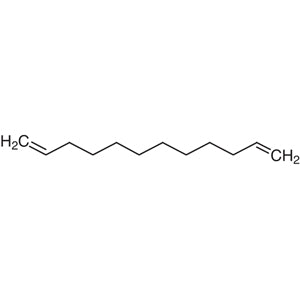
1,13-Tetradecadiene is a chemical compound widely used in laboratory settings as a building block for organic synthesis. This unsaturated hydrocarbon plays a crucial role in the development of complex molecules and industrial materials. Its unique structure, featuring two double bonds, makes it a versatile reagent for various chemical reactions. In research and production environments, 1,13-Tetradecadiene is essential for creating longer carbon chains and specific molecular structures. Its chemical properties allow it to participate in reactions such as addition, substitution, and polymerization, making it a valuable resource for chemists and researchers.
The compound’s aliphatic structure and high reactivity are key factors that make it a preferred choice in laboratory applications. The presence of two double bonds enhances its ability to undergo chemical transformations, enabling the synthesis of a wide range of compounds. Its stability under controlled conditions ensures reliable results in experimental processes. Additionally, its availability and ease of production contribute to its popularity among researchers. The compound’s simplicity and adaptability make it an ideal candidate for both academic and industrial applications.
In Indonesian laboratories, 1,13-Tetradecadiene is commonly used in organic chemistry research, particularly in educational institutions and research centers. It is relevant for the development of new materials, pharmaceutical compounds, and chemical intermediates. Its availability in the local market supports ongoing scientific activities and innovation in the chemical industry. Researchers rely on this compound for its flexibility and effectiveness in various synthetic processes.
- Organic synthesis is a primary application where 1,13-Tetradecadiene is used to build complex molecular structures and create new chemical compounds.
- Pharmaceutical research benefits from this compound as it is used in the synthesis of various drug molecules and chemical intermediates.
- Material development relies on 1,13-Tetradecadiene for creating polymers and specialty materials with specific properties.
- Educational institutions use it in teaching and research to demonstrate chemical reactivity and synthetic techniques.
- Industrial chemistry applications include the production of specialty chemicals and components for various industries.
| Brand | TCI |
|---|---|
| CAS number | 21964-49-8 |
| Molecular formula | — |
| Purity | — |
| Category | Chemistry > Building Blocks > Non-Heterocyclic Building Blocks |
| Pack sizes | Available in various quantities as per supplier specifications |
| Physical form | Liquid |
| Storage | Store in a cool, dry place away from light and incompatible materials |
1,13-Tetradecadiene should be stored in a cool, dry environment to maintain its chemical stability. It is recommended to keep the compound in a tightly sealed container to prevent exposure to air and moisture. The storage area should be well-ventilated and free from sources of heat or ignition. Due to its flammable nature, it should be kept away from incompatible substances such as strong oxidizers. Appropriate personal protective equipment, including gloves and safety goggles, should be worn when handling the compound. Regular inspections of storage conditions are necessary to ensure safety and compliance with laboratory protocols.
—
Produk Terkait
-
1,10-Undecadiene TCI U0024
Regular price From Rp 2.491.650,00Regular priceRp 1.741.950,00Sale price From Rp 2.491.650,00 -
1,11-Dodecadiene TCI D0283
Regular price From Rp 3.949.050,00Regular priceRp 2.761.500,00Sale price From Rp 3.949.050,00 -
9-Vinylanthracene TCI V0130
Regular price From Rp 2.545.200,00Regular priceRp 1.779.750,00Sale price From Rp 2.545.200,00 -
5-Vinylbicyclo[221]hept-2-ene(stabilizedwithBHT) TCI V0062
Regular price From Rp 769.650,00Regular priceRp 537.600,00Sale price From Rp 769.650,00 -
1,3,5-Undecatriene(mixtureofisomers) TCI U0062
Regular price From Rp 3.155.250,00Regular priceRp 2.206.050,00Sale price From Rp 3.155.250,00 -
1-Undecene TCI U0052
Regular price From Rp 2.068.500,00Regular priceRp 1.445.850,00Sale price From Rp 2.068.500,00 -
1-Undecene TCI U0025
Regular price Rp 1.060.500,00Regular priceRp 741.300,00Sale price Rp 1.060.500,00 -
1,4,4a,5,8,8a-Hexahydro-1,4:5,8-dimethanonaphthalene(mixtureofisomers)(stabilizedwithBHT) TCI T4428
Regular price From Rp 4.056.150,00Regular priceRp 2.836.050,00Sale price From Rp 4.056.150,00