


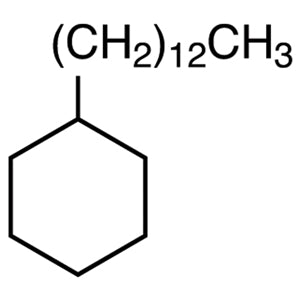
Tridecylcyclohexane is a chemical compound widely used as a building block in various chemical reactions and the synthesis of complex molecules. It is a non-heterocyclic compound with a unique molecular structure consisting of a long hydrocarbon chain attached to a cyclohexane ring. In the laboratory, it serves as a key component in organic synthesis, acting as both a structural element and a reaction facilitator. Its role is critical in the development of new chemical compounds and materials, especially in research settings where stability and controlled reactivity are essential.
The compound’s stability and low reactivity make it a preferred choice for use in chemical experiments that require non-polar and inert materials. It exhibits consistent physical properties, including high melting and boiling points, which ensure reliable performance under various experimental conditions. Additionally, its high purity guarantees the accuracy and reproducibility of chemical reactions. These characteristics make it an ideal material for applications where precision and consistency are paramount.
In Indonesian laboratories, Tridecylcyclohexane is commonly used in chemical research, particularly in higher education institutions and research centers. Its non-toxic nature and ease of handling make it a safe and practical choice for both academic and industrial research. Its reliability and chemical inertness support its widespread use in the development of new compounds and materials in the field of organic chemistry.
- Organic synthesis reactions benefit from Tridecylcyclohexane due to its non-reactive nature and structural versatility, allowing for controlled molecular modifications.
- It is used in the preparation of complex molecules as a building block, offering stability and predictable chemical behavior in synthetic pathways.
- In polymer chemistry, it serves as a component in the formulation of specialized materials, contributing to the desired physical and chemical properties.
- For solvent applications, its non-polar characteristics make it suitable for dissolving a variety of organic compounds without interfering with the reaction.
- It is employed in analytical chemistry as a standard reference material, ensuring accurate and reproducible results in qualitative and quantitative analyses.
| Brand | TCI |
|---|---|
| CAS number | 6006-33-3 |
| Molecular formula | — |
| Purity | — |
| Category | Chemistry > Building Blocks > Non-Heterocyclic Building Blocks |
| Pack sizes | Available in various quantities as per standard laboratory supply specifications |
| Physical form | Liquid |
| Storage | Store in a cool, dry place away from direct sunlight and incompatible materials |
Tridecylcyclohexane should be stored in a cool, dry environment to maintain its chemical stability and prevent degradation. It is recommended to keep it in a tightly sealed container to avoid exposure to air and moisture. Due to its non-polar nature, it is best stored in glass or high-density polyethylene containers to ensure compatibility and prevent contamination. In a laboratory setting, it should be handled with appropriate personal protective equipment, such as gloves and safety goggles, to ensure safe usage. Its inert properties make it relatively safe to handle, but standard laboratory safety protocols should still be followed to maintain a secure working environment.
—
Produk Terkait
-
Decylcyclohexane TCI D1231
Regular price Rp 4.161.150,00Regular priceRp 2.909.550,00Sale price Rp 4.161.150,00 -
Undecylcyclohexane TCI U0037
Regular price Rp 6.599.250,00Regular priceRp 4.614.750,00Sale price Rp 6.599.250,00 -
Dodecylcyclohexane TCI D1232
Regular price From Rp 2.889.600,00Regular priceRp 2.020.200,00Sale price From Rp 2.889.600,00 -
Tetradecylcyclohexane TCI T0873
Regular price From Rp 2.969.400,00Regular priceRp 2.075.850,00Sale price From Rp 2.969.400,00 -
Pentadecylcyclohexane TCI P0369
Regular price From Rp 1.856.400,00Regular priceRp 1.297.800,00Sale price From Rp 1.856.400,00 -
Nonadecylcyclohexane TCI N0394
Regular price Rp 2.837.100,00Regular priceRp 1.983.450,00Sale price Rp 2.837.100,00 -
Hexadecylcyclohexane TCI H0966
Regular price Rp 1.749.300,00Regular priceRp 1.223.250,00Sale price Rp 1.749.300,00 -
Heptadecylcyclohexane TCI H0443
Regular price Rp 1.405.950,00Regular priceRp 982.800,00Sale price Rp 1.405.950,00


