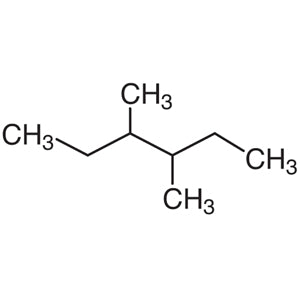
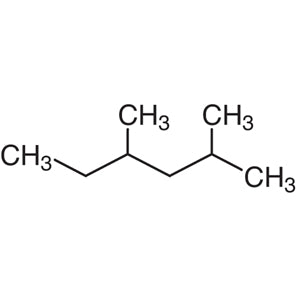
2,2,4-Trimethylhexane is an organic compound widely used as a building block in various chemical reactions. It serves as a fundamental component in the synthesis of more complex molecules, making it essential for researchers and chemists in both academic and industrial settings. Its simple molecular structure allows for versatile applications, supporting the development of compounds with diverse uses across multiple scientific disciplines. In the laboratory, this compound is frequently employed as a starting material for the creation of other chemicals, contributing to advancements in pharmaceuticals, chemical manufacturing, and material science.
The compound's non-polar nature and chemical inertness make it a preferred choice for laboratory use. These properties ensure that it does not readily react with other substances, providing stability during experiments. Its well-defined boiling and melting points also facilitate accurate identification and separation processes in analytical chemistry. These characteristics enhance its reliability and safety, making it suitable for use in environments where chemical reactivity must be minimized. Additionally, its stability and ease of production contribute to its widespread adoption in chemical research.
In Indonesian laboratories, 2,2,4-Trimethylhexane is commonly used in both pure and applied chemical research. It is a standard component in the inventory of chemistry laboratories, particularly in higher education institutions and research organizations. Its role in supporting chemical synthesis and analysis underscores its importance in the scientific community, ensuring its continued relevance in laboratory operations.
- Used in organic synthesis for creating complex molecular structures due to its stable and inert nature.
- Applied in pharmaceutical research as a building block for drug development and compound modification.
- Employed in chemical manufacturing processes for the production of industrial chemicals and materials.
- Utilized in analytical chemistry for separation and identification techniques due to its defined physical properties.
- Integrated into material science studies for the development of new polymers and composite materials.
| Brand | TCI |
|---|---|
| CAS number | 16747-26-5 |
| Molecular formula | — |
| Purity | — |
| Category | Chemistry > Building Blocks > Non-Heterocyclic Building Blocks |
| Pack sizes | Available in various quantities as per standard laboratory supply options |
| Physical form | Liquid |
| Storage | Store in a cool, dry place away from direct sunlight and incompatible materials |
2,2,4-Trimethylhexane should be stored in a cool, dry environment to maintain its stability and prevent degradation. It is recommended to keep it in a sealed container to minimize exposure to air and moisture. Due to its non-polar and inert nature, it does not react with most common laboratory materials, but it is still important to store it away from strong oxidizers and reactive substances. The container should be made of materials that are resistant to chemical interaction, such as glass or stainless steel. In laboratory settings, it is advisable to handle the compound with appropriate personal protective equipment to ensure safety during use and storage.
—
Produk Terkait
-
2,2,5-Trimethylhexane TCI T0475
Regular price Rp 11.343.150,00Regular priceRp 7.931.700,00Sale price Rp 11.343.150,00 -
3-Methylhexane TCI M0340
Regular price From Rp 1.776.600,00Regular priceRp 1.242.150,00Sale price From Rp 1.776.600,00 -
2-Methylhexane TCI M0231
Regular price From Rp 2.094.750,00Regular priceRp 1.464.750,00Sale price From Rp 2.094.750,00 -
3,4-Dimethylhexane TCI D1228
Regular price Rp 2.545.200,00Regular priceRp 1.779.750,00Sale price Rp 2.545.200,00 -
3,3-Dimethylhexane TCI D1227
Regular price Rp 4.743.900,00Regular priceRp 3.316.950,00Sale price Rp 4.743.900,00 -
2,3-Dimethylhexane TCI D1225
Regular price Rp 8.110.200,00Regular priceRp 5.671.050,00Sale price Rp 8.110.200,00 -
2,2-Dimethylhexane TCI D1224
Regular price Rp 1.115.100,00Regular priceRp 779.100,00Sale price Rp 1.115.100,00 -
2,4-Dimethylhexane TCI D1110
Regular price Rp 1.378.650,00Regular priceRp 963.900,00Sale price Rp 1.378.650,00